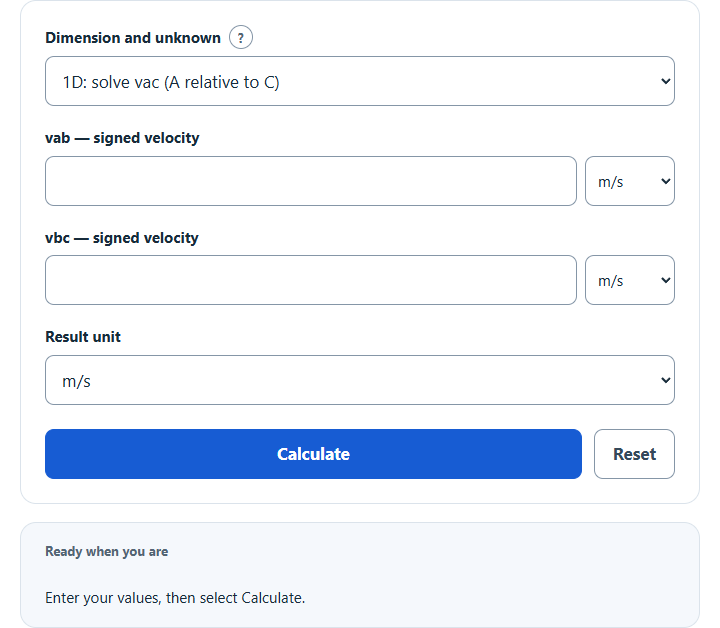
Calculate relative velocity or relative speed in 1D or 2D by adding or subtracting two known velocities, with the magnitude and direction of the result.
- All Physics Calculators
- All Velocity Calculators
- Velocity Calculator
- Initial Velocity Calculator
- Instantaneous Velocity Calculator
- Time Dilation Calculator
Calculator Functions
| Function | What it does | What it requires |
|---|---|---|
| 1D: solve vac (A relative to C) | Finds the velocity of A relative to C along a straight line | Requires the signed velocity of A relative to B and of B relative to C |
| 1D: solve vab (A relative to B) | Finds the velocity of A relative to B along a straight line | Requires the signed velocity of B relative to C and of A relative to C |
| 1D: solve vbc (B relative to C) | Finds the velocity of B relative to C along a straight line | Requires the signed velocity of A relative to B and of A relative to C |
| 2D: solve vac (A relative to C) | Finds the magnitude and direction of A relative to C in a plane | Requires the magnitude and angle of A relative to B and of B relative to C |
| 2D: solve vab (A relative to B) | Finds the magnitude and direction of A relative to B in a plane | Requires the magnitude and angle of B relative to C and of A relative to C |
| 2D: solve vbc (B relative to C) | Finds the magnitude and direction of B relative to C in a plane | Requires the magnitude and angle of A relative to B and of A relative to C |
Each velocity can be entered in m/s, km/h, mph or ft/s, and the result unit is chosen separately. In 1D a negative number means the opposite direction, and the result also shows the speed without its sign. In 2D, angles are measured counterclockwise from the +x axis and the result also shows the x and y components.
Relative Velocity Formula
| vAC | Velocity of A relative to C |
| vAB | Velocity of A relative to B |
| vBC | Velocity of B relative to C, where C is often the ground |
The middle letter drops out: A relative to B plus B relative to C is A relative to C. For an aircraft (A) in moving air (B) over the ground (C), this is ground speed = airspeed + wind speed, with a headwind counted as negative [1].
1D: solve vac (A relative to C)
An aircraft with an airspeed of 35 mph flying into a 25 mph headwind has vAB = 35 and vBC = −25, so its ground speed is 35 + (−25) = 10 mph. With a 25 mph tailwind it is 35 + 25 = 60 mph [1].
1D: solve vab (A relative to B)
Car A moves at 10 m/s and car B at 5 m/s along the same road in the same direction, both measured from the ground. A relative to B is 10 − 5 = 5 m/s. If B drives the other way its velocity is −5 m/s, and A relative to B is 10 − (−5) = 15 m/s.
1D: solve vbc (B relative to C)
An aircraft with a ground speed of 60 mph and an airspeed of 35 mph is in air that moves at 60 − 35 = 25 mph over the ground, a tailwind.
2D: solve vac (A relative to C)
y = |v| × sin θ [2]
Each known velocity is split into x and y components [2]. The components are added, x with x and y with y [3], and the result is turned back into a magnitude √(x² + y²) [2] and a direction, the angle whose tangent is y ÷ x, placed in the correct quadrant and given from 0° to 360°. This is how a crosswind combines with airspeed to give ground speed [4]. An aircraft that flies at 100 m/s at 0° through air that moves at 20 m/s at 90° has components (100, 0) and (0, 20). The sum is (100, 20), a speed of √(100² + 20²) = 101.98 m/s at 11.31°.
2D: solve vab (A relative to B)
The components of vBC are subtracted from those of vAC. If A relative to C is 5 m/s at 53.13°, its components are (3, 4). With B relative to C at 4 m/s at 90°, or (0, 4), A relative to B is (3, 0): 3 m/s at 0°.
2D: solve vbc (B relative to C)
The components of vAB are subtracted from those of vAC. With A relative to C at 5 m/s at 53.13°, or (3, 4), and A relative to B at 3 m/s at 0°, or (3, 0), B relative to C is (0, 4): 4 m/s at 90°. To combine several velocities of one object instead, use the resultant velocity calculator.
Limits of This Estimate
- Velocities add this simply only at everyday speeds. Near the speed of light the sum has to be worked out with special relativity, which this calculator does not do.
- In 1D every value needs the same choice of positive direction. Mixing conventions gives the wrong sign.
- All three velocities must describe the same moment, and steady motion is assumed. Gusts and turning are not covered [4].
- A result of zero has no direction, so no angle is shown for it.
Sources
- NASA Glenn Research Center, Relative Velocity: Ground Reference: airspeed as ground speed minus wind speed along one line, with signs, and the takeoff example
- NASA Glenn Research Center, Vector Components: x and y components from a magnitude and an angle, and the magnitude from the components
- NASA Glenn Research Center, Vector Addition: adding two vectors by adding their components
- NASA Glenn Research Center, Cross Winds: ground speed as the vector sum of airspeed and wind when they are not in line