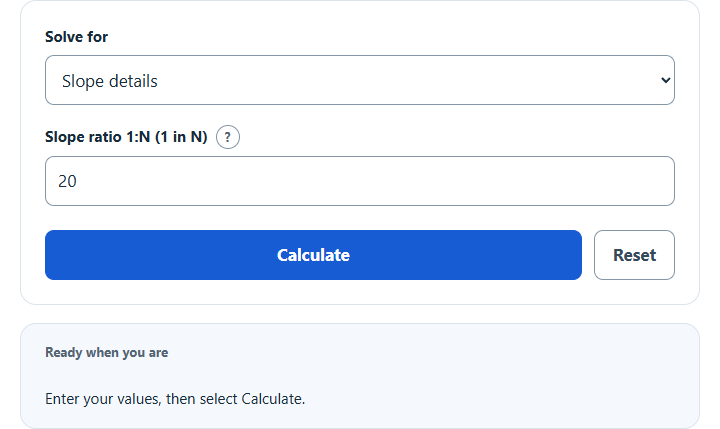
How do I use this calculator?
The basic portion of this calculator allows you to calculate any of the variables shown directly above.
Calculator Operations:
- Enter the horizontal distance and vertical height to calculate the slope length.
- Enter the horizontal distance and slope length to calculate the vertical height.
- Enter the vertical height and slope length to calculate the horizontal distance.
The advanced version of this calculator allows you to calculate both the slope length and angle using the horizontal distance and vertical height.
Use the calculate button when all known values have been entered and use the reset button when you want to clear the values from the calculator.
Calculate a 1:20 slope as a percent grade (5%) and angle in degrees, or find the rise or run for any 1:N ratio in inches, feet, cm, m or mm.
Related Calculators
- Rate of Change Calculator
- Rise And Run Calculator
- Angle Depth Calculator
- Fraction to Ratio Conversion Calculator
- Actual Distance Calculator
- All Math and Numbers Calculators
Calculator Functions
| Function | What it does | What it requires |
|---|---|---|
| Slope details | Converts a 1:N slope ratio to percent grade, angle in degrees and fall per meter and per foot of run | Requires the ratio number N, which starts at 20 |
| Vertical rise from horizontal run | Finds how much a slope rises over a horizontal distance, and the length of the sloped surface | Requires the ratio number N and the horizontal run |
| Horizontal run from vertical rise | Finds the horizontal distance a slope needs to climb a height, and the length of the sloped surface | Requires the ratio number N and the vertical rise |
The ratio is entered as N only: 20 for a 1:20 (1 in 20) slope, 12 for 1:12. Run and rise can be in m, ft, cm, in or mm, and the answer comes back in the unit entered. Every result also states where the slope falls against the 1:20 and 1:12 limits in the US accessibility standards.
1:20 Slope Formulas
| VH | Vertical height, or rise |
| HD | Horizontal distance, or run, in the same unit as VH |
| N | Ratio number: 20 for a 1:20 slope |
A 1:20 slope rises 1 unit for every 20 units of horizontal distance. The run is measured level, not along the sloped surface.
Slope details
Angle = arctan(1 ÷ N)
For 1:20, the grade is 100 ÷ 20 = 5% and the angle is arctan(0.05) = 2.8624° from horizontal. The fall is 1,000 ÷ 20 = 50 mm per meter of run, or 12 ÷ 20 = 0.6 in per foot. A 1:12 slope is 8.3333% and 4.7636°.
Vertical rise from horizontal run
The run is divided by N. Over 100 m of horizontal run, a 1:20 slope rises 100 ÷ 20 = 5 m. The sloped surface length comes from the Pythagorean theorem:
For the same slope, SL = √(100² + 5²) = √10,025 = 100.125 m, which is only 0.125 m longer than the run.
Horizontal run from vertical rise
Climbing 0.5 m at 1:20 takes 0.5 × 20 = 10 m of horizontal run. A 30 in rise at 1:12 takes 30 × 12 = 360 in, which is 30 ft.
1:20 and 1:12 in the ADA Standards
Under the US ADA Standards, the running slope of a walking surface on an accessible route may be no steeper than 1:20, and its cross slope no steeper than 1:48 [1]. A steeper route is treated as a ramp, where the running slope may be no steeper than 1:12 and a single run may rise no more than 30 in [1]. Existing sites with limited space may use 1:10 for a rise of up to 6 in and 1:8 for a rise of up to 3 in, and nothing steeper than 1:8 is allowed [1].
Limits of This Estimate
- The calculator checks geometry only. Whether a route is accessible also depends on cross slope, width, surface and landings, and on the standard that applies to the site.
- The slope is assumed to be straight and even from end to end.
- The ADA figures are US rules. Other countries and local codes set their own limits.
Sources
- U.S. Access Board, ADA Accessibility Standards, Chapter 4, Sections 403.3, 405.2 and 405.6: 1:20 walking surface limit, 1:48 cross slope, 1:12 ramp limit, 30 in maximum rise and the existing-site table