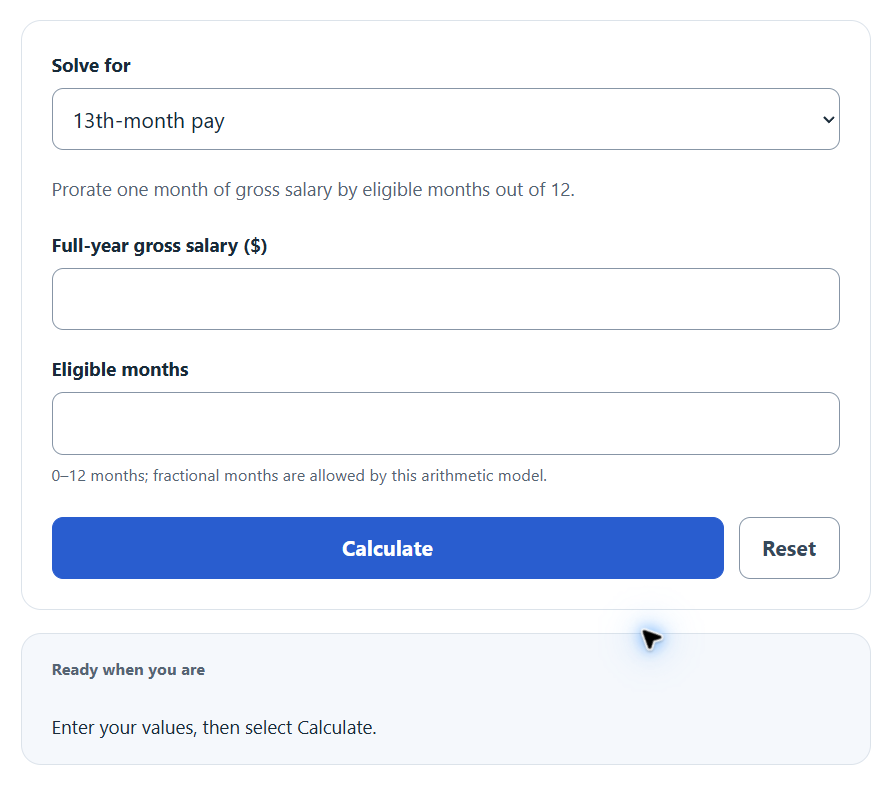
Choose 13th-month pay, annual salary, or eligible months. Enter the two known values shown for that choice.
13th Month Salary Formula
The following equation is used to calculate the 13th Month Salary.
- Where 13M is the 13th month salary ($)
- TE is the annual salary for a full 12-month year ($)
- LS is the number of months worked during the year (months, typically 0–12)
To calculate the 13th month salary from an annual salary, first convert the annual salary to one month of pay by dividing by 12, then prorate it by the fraction of the year worked (months worked divided by 12).
What is a 13th Month Salary?
Definition:
A 13th month salary is an additional payment generally provided at the end of the year, on top of regular twelve-month wages. It is often prorated based on how long an employee has worked during the year.
How to Calculate 13th Month Salary?
Example Problem:
The following example outlines the steps and information needed to calculate the 13th Month Salary.
First, determine the annual salary for a full year. In this example, the employee earns $48,000 annually.
Next, determine the number of months worked during the year. This employee has worked 9 months.
Finally, calculate the 13th month salary using the formula above:
13M = (TE / 12) × (LS / 12)
13M = ($48,000 / 12) × (9 / 12)
13M = $4,000 × 0.75 = $3,000
FAQ
Is the 13th month salary mandatory everywhere?
This varies by country and by contractual agreements. Some countries have laws mandating a 13th month salary, while in others it may be an optional benefit offered by employers.
Can the 13th month salary be taxed?
Depending on local tax regulations, the 13th month salary might be subject to the same tax rules that apply to regular wages, or it might receive a special tax treatment.
How do employers usually calculate the 13th month salary for partial-year employment?
Employers typically prorate the payment based on the number of months an employee has worked during the year. This ensures an equitable distribution of the 13th month salary proportional to the length of service.