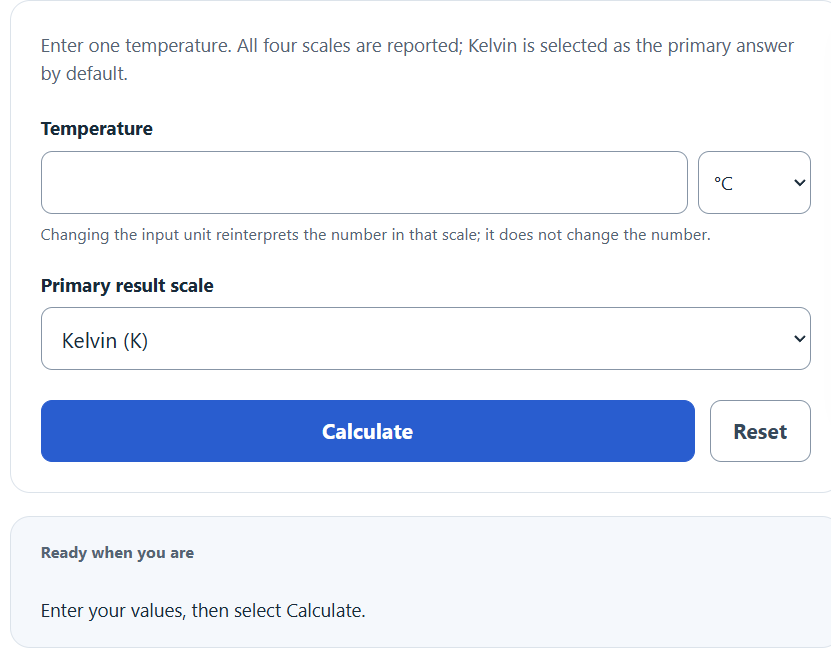
Convert Celsius, Fahrenheit, Kelvin or Rankine to absolute temperature in Kelvin and see equivalent Rankine, Celsius and Fahrenheit values.
Absolute Temperature Formula
Absolute temperature is measured from absolute zero. The calculator converts your input to Kelvin (K), the SI absolute scale, and to Rankine (°R), the absolute scale tied to Fahrenheit.
- K = temperature in Kelvin
- °C = temperature in Celsius
- °F = temperature in Fahrenheit
- °R = temperature in Rankine
Enter the temperature and its unit, then choose the primary result scale. Kelvin is the default; all four equivalent scales are reported. Changing the input unit reinterprets the entered number, as explained beside the input. The calculator rejects temperatures below absolute zero (0 K, 0 °R, -273.15 °C, -459.67 °F).
Reference Values and Conversions
Use these as sanity checks on the calculator output.
| Reference point | K | °R | °C | °F |
|---|---|---|---|---|
| Absolute zero | 0 | 0 | -273.15 | -459.67 |
| Dry ice sublimation | 194.65 | 350.37 | -78.5 | -109.3 |
| Water freezes | 273.15 | 491.67 | 0 | 32 |
| Room temperature | 293.15 | 527.67 | 20 | 68 |
| Body temperature | 310.15 | 558.27 | 37 | 98.6 |
| Water boils | 373.15 | 671.67 | 100 | 212 |
| Scale | Type | Zero point | Degree size |
|---|---|---|---|
| Kelvin | Absolute | Absolute zero | Same as Celsius |
| Rankine | Absolute | Absolute zero | Same as Fahrenheit |
| Celsius | Relative | Water freezing point | 1/100 of freeze-to-boil |
| Fahrenheit | Relative | Brine mixture | 5/9 of a Celsius degree |
Example Problems and FAQ
Example 1. Convert 25 °C to absolute temperature.
K = 25 + 273.15 = 298.15 K. In Rankine, °R = 298.15 × 9/5 = 536.67 °R.
Example 2. Convert 100 °F to Kelvin.
K = (100 + 459.67) × 5/9 = 559.67 × 5/9 = 310.93 K.
Why use absolute temperature? Gas laws, thermodynamic equations, and radiation formulas (PV = nRT, Stefan-Boltzmann, etc.) require an absolute scale. Using Celsius or Fahrenheit in those equations gives wrong answers because their zero points are arbitrary.
Is Kelvin or Rankine the absolute scale? Both are absolute. Kelvin uses Celsius-sized degrees and is the SI standard. Rankine uses Fahrenheit-sized degrees and is common in U.S. engineering work.
Why no degree symbol on Kelvin? By SI convention, Kelvin is written as “K” with no degree symbol. Rankine is written as “°R.”
Can a temperature be negative in Kelvin? No. Absolute zero (0 K) is the lower limit. The calculator rejects any input that converts to a negative Kelvin value.