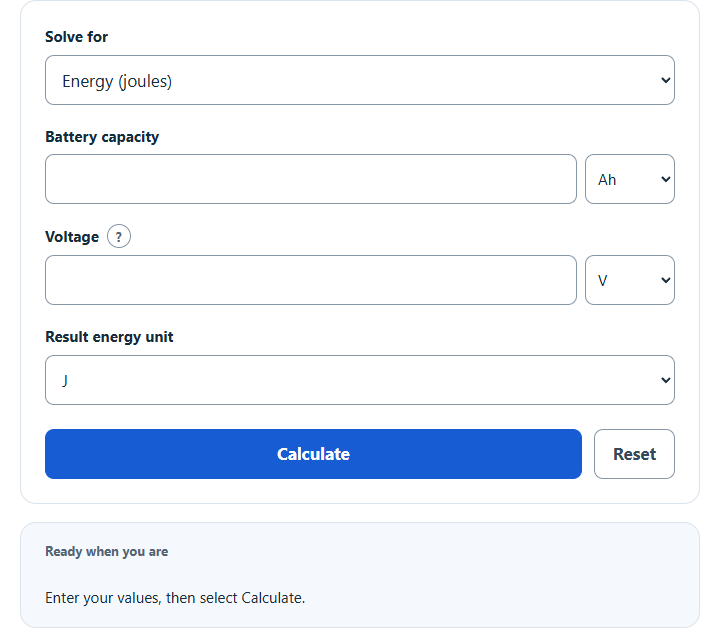
Convert Ah to joules (or mAh to joules) from battery capacity and voltage, or work back from joules to amp-hours or voltage, with Wh and kWh.
- All Unit Converters
- Joules To Amp Hours Calculator
- Ah To Hours Calculator
- Current to Energy Calculator (Amps to Joules)
Calculator Functions
| Function | What it does | What it requires |
|---|---|---|
| Energy (joules) | Converts battery capacity to stored energy | Requires the battery capacity and the voltage |
| Battery capacity (Ah) | Finds the capacity that holds a known energy | Requires the known energy and the voltage |
| Voltage | Finds the voltage at which a capacity holds a known energy | Requires the known energy and the battery capacity |
Capacity can be entered in Ah or mAh, voltage in V, mV or kV, and energy in J, kJ, MJ, Wh or kWh. Each function has a result unit setting with the same choices. Voltage has presets for a 1.2 V NiMH cell, a 1.5 V alkaline cell, a 3.7 V Li-ion cell and a 12 V lead-acid battery. Every result also gives the energy in watt-hours.
Ah to Joules Formulas
| E | Energy (J) |
| Q | Battery capacity (Ah) |
| V | Voltage (V) |
Amp-hours times volts gives watt-hours, and one watt-hour is exactly 3,600 J [1]. The 3,600 is the number of seconds in an hour: one amp-hour is 3,600 coulombs of charge [1]. Amp-hours alone do not convert to joules, because the same charge holds more energy at a higher voltage.
Energy (joules)
The main formula applies directly. A 5 Ah battery at 12 V holds 5 × 12 × 3,600 = 216,000 J, which is 60 Wh. A 100 Ah battery at 12 V holds 4,320,000 J, or 4.32 MJ.
mAh to joules
A milliamp-hour is a thousandth of an amp-hour, so the factor drops from 3,600 to 3.6. A 3,000 mAh cell at 3.7 V holds 3,000 × 3.7 × 3.6 = 39,960 J, which is 11.1 Wh. A 10,000 mAh power bank built from 3.7 V cells holds 133,200 J.
Battery capacity (Ah)
216,000 J at 12 V is 5 Ah. The voltage has to be above zero.
Voltage
216,000 J held in 5 Ah means 12 V. The capacity has to be above zero.
Limits of This Estimate
- With the nominal voltage of a battery the result is an estimate. The voltage falls as a battery discharges, so the usable energy depends on the discharge conditions.
- No loss or efficiency adjustment is applied.
- The formula is exact only for a constant voltage, or for the average voltage over the charge delivered.
Sources
- NIST, Guide to the SI (Special Publication 811), Appendix B.8: 1 Ah = 3,600 C and 1 Wh = 3,600 J, both exact