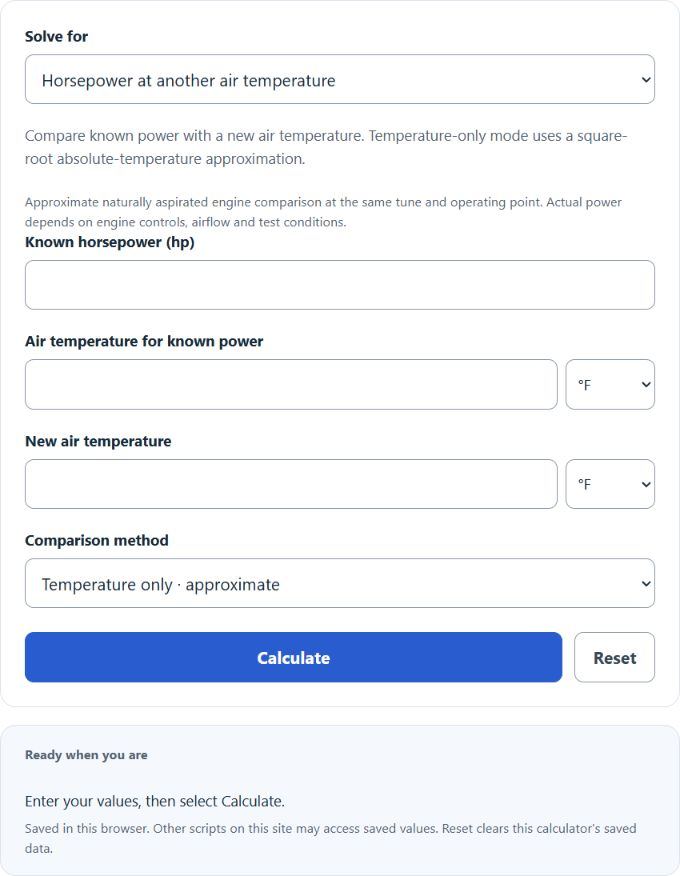
Compare known engine horsepower at two air temperatures, or solve the temperature-only approximation for a target power. The optional legacy SAE-style comparison uses shared station pressure and relative humidity; it does not provide a certified dyno correction.
Formula
Temperature-only approximation:
HP₂ = HP₁ × √(T₁ / T₂)
T₁ and T₂ are absolute temperatures in kelvin (°C +273.15). The inverse is T₂ = T₁ × (HP₁ / HPtarget)².
Legacy SAE-style comparison:
CF = 1.18 × (99 / Pd) × √((T +273) /298) −0.18
HP₂ = HP₁ × CF₁ / CF₂, assuming unchanged corrected power.
Pd is absolute dry-air pressure in kPa, and T is temperature in °C. Water-vapor pressure is recomputed at each temperature. This is the historical 1.18/0.18 approximation, not the full current SAE J1349 test code.
Interpretation
The result is a model comparison, not a measurement of actual engine output. The temperature-only approximation holds other conditions constant; the legacy mode assumes unchanged corrected power and shared pressure/RH. Engine management, heat soak, airflow, fuel and operating point can change the real response.
- CF below 0.97: Outside the historical ±3% near-reference correction window; identified as nonstandard.
- CF from 0.97 to 1.03: Within the historical near-reference factor window; this alone does not establish compliance.
- CF above 1.03: Outside the historical ±3% near-reference correction window; identified as nonstandard.
- Legacy input range: 15–35°C and 90–105 kPa dry pressure at both temperatures. The current SAE revision has additional procedures that this calculator does not reproduce.
Quick Reference: Temperature vs. Power
| Air Temp | Ratio vs. 60°F | 350 hp becomes |
|---|---|---|
| 30°F | 1.030 | 361 hp |
| 45°F | 1.015 | 355 hp |
| 60°F | 1.000 | 350 hp |
| 75°F | 0.986 | 345 hp |
| 90°F | 0.972 | 340 hp |
| 105°F | 0.959 | 336 hp |
| 120°F | 0.947 | 331 hp |
FAQ
Does this apply to turbocharged or supercharged engines?
Boosted engines need engine-specific treatment of boost control, charge cooling and engine management. Use the procedure supplied by the engine manufacturer or dyno software.
Why do I need barometric pressure and humidity for SAE correction?
Power depends on the mass of oxygen entering the cylinder, not just temperature. Low pressure (high altitude or storms) and high humidity both reduce oxygen density, so leaving them out can swing the correction factor by several percent.
What pressure should I enter — station or sea-level adjusted?
Use absolute (station) pressure, which is what a local barometer or weather station reports as “station pressure.” Sea-level-adjusted values from weather apps will overstate density at altitude and give a wrong correction.
Why does the Temperature Effect tab give a different number than SAE correction?
The temperature-only model uses an absolute-temperature ratio. The legacy model includes dry-air pressure and empirical correction factors; equal relative humidity produces different vapor pressures at different temperatures. Both are approximations; use the correction supplied by the dyno for an official run comparison.