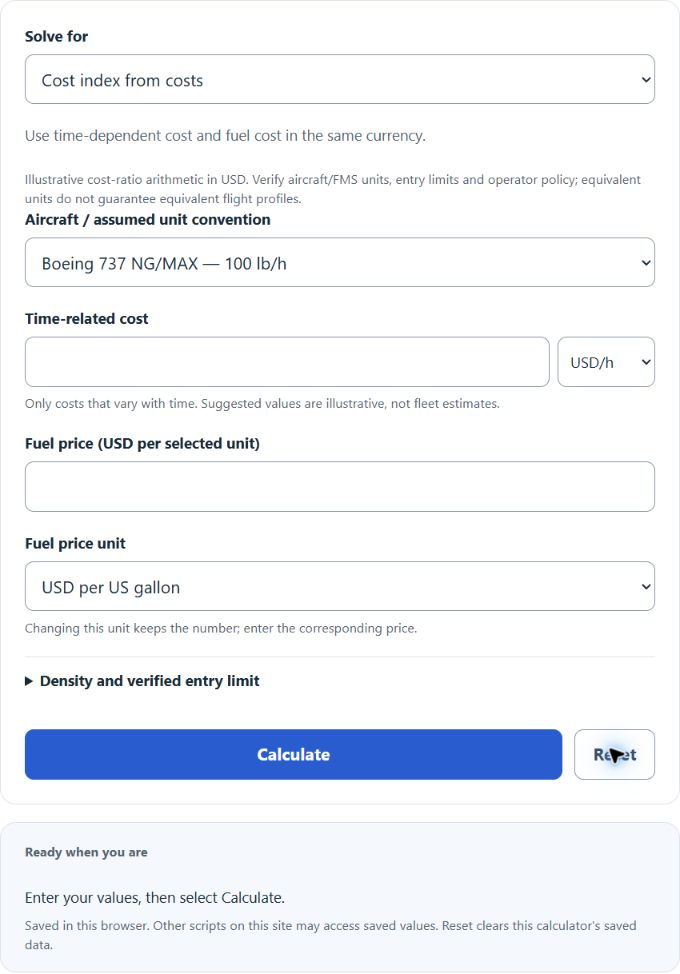
Calculate the airline cost index from time-related cost per hour and jet fuel price, on both the Boeing 100 lb/hr and Airbus kg/min scales.
Airline Cost Index Formula
The unscaled ratio below has units of lb/h when time cost is in USD/h and fuel price is in USD/lb. For the normalized 100 lb/h convention, divide that ratio by 100. For the kg/min convention, divide time cost per minute by fuel price per kilogram.
- Where ACI is the airline cost index
- TCT is the total cost of time ($/hr)
- TCF is the total cost of fuel ($/lb)
Select the required calculation and unit convention. Use time-dependent cost and fuel price in the same currency. The calculator reports an economic ratio, not an operational FMC entry recommendation.
What Is an Airline Cost Index?
An airline cost index (CI) is a numerical ratio that expresses the relationship between an airline’s time-related operating costs and its fuel costs. It is the primary parameter entered into a flight management system (FMS) or flight management computer (FMC) to determine the most economical speed and altitude profile for each phase of flight. The CI tells the aircraft’s onboard computers how much weight to give to saving time versus saving fuel when computing climb speeds, cruise speeds, cruise altitude, and descent profiles.
At CI = 0, time-dependent cost has zero weight relative to fuel cost in the economic model. The actual minimum-fuel flight profile depends on the aircraft, installed FMS, winds and operating constraints; it is not determined by this ratio calculator.
A larger CI gives greater economic weight to saving time relative to saving fuel. Maximum accepted values and resulting speed profiles are specific to the aircraft and installed FMS; use approved operator documentation.
Most airline operations fall between these two extremes. Dispatchers and flight operations departments select a CI that reflects the airline’s current cost structure, route economics, and schedule constraints. The CI can also be adjusted in flight if, for example, a delay makes an on-time arrival more valuable than fuel savings.
Boeing vs. Airbus Cost Index: Key Differences
Although the underlying concept is identical, Boeing and Airbus use different units and scales for the cost index, which means the same CI number produces very different results depending on the aircraft manufacturer.
The Boeing-style convention used here is time cost in USD/h divided by fuel cost in cents/lb, equivalently USD per 100 lb. Historical manufacturer documents list model-specific ranges, but a broad fleet name does not establish the valid range for an installed FMC. No limit is inferred by the calculator.
The Airbus-style convention used here is time cost in USD/min divided by fuel cost in USD/kg, giving kg/min. Manufacturer documentation also describes other conventions and software-dependent entry ranges or mappings. Verify the units for the installed FMS.
The normalized 100 lb/h ratio equals the kg/min ratio multiplied by 60/(100 × 0.45359237), approximately 1.3227735731. This preserves economic time-versus-fuel weighting; it does not guarantee the same speed, fuel burn, flight profile or accepted entry across aircraft.
What Costs Make Up the Time Component?
The time-related cost side of the cost index captures every expense that increases as the aircraft spends more time airborne or away from the gate. These include crew wages and overtime pay (particularly for pilots paid by the flight hour rather than by salary), hourly maintenance program charges for engines and airframe, lease payments structured on a per-flight-hour basis, and per-hour insurance premiums.
Beyond direct operating costs, airlines sometimes factor in indirect time costs such as passenger re-accommodation expenses when delays cause missed connections, loss of goodwill and future booking revenue from chronically late arrivals, airport curfew penalties for arriving after noise restriction hours, and slot utilization fees at congested airports where a late arrival may forfeit a departure slot.
The structure of an airline’s contracts determines which of these costs are truly variable. A salaried flight crew adds no incremental time cost per hour, so an airline with salaried pilots will have a lower time-cost numerator than one with hourly-pay pilots, all else being equal. Similarly, an airline that leases engines on a fixed monthly rate rather than a per-cycle or per-hour rate will exclude that cost from the time component. These contract differences are a major reason why two airlines operating the same aircraft type on the same route may use very different CI values.
How Cost Index Affects Each Phase of Flight
The CI directly shapes the speed, altitude, and timing decisions the FMS makes during climb, cruise, and descent.
Climb: CI weights time-related cost against fuel cost in the FMS economic model. The resulting climb speed and profile depend on aircraft performance, constraints and installed software; CI = 0 is not a universal command for best rate-of-climb airspeed.
Cruise: Greater time-cost weighting generally favors shorter flight time at the expense of fuel. The actual economic cruise speed, altitude and wind adjustment require the aircraft-specific FMS/performance model and cannot be calculated from CI alone.
Descent: Economic descent speed and top-of-descent planning depend on aircraft, winds, constraints and FMS software. This cost-ratio calculator does not predict them.
Typical Cost Index Values by Airline and Aircraft
No current operator-specific CI policies are verified here. Determine the economic ratio from applicable costs, then apply approved aircraft/FMS and operator guidance.
There is no universal “typical” CI band. A value that suits one operator, aircraft, route or unit convention may not suit another. Do not treat a cost-ratio value as permission to exceed an installed FMS limit.
Historical FMC Range Examples — Verify Installed System
The following historical examples are not verified current limits. Range and mapping depend on the installed FMS/vendor/software; consult approved documentation. The calculator checks only a maximum that you explicitly enter.
| Aircraft | FMC CI Range | Unit System |
|---|---|---|
| Boeing 737-300/400/500 (Classics) | 0 to 200 | 100 lb/hr |
| Boeing 737-600/700/800 (NG) | 0 to 500 or 0 to 9999 | 100 lb/hr |
| Boeing 747-400 | 0 to 9999 | 100 lb/hr |
| Boeing 757/767 (Honeywell 200K/700K FMC) | 0 to 999 | 100 lb/hr |
| Boeing 757/767 (later FMC variants) | 0 to 9999 | 100 lb/hr |
| Boeing 777 | 0 to 9999 | 100 lb/hr |
| Airbus A320 family | 0 to 999 | kg/min |
| Airbus A330 | 0 to 999 | kg/min |
| Airbus A340 | 0 to 999 | kg/min |
Fuel Savings and Operational Impact
Fuel and time differences from changing CI depend on aircraft, route, winds, loading, constraints and fuel prices. They require a validated aircraft performance model; this calculator cannot substantiate a per-flight or annual savings amount.
Use aircraft-specific performance/dispatch analysis to compare speed and altitude strategies. No universal savings percentage is implied by this economic-ratio calculation.
The operational tradeoff is straightforward: flying at a lower CI saves fuel but adds flight time, while flying at a higher CI reduces flight time but burns more fuel. The cost index exists to find the speed at which the marginal cost of saving one more minute of flight time exactly equals the marginal cost of the extra fuel required. At that equilibrium, total trip cost is minimized.
When and Why Airlines Adjust Cost Index in Flight
The CI is not always fixed for the duration of a flight. Dispatchers or pilots may update it based on real-time operational conditions. If an aircraft departs late and an on-time arrival is critical for passenger connections or a curfew at the destination, the CI may be increased mid-flight to recover time. Conversely, if an aircraft is well ahead of schedule and fuel prices are high, the CI may be decreased to save fuel during the remaining cruise segment.
Some airlines use a strategic CI approach where different CI values are assigned to different route types. Short-haul flights with tight turnarounds may receive a higher CI to protect schedule integrity, while long-haul flights with generous buffer time may receive a lower CI to maximize fuel savings over a longer distance where even small speed reductions compound into significant fuel differences.
Airlines with advanced flight operations analytics may also use dynamic CI models that recalculate the optimal CI before each flight based on current jet fuel spot prices, crew scheduling constraints, expected en-route winds, and the estimated cost of delay at the destination. This approach moves beyond a single fleet-wide CI to a flight-specific optimization.
Cost Index and Carbon Emissions
Because the cost index directly controls cruise speed and fuel burn, it has a direct relationship with carbon dioxide emissions. Every kilogram of jet fuel burned produces approximately 3.16 kg of CO2. Lowering the CI reduces fuel consumption and therefore reduces the carbon footprint of each flight proportionally.
If applicable emissions costs are included in the operator’s effective fuel price, a higher fuel-cost denominator lowers the calculated ratio for unchanged time cost. Applicability and accounting must follow the operator’s current requirements; this calculator does not determine them.