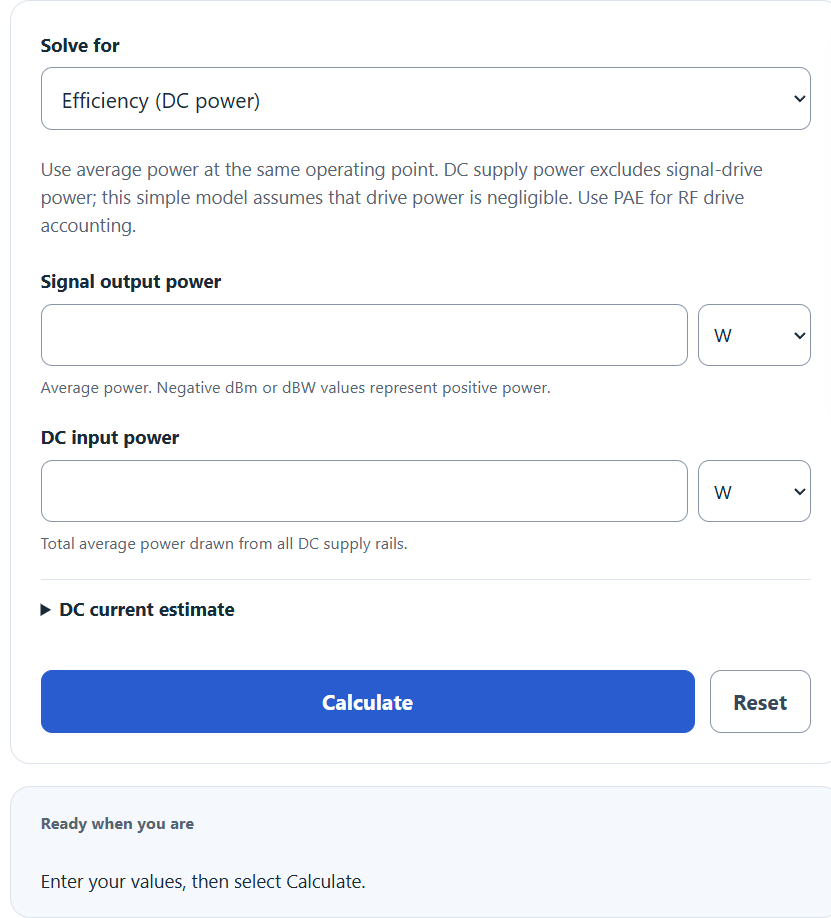
Select a solve mode to calculate amplifier efficiency, RF power-added efficiency (PAE), gain, DC input power, current, or estimated dissipation. Class presets describe ideal full-output limits; Class AB uses an efficiency assumption.
Amplifier Efficiency Formula
The following formula is used to calculate the Amplifier Efficiency.
- Where Eamp is the Amplifier Efficiency (%)
- O is the average amplifier signal output power (W)
- I is the average DC supply input power (W), not RF drive power or current
To calculate amplifier efficiency, divide average signal output power by average DC supply power at the same operating point, then multiply by 100. This simple model neglects signal-drive power. RF PAE instead subtracts RF input drive power from RF output power before dividing by DC supply power.
How to Calculate Amplifier Efficiency?
The following example outlines how to calculate amplifier efficiency.
Example Problem #1:
- First, determine the amplifier output power. In this example, the amplifier output power is given as 15 W.
- Next, determine the amplifier DC supply input power. For this problem, it is 283 W.
- Finally, calculate the Amplifier Efficiency using the equation above:
Eamp = O / I *100
Inserting the values from above and solving the equation:
Eamp = 15 W / 283 W × 100 ≈ 5.3%
FAQ
What factors can affect amplifier efficiency?
Several factors can impact the efficiency of an amplifier, including the design of the amplifier circuit, the quality of components used, the operating frequency, and how well the amplifier is matched to its load. Environmental factors like temperature can also play a role.
How can improving amplifier efficiency benefit a system?
Improving amplifier efficiency can lead to reduced power consumption, which is crucial for battery-operated devices. It can also help in minimizing heat generation, thereby reducing the need for cooling systems and potentially extending the lifespan of the amplifier and associated components.
Are there different types of amplifiers based on efficiency?
Common output-stage classes include Class A, Class B, Class AB, and Class D. Their operating principles affect efficiency, but class alone does not determine sound quality or actual power consumption. The calculator’s Class A, B, and D presets are ideal limits; real efficiency depends on the circuit and operating point.