Calculate amplifier gain target voltage and dB gain from RMS watts, speaker ohms, or input and output levels for multimeter setup.
Related Calculators
- Decoupling Capacitor Calculator
- Inductor Impedance Calculator
- Active Power Calculator
- Total Voltage Calculator
- All Physics Calculators
Amplifier Gain Formula
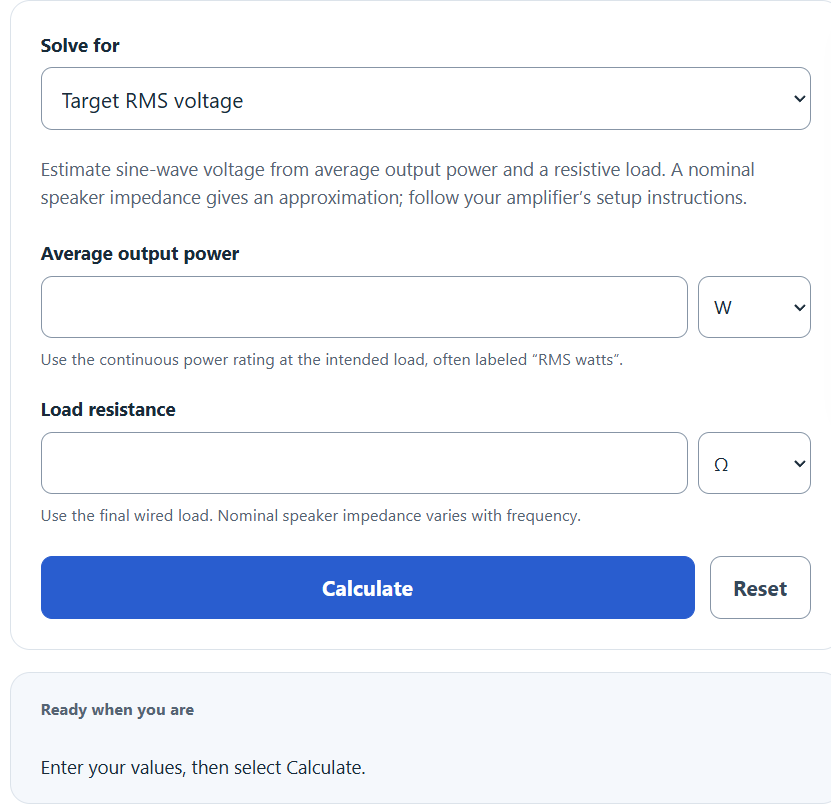
Choose Target RMS voltage, Power gain (dB), or Voltage gain (dB). Enter the relevant values and select Calculate. Target voltage is a resistive-load estimate; use your amplifier manufacturer’s setup procedure.
Target voltage mode:
dB gain mode:
- V = target AC RMS voltage at the speaker terminals, in volts
- P = average amplifier output power at the intended load, often rated as RMS watts
- R = load resistance, in ohms; nominal speaker impedance is an approximation
- Pout, Pin = output and input power, same unit
- Vout, Vin = output and input voltage, same unit
The target voltage mode takes the square root of average power times resistance. This gives RMS voltage for a resistive load; nominal speaker impedance only approximates a real speaker’s frequency-dependent load. Voltage alone does not prove unclipped output. The dB gain mode takes the ratio of output to input and converts it to decibels using the log10 factor that matches the quantity (10 for power, 20 for voltage).
Reference Tables
Theoretical RMS voltages for the stated average powers and resistive loads:
| RMS Power | 1 Ω | 2 Ω | 4 Ω | 8 Ω |
|---|---|---|---|---|
| 100 W | 10.0 V | 14.1 V | 20.0 V | 28.3 V |
| 250 W | 15.8 V | 22.4 V | 31.6 V | 44.7 V |
| 500 W | 22.4 V | 31.6 V | 44.7 V | 63.2 V |
| 750 W | 27.4 V | 38.7 V | 54.8 V | 77.5 V |
| 1000 W | 31.6 V | 44.7 V | 63.2 V | 89.4 V |
| 1500 W | 38.7 V | 54.8 V | 77.5 V | 109.5 V |
| 2000 W | 44.7 V | 63.2 V | 89.4 V | 126.5 V |
Approximate dB ratios used in specifications. Comparing voltage and power ratios assumes equal input and output impedances:
| dB | Voltage Ratio | Power Ratio |
|---|---|---|
| 3 dB | 1.41 : 1 | 2 : 1 |
| 6 dB | 2 : 1 | 4 : 1 |
| 10 dB | 3.16 : 1 | 10 : 1 |
| 20 dB | 10 : 1 | 100 : 1 |
| 30 dB | 31.6 : 1 | 1,000 : 1 |
| 40 dB | 100 : 1 | 10,000 : 1 |
Examples and FAQ
Example 1. A 600 W RMS amp is wired to a 2 ohm final load. V = sqrt(600 × 2) = sqrt(1200) = 34.64 V RMS. This is an approximate target using nominal impedance. Follow the amplifier’s manual for speaker connection, test tone, source volume and gain adjustment; do not exceed its clean-output capability.
Example 2. An amp produces 50 W out from a 0.5 W input. Power gain = 10 × log10(50 / 0.5) = 10 × log10(100) = 20 dB.
Should I disconnect the speakers when setting gain? Follow the amplifier’s manual. Some manufacturers specify disconnected speakers for their voltage-setting procedure, but unloaded behavior and the required test conditions depend on the amplifier.
What test tone frequency should I use? Use the frequency and recorded level specified by the amplifier manufacturer, within its passband and your meter’s measurement range. A specified 0 dBFS digital test tone refers to recording level, not amplifier gain.
Why does my measured voltage drop when I reconnect the speakers? Speaker impedance varies with frequency, and amplifier output voltage can change under load. Use the manufacturer’s specified test conditions; the calculator cannot determine whether a measured drop is acceptable.
Is more gain the same as more power? No. The gain knob matches the amplifier's input sensitivity to your head unit's output voltage. Increasing it beyond the clean-output limit can cause clipping; it does not increase the amplifier’s clean power capability.