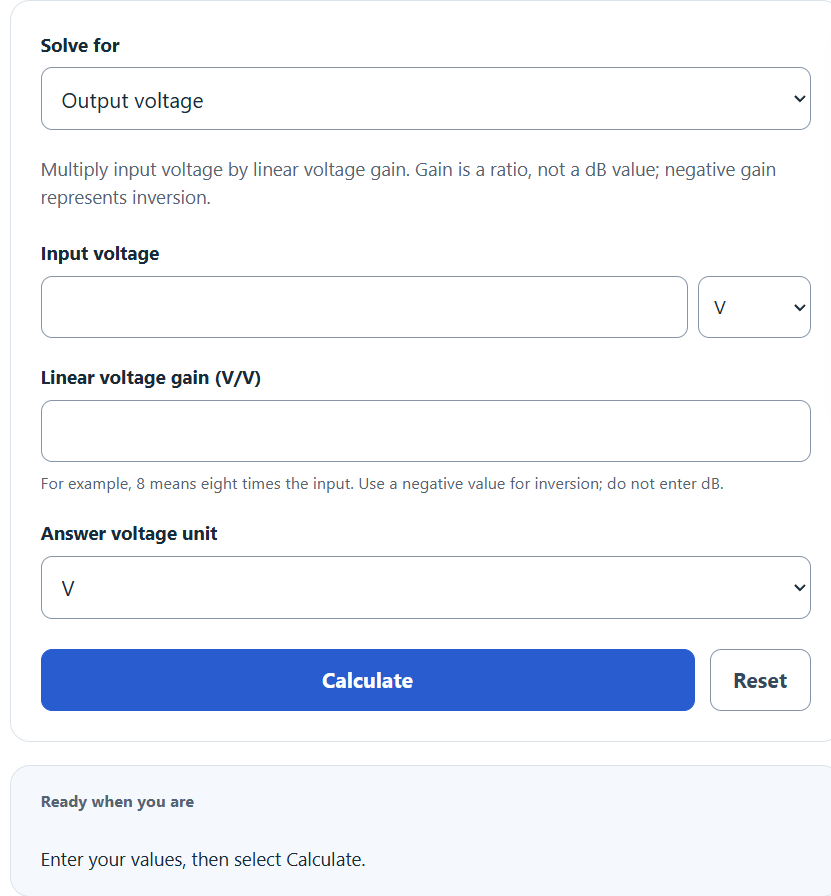
Calculate amplifier input voltage, output voltage, or gain by choosing Solve for, entering the two known values, and selecting Calculate. V, mV, and kV units are supported.
- All Physics Calculators
- All Electrical Calculators
- dB Gain Calculator
- Speaker Impedance Calculator
- Speaker Voltage Calculator
Amplifier Voltage Formula
The amplifier voltage calculation is based on the relationship between input voltage, amplifier gain, and output voltage.
- V_out = amplifier output voltage
- V_in = input or source voltage
- A_v = voltage gain of the amplifier, unitless
The calculator uses the first formula when you enter input voltage and gain to find output voltage. It uses the second formula when you enter input and output voltage to find gain. It uses the third formula when you enter output voltage and gain to find the required input voltage.
Voltage inputs are converted to volts for the calculation. For voltage results, choose the Answer voltage unit. Supported voltage units are millivolts, volts, and kilovolts.
Voltage Unit Conversions
| Unit | Symbol | Value in volts |
|---|---|---|
| Millivolt | mV | 0.001 V |
| Volt | V | 1 V |
| Kilovolt | kV | 1,000 V |
Common Gain Values and Output Examples
| Input voltage | Gain | Output voltage | Meaning |
|---|---|---|---|
| 100 mV | 2 | 200 mV | Voltage is doubled |
| 100 mV | 10 | 1 V | Small signal is amplified to volts |
| 1 V | 5 | 5 V | Output is five times the input |
| 2 V | 0.5 | 1 V | Gain below 1 reduces voltage |
Example Problems
Example 1: Calculate output voltage
You have an input voltage of 250 mV and an amplifier gain of 8.
Convert the input voltage to volts:
Apply the gain:
The output voltage is 2 V.
Example 2: Calculate amplifier gain
You have an input voltage of 0.5 V and an output voltage of 12 V.
The amplifier gain is 24.
FAQ
Is amplifier gain measured in volts?
No. Voltage gain is unitless because it is a ratio of output voltage to input voltage. For example, if an amplifier outputs 10 V from a 2 V input, the gain is 5.
Can amplifier gain be less than 1?
Yes. A gain magnitude below 1 reduces voltage magnitude; a negative gain indicates inversion. For example, a gain of 0.5 changes a 4 V input into a 2 V output.
Why does the calculator require exactly two values?
Choose the unknown in Solve for and enter the other two values. Zero divisors can make an inverse solution impossible or nonunique; the calculator explains these cases. The relationship assumes ideal linear operation and does not predict clipping or supply limits.