Apothem Calculator solves a regular polygon from side length, apothem, circumradius, or area and reports perimeter, area, angles, diagonals, and unit conversions.
- All Math and Numbers Calculators
- Octagon Calculator
- Interior Angle Calculator
- Arc Length Calculator
- Central Angle Calculator
- Arc Height (sagitta) Calculator
Apothem Formula
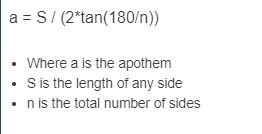
For a regular polygon, the apothem is the perpendicular distance from the center of the polygon to the midpoint of any side. This calculator uses the relationship between side length, number of sides, and apothem.
- a = apothem of the regular polygon
- s = length of one side
- n = number of sides
- pi = 3.14159...
- tan = tangent function
- atan = inverse tangent function
If you enter the side length and number of sides, the calculator finds the apothem. If you enter the apothem and number of sides, it finds the side length. If you enter the side length and apothem, it estimates the number of sides and rounds to the nearest whole number, since a polygon must have a whole number of sides.
The calculator supports inches, feet, centimeters, meters, and millimeters. Length and apothem values are converted internally so mixed units can be used correctly.
Common Regular Polygon Apothem Relationships
The table below shows the approximate apothem when the side length is 1 unit. To scale the result, multiply the listed value by your side length.
| Regular Polygon | Number of Sides | Apothem when Side Length = 1 |
|---|---|---|
| Equilateral triangle | 3 | 0.2887 |
| Square | 4 | 0.5000 |
| Regular pentagon | 5 | 0.6882 |
| Regular hexagon | 6 | 0.8660 |
| Regular octagon | 8 | 1.2071 |
| Regular decagon | 10 | 1.5388 |
Examples
Example 1: Find the apothem
You have a regular hexagon with a side length of 12 cm.
The apothem is about 10.3923 cm.
Example 2: Find the side length
You have a regular octagon with an apothem of 5 in.
The side length is about 4.1421 in.
FAQ
What is an apothem?
The apothem is the distance from the center of a regular polygon to the midpoint of one of its sides. It is not the same as the radius from the center to a vertex.
Does this work for irregular polygons?
No. These formulas only work for regular polygons, where all sides are equal and all angles are equal. An irregular polygon may not have one consistent apothem.
Why does the number of sides have to be a whole number?
A polygon cannot have a fractional number of sides. When the calculator solves for the number of sides, it rounds the result to the nearest whole number. If your input values come from measurement, small differences can cause the raw result to be slightly above or below an exact whole number.