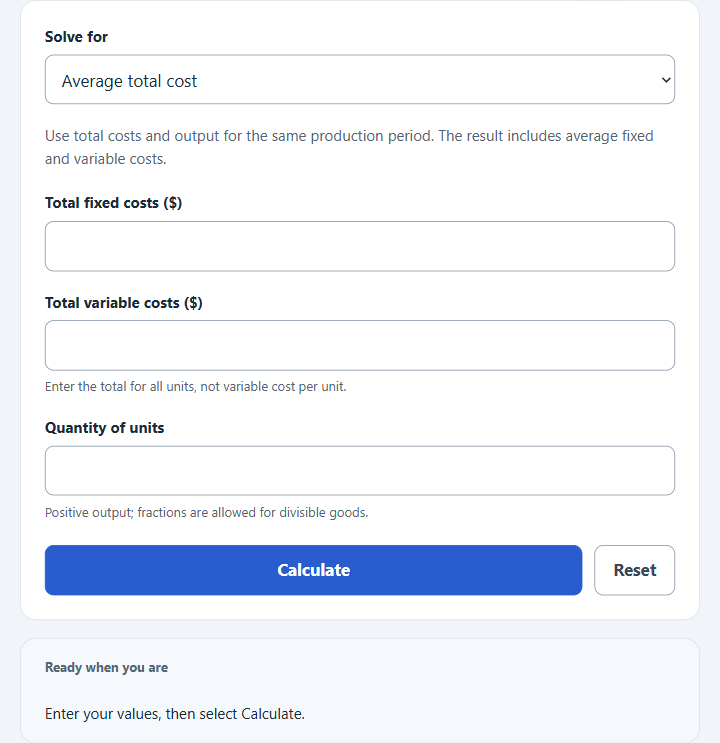
Choose Solve for, then enter the three known values to find average total cost, fixed costs, variable costs, or quantity. Every result includes total cost, average fixed cost (AFC), and average variable cost (AVC). Use nonnegative costs and positive output for the same period.
Average Total Cost Formula
The following formula is used to calculate an average total cost (ATC).
- Where ATC is the average total cost
- FC is the total fixed costs
- VC is the total variable costs
- Q is the quantity of goods
To calculate the average total cost, divide the fixed costs by the quantity, then add this value to the result of the variable costs divided by the quantity.
Definition
What is ATC?
ATC, short for the average total cost, is a measure of the sum of the fixed and variable costs per unit or quantity of goods.
The fixed costs in this case are costs that do not change based on quantity while the variable costs can change based on quantity and other factors. More on this is explored in the calculators linked above.
Example Problem
How to calculate ATC?
The following example problem outlines the process for calculating an average total cost of a product or good.
First, determine the total number of units that are produced. In this case, there were a total of 1,000 units produced in the lot.
Next, determine the total fixed costs associated with those goods. In this example, the fixed costs it took to produce the 1000 units are found to be $4,000.00.
Next, determine the total variable costs. In this problem, there was $1000.00 worth of variable costs.
Finally, calculate the ATC using the formula above:
ATC = (FC / Q ) + (VC / Q)
ATC = (4000 / 1000 ) + (1000/ 1000)
ATC = $5.00 average total cost per unit