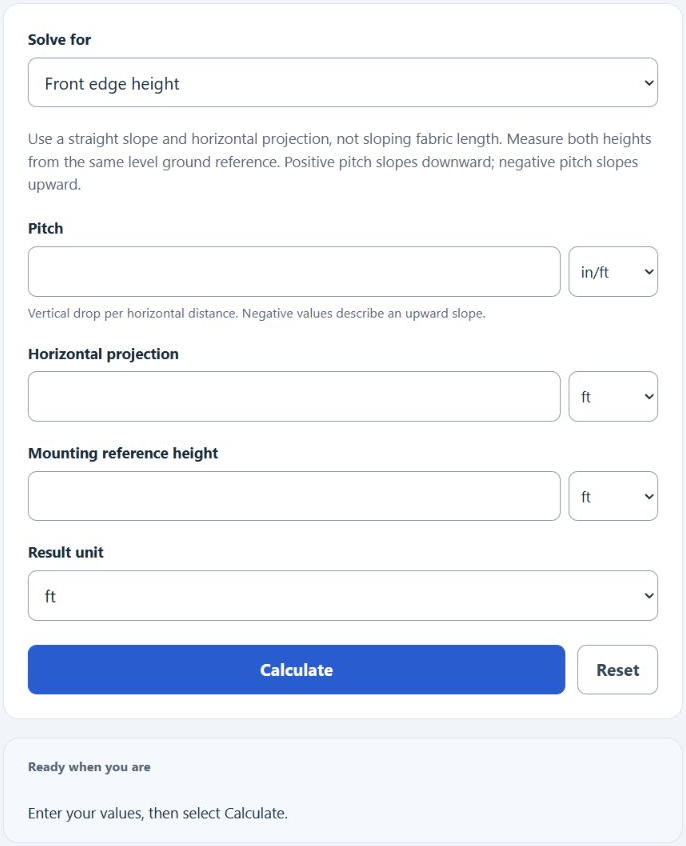
Enter the pitch, projection, and mounting height into the calculator to determine the awning height at full extension. The calculator solves for any one of the four variables when the other three are known.

Awning Height Calculator

Enter any 3 values to calculate the missing variable


Related Calculators

Awning Height Formula

The following formula calculates awning height when pitch is in inches per foot and projection and mounting height are in feet.

AH = MH - \frac{P \cdot PR}{12}

Variables:

  • AH is the awning height (feet)
  • MH is the mounting height (feet)
  • P is the pitch (inches per foot)
  • PR is the projection (feet)

To calculate the awning height, the vertical drop is first computed by multiplying pitch (in/ft) by projection (ft), giving the drop in inches. Dividing that result by 12 converts it to feet. Subtracting the drop from the mounting height yields the awning height at the leading edge.

What is Awning Height?

Awning height is the vertical distance from the ground to the lowest point of the awning fabric or valance when the awning is fully extended. Because an awning slopes downward from its mounting point toward its leading edge, the lowest point always occurs at the front of the projection rather than at the wall. This distinction matters during installation planning: the mounting height and the awning height are not the same measurement, and conflating the two is the most common source of clearance errors.

Three variables control the final awning height: where the brackets attach to the wall (mounting height), how far the awning reaches outward (projection), and the downward angle of slope (pitch). Increasing projection or pitch lowers the leading edge; increasing mounting height raises it proportionally. The calculator above solves for any one of these variables when the other three are known, which is useful both for planning a new installation and for reverse-engineering an existing awning’s parameters from a measured clearance.

Minimum Clearance Requirements

Most jurisdictions govern awning clearance under two separate frameworks: a residential standard and a stricter commercial standard for awnings projecting over public sidewalks or rights-of-way.

For residential installations, the practical minimum awning height is 7 feet (84 inches) above finished grade. Most awning manufacturers set 7 feet 6 inches as a recommended floor, because standard door heights run 6 feet 8 inches and the awning mechanism requires an additional 8 to 10 inches of wall clearance above the door frame for the cassette housing, motor, and arm travel. Installing at or below the 7-foot threshold routinely results in the retraction mechanism clipping door frames during deployment.

For awnings that overhang a public pedestrian path, the Americans with Disabilities Act Accessibility Guidelines (ADAAG) set 80 inches (6 feet 8 inches) as the absolute minimum vertical clearance above any circulation route. The International Building Code (IBC) Section 3105 and local codes based on it require that awnings projecting over a public right-of-way maintain at least 7 feet to the lowest point of the cover or support. San Francisco’s encroachment code, which closely reflects standard IBC principles, ties permitted projection depth to clearance height: a 2-foot projection is allowed at 10 feet of clearance above grade, with the permitted projection increasing by 1 inch for each additional foot of clearance, up to a 4-foot maximum. Above 15 feet of clearance, projection depth is generally unrestricted. Temporary entrance awnings at commercial sites are typically required to maintain at least 7 feet (2,134 mm) to the lowest edge of the hood structure. Awning permit requirements vary significantly by jurisdiction: many municipalities require permits for any awning projecting more than 36 to 54 inches from the exterior wall, with exact thresholds depending on occupancy type and local amendments to the IBC or IRC.

Recommended Mounting Heights

The mounting height directly sets the ceiling on how much clearance the awning can provide at any given pitch and projection. Industry guidelines cluster around a few specific targets depending on application.

For a standard 10-foot projection retractable awning, mounting at 9 feet 6 inches with a 3-in/ft pitch delivers exactly 7 feet of clearance beneath the leading edge, which is the accepted practical minimum. Mounting at 10 feet raises the leading edge to 7 feet 6 inches at the same pitch, which is more appropriate where tall adults or outdoor furniture will be present beneath the awning. Mounting above 10 feet at a 3-in/ft pitch produces leading-edge heights above 7 feet 6 inches, which suits commercial patios, accessible routes, and installations adjacent to 8-foot sliding glass doors. The table below shows calculated awning heights for common configurations using the formula above.

Mounting HeightProjectionPitch (in/ft)Awning Height
9 ft 6 in10 ft37 ft 0 in
9 ft 6 in10 ft46 ft 2 in
10 ft10 ft37 ft 6 in
10 ft10 ft46 ft 8 in
10 ft8 ft38 ft 0 in
10 ft8 ft47 ft 4 in

How Pitch Affects Height and Sun Shading

Pitch is not merely a structural variable; it is the primary lever controlling the awning’s shading geometry. A steeper pitch lowers the leading edge and therefore reduces awning height, but simultaneously projects a larger shadow footprint onto the glazing below. This trade-off becomes consequential when the installation goal is heat reduction rather than purely weather protection.

The U.S. Department of Energy reports that properly positioned awnings reduce solar heat gain through south-facing windows by up to 65% and through west-facing windows by up to 77%. These figures depend on the awning covering the window’s solar angle of incidence, which is governed by both the pitch and the projection relative to window height. An awning with too shallow a pitch may fail to intercept low-angle afternoon sun even when the projection is generous, while one with too steep a pitch may intercept midday sun effectively but lower the leading edge to a point that conflicts with door clearance requirements. For west-facing installations where afternoon heat control is the priority, a longer projection combined with a pitch in the 3.5 to 5 in/ft range typically provides the best balance between shading effectiveness and usable clearance.

The conventional minimum pitch for a retractable awning is 3.5 inches per foot (roughly 16 degrees), which balances drainage, structural rigidity under wind load, and usable clearance. Pitches below this range increase the risk of water pooling in the fabric and reduce the awning’s resistance to upward wind pressure. Each additional inch of pitch per foot reduces the leading-edge height by 1 inch per foot of projection. On a 10-foot projection, moving from a 3 in/ft pitch to a 5 in/ft pitch drops the leading edge by 20 inches, which can push a borderline installation well below the 7-foot clearance threshold.

Awning Types and Their Height Implications

The awning type affects height planning in ways that go beyond the basic formula. Fixed awnings are set at a permanent pitch and projection, so the awning height is static after installation. Retractable awnings, particularly lateral arm (folding arm) models, deploy at a variable pitch within a manufacturer-specified range, typically 5 to 25 degrees depending on the product. This means the awning height changes each time the pitch setting is adjusted: a unit set to 5 degrees on a 12-foot projection will have a leading edge several inches higher than the same unit set to 25 degrees, and both conditions should be calculated before finalizing the mounting height.

Lateral arm retractable awnings use torsion bars and tensioned arms to support larger spans, commonly 8 to 40 feet wide, and are the standard choice for patios and decks. Drop arm awnings use spring-loaded side arms and are suited to smaller windows and door apertures, typically projecting 3 to 5 feet. Because drop arm awnings are narrower and shallower, their height impact is more limited, though the clearance requirement over door frames still applies. Motorized cassette models introduce an additional height consideration: the cassette housing that contains the rolled fabric requires 9 to 10 inches of vertical wall space above the mounting bracket. When a fascia or soffit begins 10 inches above the intended bracket location, the effective mounting height is constrained downward by that obstruction, which reduces the achievable awning height at any given pitch.

Factors That Reduce Available Awning Height

Several wall-mounted and architectural features routinely reduce achievable awning height below what a paper calculation suggests. Light fixtures, security cameras, and electrical conduit mounted between the intended bracket location and the finished grade can obstruct arm travel during deployment. Gutters and downspouts often run at heights that conflict with bracket placement, forcing the mount to shift upward or the projection to shorten. Roofline overhangs reduce the vertical wall space available for mounting. Window trim or shutters between the bracket location and the door frame can prevent the awning arms from fully extending without contact. Each of these constraints should be identified before determining the target mounting height, because the bracket location is the one input in the awning height formula that cannot be adjusted after installation without repatching and repainting the wall surface.