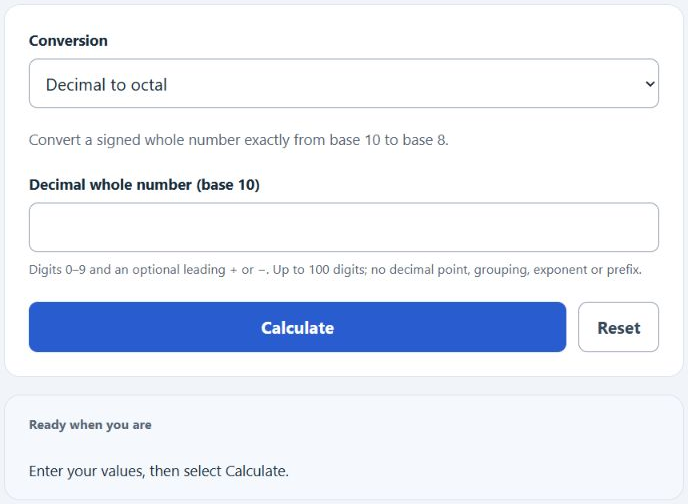
Convert between decimal and octal with this base 8 calculator and see the converted value plus step-by-step conversion details shown below.
- All Math and Numbers Calculators
- Base 9 Calculator
- BCD Binary Coded Decimal Calculator
- Decimal to Floating Point Calculator
- Log Base 2 Calculator
- Exponent Calculator
Base 8 Formula
The base 8 calculator converts signed whole numbers between decimal and octal. For negative values, convert the absolute value and retain the negative sign. Octal, also called base 8, uses only the digits 0 through 7.
To convert an octal number to decimal, multiply each octal digit by a power of 8 based on its position, then add the results.
- Decimal is the base 10 value.
- d is an octal digit from 0 to 7.
- n is the position of the digit, counted from right to left starting at 0.
- 8 is the base used by octal numbers.
To convert a decimal number to octal, repeatedly divide the decimal number by 8 and record each remainder. The octal result is the remainders read from last to first.
- Decimal is the number being divided at each step.
- Quotient is the whole-number result after dividing by 8.
- Remainder is the digit used in the octal result.
If you enter a decimal value, the calculator returns the equivalent octal value. If you enter an octal value, the calculator expands each digit by powers of 8 and returns the decimal value.
Octal Place Values and Common Conversions
Use these tables to check how octal digits are weighted and to compare common decimal and octal values.
| Octal place | Power of 8 | Decimal value |
|---|---|---|
| 1s place | 80 | 1 |
| 8s place | 81 | 8 |
| 64s place | 82 | 64 |
| 512s place | 83 | 512 |
| 4096s place | 84 | 4096 |
| Decimal | Octal | Note |
|---|---|---|
| 8 | 10 | One group of 8 |
| 16 | 20 | Two groups of 8 |
| 64 | 100 | One group of 64 |
| 255 | 377 | Common 8-bit maximum |
Example Problems
Example 1: Convert octal 157 to decimal
Break the octal number into place values:
So, octal 157 equals decimal 111.
Example 2: Convert decimal 100 to octal
Divide by 8 and track the remainders:
- 100 ÷ 8 = 12 remainder 4
- 12 ÷ 8 = 1 remainder 4
- 1 ÷ 8 = 0 remainder 1
Read the remainders from bottom to top:
FAQ
What digits are allowed in base 8?
Base 8 uses the digits 0, 1, 2, 3, 4, 5, 6, and 7. The digits 8 and 9 are not valid in an octal number because each place represents powers of 8.
Why does octal 10 equal decimal 8?
In octal, 10 means one group of 8 and zero 1s. It does not mean ten in decimal. The value is calculated as 1 × 81 + 0 × 80, which equals 8.
How do you know which field to fill in?
Choose Decimal to octal or Octal to decimal, enter the signed whole number in the visible field, and select Calculate. Use at most 100 digits, with no fractions, grouping separators, exponent notation or base prefixes. Conversion is exact; leading zeros are removed.