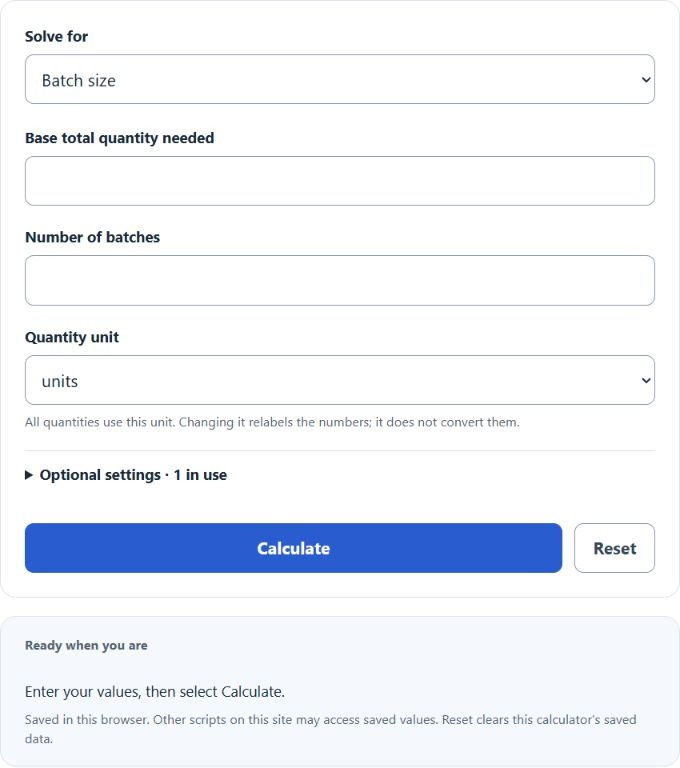
Choose batch size, number of batches, or base total quantity. Include an optional overage allowance and whole-batch rounding. Quantities use the selected unit label without unit conversion.
Related Calculators
- Baker’s Percentage Calculator
- Bread Hydration Calculator
- Product Yield Calculator
- Food Quantity Calculator
- Amount Per Serving Calculator
- Cooking Ratio Calculator
- All Food and Cooking Calculators
Batch Size Formula
The adjusted total quantity equals the number of batches multiplied by the quantity per batch. The base total excludes the added overage allowance.
When you include overage or expected waste, the calculator first increases the total quantity by the overage percentage.
To calculate the number of batches:
To calculate the batch size:
To calculate the total quantity when batch size and number of batches are known:
If you choose to round the number of batches up to a whole batch, the calculator uses:
- TQ = base total quantity needed before overage or waste
- ATQ = adjusted total quantity after adding overage or waste
- NB = number of batches
- BS = batch size
- OP = overage or waste percentage
- ceil(NB) = the next whole number greater than or equal to NB
Choose the value to solve for and enter the two shown positive quantities. If you enter an overage percentage, that percentage is added to the total before the missing batch value is calculated. If you select round up, the number of batches is rounded to a whole number and the batch size is adjusted so the rounded batches still equal the adjusted total quantity.
Common Batch Planning Values
These ranges are illustrations, not standards or validated loss predictions. Use measured process losses to choose an allowance. The second table maps the two supplied quantities to the selected solve mode.
| Situation | Illustrative overage range | Reason |
|---|---|---|
| Simple counting items | 0% to 2% | Low expected loss when items are counted individually. |
| Food prep or recipes | 3% to 10% | Trimming, evaporation, spillage, or serving variation. |
| Liquid filling | 1% to 5% | Line loss, residue, and fill variation. |
| Manufacturing or packaging | 2% to 8% | Scrap, defects, test samples, or setup loss. |
| If you know… | Solve for… | Calculator finds… |
|---|---|---|
| Total quantity and number of batches | Batch size | How much goes in each batch. |
| Total quantity and batch size | Number of batches | How many batches are required. |
| Number of batches and batch size | Total quantity | The base quantity supported by the supplied production total after removing the overage allowance. |
Batch Size Examples
Example 1: Find the batch size
You need 10,000 units and want to make 25 batches. There is no overage.
The batch size is 400 units per batch.
Example 2: Find batches with overage
You need 5,000 pieces, each batch can hold 450 pieces, and you want to add 5% for waste.
Without rounding, the result is 11.666667 batches. If you round up, the calculator uses 12 batches and adjusts the batch size to 437.5 pieces per batch.
FAQ
What is batch size?
Batch size is the amount made, processed, packed, or prepared in one batch. For example, if you need 2,000 items and split them into 10 equal batches, the batch size is 200 items per batch.
How does overage or waste percentage affect the result?
Overage increases the total quantity before the missing value is calculated. For example, a total quantity of 1,000 with 5% overage becomes an adjusted total of 1,050. The extra 50 units are the overage or waste amount.
Should you round the number of batches up?
Round up when you cannot run a partial batch. For example, 6.3 batches usually means you need 7 batch runs. In this calculator, rounding up changes the number of batches to a whole number and recalculates the batch size so the adjusted total is spread evenly across those batches.