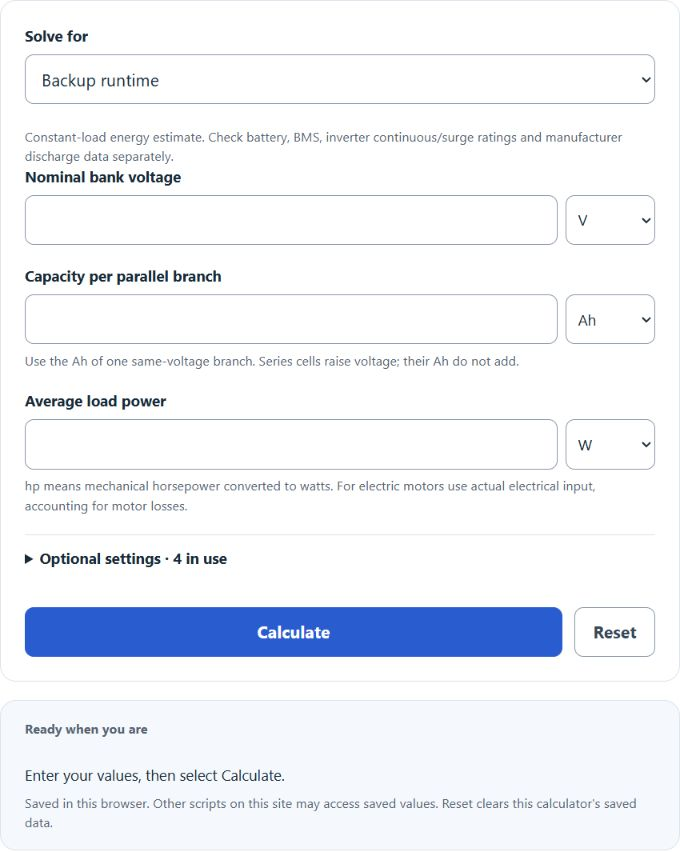
Enter the power consumption, battery capacity, and battery voltage into the calculator to determine the backup time for your battery system. This calculator helps you estimate how long your battery can run a particular device or system.

Battery Backup Calculator

Basic Calculator
Backup Recommendation

Enter any 3 values to calculate the missing variable


Related Calculators

Battery Backup Time Formula

The basic formula for battery backup time is:

B = (C * V) / P

Variables:

  • B is the backup time (hours)
  • C is the battery capacity (ampere-hours)
  • V is the battery voltage (volts)
  • P is the power consumption (watts)

This formula gives a theoretical maximum. In practice, real-world runtime is always shorter due to inverter efficiency losses, the Peukert effect on lead-acid batteries, depth of discharge limits, temperature derating, and battery age degradation. A more accurate real-world formula accounts for these factors:

B_{real} = (C * V * DoD * \eta * T_f) / P

Where DoD is the depth of discharge (typically 0.5 for lead-acid or 0.8 to 0.9 for lithium), eta is inverter/system efficiency (0.85 to 0.95), and T_f is a temperature correction factor (1.0 at 25 C, decreasing in cold environments).

What is Battery Backup Time?

Battery backup time is the duration a battery system can sustain a connected load before the stored energy is depleted to its minimum safe level. It applies to uninterruptible power supplies (UPS) protecting servers and networking equipment, solar battery banks powering homes during grid outages, portable power stations running camping or tailgating gear, medical device backup systems in hospitals, and emergency lighting in commercial buildings. The rated capacity on a battery label represents ideal conditions at a specific discharge rate and temperature. Actual runtime in a real installation almost always differs from that label value.

Factors That Reduce Real-World Battery Backup Time

The Peukert Effect

Battery capacity ratings (like 100 Ah) are measured at a standardized slow discharge rate, usually the 20-hour rate (C/20). When you discharge a battery faster than that rated speed, its effective capacity drops. This phenomenon is described by Peukert’s law, and the magnitude depends on battery chemistry. Flooded lead-acid batteries have Peukert exponents of 1.2 to 1.5, meaning high-drain loads can reduce usable capacity by 30 to 50%. Sealed AGM batteries perform better at 1.05 to 1.15. Lithium-ion and LiFePO4 batteries have exponents near 1.05, so their capacity stays nearly constant regardless of discharge rate. This means a 100 Ah lead-acid battery powering a 500 W load through a 12 V inverter might only deliver 60 to 70 Ah of usable energy, while a 100 Ah lithium battery under the same load delivers close to 95 Ah.

Depth of Discharge (DoD)

No battery should be drained to 0%. The depth of discharge is the percentage of total capacity you actually use before recharging. Lead-acid batteries achieve optimal cycle life at 50% DoD, which yields roughly 1,500 or more charge cycles. Draining them to 80% cuts cycle life to around 500 cycles. Lithium batteries can safely operate at 80 to 90% DoD while still maintaining 2,000 or more cycles. This means when sizing a lead-acid backup system, you should effectively double the calculated capacity to stay within the 50% DoD guideline.

Inverter and System Efficiency

Every battery backup system loses energy converting stored DC power into usable AC power. UPS and inverter efficiency varies by topology. Standby (offline) UPS units are the most efficient during normal operation at 95 to 98%, since the inverter only engages during an outage, but they have a 5 to 12 millisecond transfer time. Line-interactive UPS units operate at 95 to 97% efficiency and add automatic voltage regulation with a 2 to 4 millisecond transfer time. Online (double-conversion) UPS units provide zero transfer time and the cleanest power output, but their constant DC-to-AC conversion reduces efficiency to 85 to 93%. For most home and small office setups, a line-interactive UPS gives the best balance of efficiency and protection.

Temperature Derating

Battery capacity is rated at 25 C (77 F). Deviations from this temperature reduce available energy. At 0 C (32 F), a typical VRLA (valve-regulated lead-acid) battery loses 20 to 30% of its effective capacity. At 40 C (104 F), capacity may temporarily increase slightly, but battery lifespan drops substantially. The general engineering rule for lead-acid batteries is that every 8 to 10 C rise above 25 C cuts expected battery life in half. Lithium batteries are less sensitive to temperature variation but still lose 10 to 15% capacity at freezing temperatures and should not be charged below 0 C without a heated battery management system.

Battery Age and Degradation

Batteries lose capacity over time even when properly maintained. VRLA batteries in UPS systems typically lose 20 to 30% of their original capacity over 3 to 5 years at 25 C. The industry standard end-of-life threshold is 80% of original rated capacity, at which point the battery should be replaced. Lithium batteries degrade more slowly, often retaining 80% capacity after 2,000 to 3,000 cycles depending on chemistry and usage patterns. For critical backup systems, engineers typically add a 10 to 15% design margin on top of calculated capacity to account for degradation over the battery’s service life.

Battery Chemistry Comparison for Backup Applications

CharacteristicFlooded Lead-AcidSealed AGMLithium-Ion (LiFePO4)
Typical Peukert Exponent1.2 – 1.51.05 – 1.151.02 – 1.05
Recommended DoD50%50%80 – 90%
Cycle Life at Recommended DoD500 – 1,500600 – 1,2002,000 – 5,000
Round-Trip Efficiency70 – 80%80 – 85%92 – 98%
Self-Discharge Rate per Month5 – 15%3 – 5%1 – 3%
Weight per kWh25 – 35 kg22 – 30 kg6 – 10 kg
Maintenance RequiredRegular (water topping)NoneNone
Upfront Cost per kWh (USD, approx.)$100 – $200$200 – $350$400 – $700
Effective Cost per Cycle per kWh$0.13 – $0.40$0.17 – $0.58$0.08 – $0.14

Despite the higher upfront cost, lithium batteries deliver the lowest cost per cycle due to their deeper usable discharge, longer cycle life, and higher round-trip efficiency. For backup applications where the battery sits idle most of the time (like a UPS), the low self-discharge rate of lithium is also an advantage since the battery retains more of its charge between power events.

Common Device Power Consumption Reference

Knowing the wattage of devices connected to your backup system is essential for accurate runtime calculation. The following table provides typical power consumption values for common devices:

DeviceTypical Wattage
Wi-Fi Router5 – 20 W
Cable/DSL Modem8 – 15 W
LED Monitor (24 inch)20 – 40 W
Laptop (charging)45 – 100 W
Desktop Computer (mid-range)200 – 400 W
Gaming PC400 – 800 W
NAS (2-bay)20 – 40 W
Home Server100 – 250 W
Security Camera System (4 cameras + DVR)40 – 80 W
LED Light Bulb8 – 15 W
Refrigerator (running)100 – 200 W
Sump Pump250 – 600 W
CPAP Machine30 – 60 W
Phone Charger5 – 20 W
Television (55 inch LED)60 – 90 W

To find the actual wattage of a specific device, check the label on the power adapter or the device itself. The label lists either watts directly or volts and amps, which you can multiply together (W = V x A) to get the wattage. UPS units are typically rated in volt-amperes (VA) rather than watts, and the ratio between the two is the power factor. A common power factor for computer equipment is 0.6 to 0.7, meaning a 1000 VA UPS can typically support 600 to 700 W of actual load.

UPS Topology Quick Reference

FeatureStandby (Offline)Line-InteractiveOnline (Double-Conversion)
Transfer Time5 – 12 ms2 – 4 ms0 ms
Efficiency95 – 98%95 – 97%85 – 93%
Voltage RegulationNone (pass-through)+/- 8 to 15%+/- 2 to 3%
Best ForHome PCs, peripheralsSmall servers, network gearData centers, medical devices
Typical VA Range300 – 1,500 VA500 – 5,000 VA1,000 – 200,000+ VA
Relative CostLowModerateHigh

The UPS topology you choose directly affects how much of the battery’s stored energy actually reaches your devices. An online UPS with 90% efficiency will deliver about 5 to 10% less runtime than a line-interactive unit with 97% efficiency, even with identical batteries and loads.

Temperature Correction Factors for Battery Capacity

TemperatureLead-Acid Capacity FactorLithium Capacity Factor
-10 C (14 F)0.600.80
0 C (32 F)0.750.88
10 C (50 F)0.850.94
20 C (68 F)0.950.98
25 C (77 F)1.001.00
30 C (86 F)1.021.00
40 C (104 F)1.040.98

These factors represent the fraction of rated capacity available at each temperature. A lead-acid battery in an unheated garage at 0 C will only deliver about 75% of its rated capacity. When sizing battery backup for environments that experience temperature extremes, multiply your calculated Ah requirement by the inverse of the temperature factor to ensure adequate runtime. For example, at 0 C with lead-acid, divide your required capacity by 0.75 (effectively increasing it by 33%).

Sizing a Battery Backup System

Proper battery backup sizing involves more than plugging numbers into the basic formula. Start by measuring or adding up the wattage of every device that will be connected to the backup system. Include surge or startup loads for motors, compressors, and laser printers, which can draw 3 to 7 times their running wattage for the first few seconds. Next, determine how long you need backup power. For a UPS protecting a workstation during short grid interruptions, 10 to 15 minutes may be sufficient. For a whole-home battery system covering overnight solar gaps, you may need 8 to 12 hours. Then apply the real-world correction factors: divide by your system’s efficiency, divide by the safe depth of discharge for your battery chemistry, and divide by the temperature factor for your installation environment. Finally, add a 10 to 15% design margin for battery aging over its service life. The result is the actual battery capacity you need to purchase.