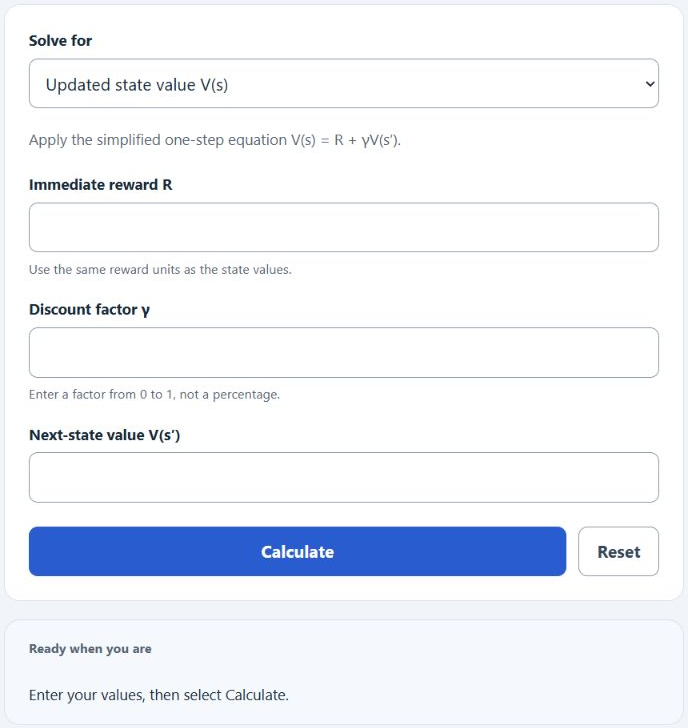
Calculate the missing value in the Bellman equation from reward, discount factor, and next state value to get the updated state value.
Related Calculators
- Exp Calculator
- Decay Factor Calculator
- Average Rate Calculator
- Arden’s Theorem Calculator
- All Math and Numbers Calculators
Bellman Equation Formula
The calculator uses the simplified one-step Bellman equation. It assumes one immediate reward and one next-state value.
To solve for a missing input, the same equation is rearranged:
- V(s) is the updated value of the current state.
- R is the immediate reward received after taking the action.
- γ is the discount factor, restricted to 0 through 1 in this calculator.
- V(s’) is the value of the next state.
Select the value to solve for, enter the three displayed inputs, then select Calculate. The calculator supports Updated state value, Immediate reward, Discount factor, and Next-state value. It distinguishes conflicting inputs from cases with infinitely many solutions.
Discount Factor and Bellman Value Interpretation
| Discount factor γ | Meaning | Effect on V(s) |
|---|---|---|
| 0 | Only the immediate reward matters. | V(s) = R |
| 0.1 to 0.4 | The next-state value is multiplied by 0.1 to 0.4. | The actual contribution also depends on the magnitude and sign of the next-state value. |
| 0.5 to 0.8 | Immediate and future values both matter. | The contribution is γ times the supplied next-state value. |
| 0.9 to 1 | Future value is weighted heavily. | The future-value term retains 90% to 100% of the supplied next-state value. |
| Selected solve mode | What is calculated | Required nonzero condition |
|---|---|---|
| Reward R | R = V(s) – γV(s’) | None |
| Discount factor γ | γ = (V(s) – R) / V(s’) | V(s’) cannot be 0 |
| Next-state value V(s’) | V(s’) = (V(s) – R) / γ | γ cannot be 0 |
| Updated value V(s) | V(s) = R + γV(s’) | None |
Example Problems
Example 1: Calculate the updated value
Suppose the reward is 5, the discount factor is 0.9, and the next-state value is 20.
The updated value is 23.
Example 2: Calculate the reward
Suppose the updated value is 14, the discount factor is 0.8, and the next-state value is 10.
The reward is 6.
FAQ
What does the Bellman equation calculate?
The Bellman equation calculates the value of a state by combining the immediate reward with the discounted value of the next state. In this simplified one-step version, it answers: what is this state worth if you receive reward R now and then move to a next state worth V(s’)?
Why is the discount factor usually between 0 and 1?
The discount factor controls how much future value counts. A value near 0 reduces the weight on the next-state value; a value near 1 preserves most of it. Its contribution also depends on the size and sign of that value. For bounded rewards in continuing tasks, a factor below 1 supports a finite discounted return. A factor of 1 is undiscounted and requires separate assumptions, such as a terminating episode.
Can the next-state value or reward be negative?
Yes. A negative reward can represent a penalty or cost. A negative next-state value can represent a bad future state. The same formula still applies, but negative values will reduce the updated state value depending on the discount factor.