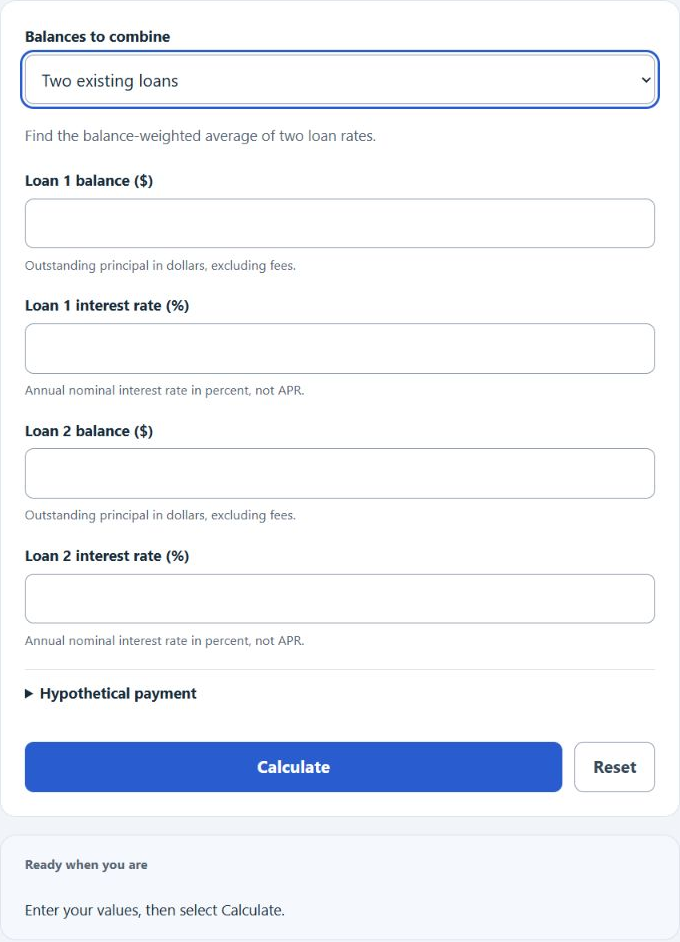
Calculate a balance-weighted rate for two loans or current debt plus new borrowing. Optionally estimate a hypothetical single-loan payment; this is not a lender’s blend-and-extend quote.
Blended Rate Mortgage Formula
The following equation is used to calculate the Blended Rate Mortgage.
- Where BR is the blended mortgage rate in the same rate convention as the inputs
- L1, L2, …, Ln are the principal amounts of each loan ($)
- R1, R2, …, Rn are the interest rates for each loan. Use percentages throughout to get BR as a percentage, or decimals throughout to get a decimal result. The calculator accepts percentages.
To calculate the blended mortgage rate, multiply each principal balance by its respective interest rate, sum these products, and divide by the total principal of all loans combined.
What is a Blended Rate Mortgage?
Definition:
A balance-weighted rate summarizes interest rates on multiple loan balances at one point in time. It does not combine contracts or determine a new lender rate. A lender’s blend-and-extend product can also depend on remaining terms and lender rules. This calculator retains the current-plus-new-borrowing comparison but weights principal only.
How to Calculate Blended Rate Mortgage?
Example Problem:
The following example outlines the steps and information needed to calculate the blended rate mortgage.
First, determine the amounts and rates for each loan. In this example, there are two loans: Loan 1 is $200,000 with an interest rate of 4.00%, and Loan 2 is $100,000 with an interest rate of 5.00%.
Next, use the formula above to calculate the blended rate:
BR = (L1 × R1 + L2 × R2) / (L1 + L2)
BR = ($200,000 × 0.04 + $100,000 × 0.05) / ($300,000)
BR = ($8,000 + $5,000) / $300,000 ≈ 0.043333 = 4.3333%
The current balance-weighted rate is about 4.3333%. This does not merge the loans or establish refinancing savings. The optional payment assumes one fixed-rate loan over the chosen amortization period, with monthly rate equal to annual nominal rate divided by 12. It excludes taxes, insurance, fees and penalties and is not the sum of existing payments.
FAQ
How does a blended rate mortgage benefit me?
A weighted rate helps summarize current borrowing costs. It is not APR and does not include refinancing fees. Whether a new loan saves money depends on the actual offer, repayment schedule, fees and penalties; averaging rates alone does not create savings.
Will I have to pay refinancing fees with a blended rate mortgage?
Refinancing may involve closing costs and other charges under your lender’s terms. These are excluded here. Compare the actual loan offers, costs and repayment schedules.
How often should I re-evaluate my blended mortgage rate?
Recalculate this snapshot when balances or rates change. It cannot determine which financing choice is most cost-effective. Review actual terms and fees when comparing offers.