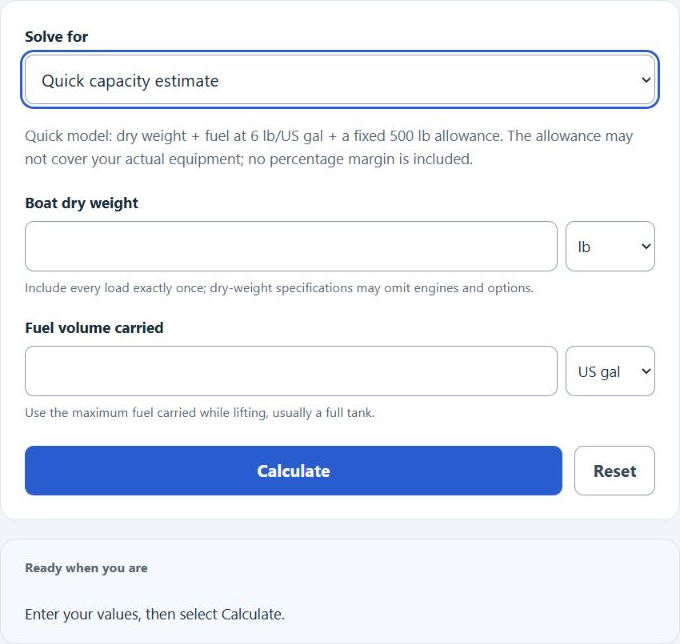
Estimate loaded weight and a modeled lift capacity from dry weight, fuel volume and density, gear, freshwater ballast, and a manufacturer-supported margin.
Note: Boat lift sizing is typically based on the boat’s actual loaded (“wet”) weight plus a margin specified by the lift manufacturer for the boat, installation and operating conditions. “Dry weight” may exclude engines, batteries, fluids, options, and gear.
Boat Lift Capacity Formula (Loaded Weight + Safety Margin)
The following example outlines a common approach for sizing a boat lift: estimate the boat’s loaded (wet) weight, then apply a safety margin. The Custom loaded weight and margin mode matches this approach.
Variables:
- BLCrec is the modeled boat lift capacity (lb)
- Wloaded is the total loaded (wet) weight (lb)
- DW is the boat dry weight (lb)
- TS is the fuel volume (US gallons)
- ρfuel is fuel density (lb/US gal), e.g., gasoline ≈ 6.0–6.3 lb/gal and diesel ≈ 7.0–7.3 lb/gal
- GW is additional gear/passengers/accessories weight (lb)
- WV is water/ballast volume (US gallons); fresh water is ≈ 8.34 lb/gal
- M is the safety margin (%)
How to Calculate Boat Lift Capacity?
The following steps outline how to calculate a modeled boat lift capacity for manufacturer review.
- Determine the boat’s dry weight (from manufacturer specs or a scale ticket, if available).
- Estimate fuel weight using tank volume and fuel density (gasoline and diesel vary by blend and temperature).
- Add additional weight for typical gear/passengers/accessories and any water/ballast carried.
- Compute the total loaded (wet) weight.
- Apply the margin specified by the lift manufacturer, then confirm rated capacity, hull support and installation requirements with the manufacturer.
Example Problem :
Use the following variables as an example problem to test your knowledge.
dry weight of the boat (lbs) = 2000
gas tank size (gallons) = 100
Assume gasoline density = 6.0 lb/gal, additional gear/passengers = 500 lb, safety margin = 15%.
Fuel weight = 100 × 6.0 = 600 lb
Total loaded weight = 2000 + 600 + 500 = 3100 lb
Modeled lift capacity = 3100 × (1 + 0.15) = 3565 lb. Confirm the appropriate rated lift and installation with its manufacturer; this example does not certify a 4000 lb lift for a specific boat.