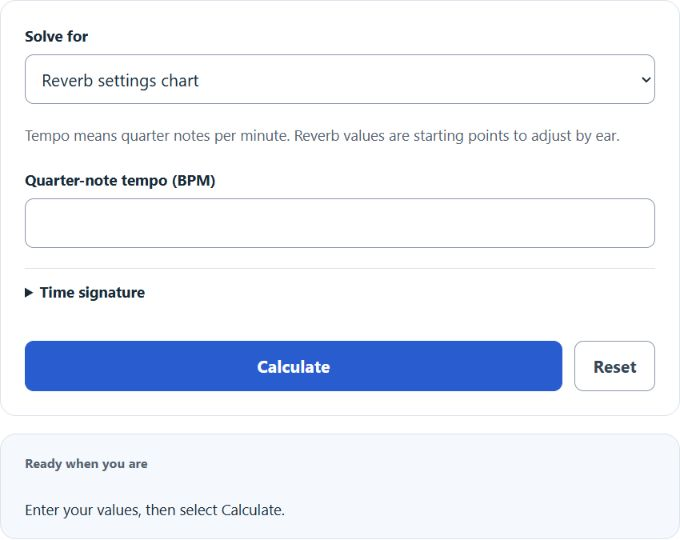
Calculate tempo-synced delay times, dotted and triplet delays, LFO rates, and reverb pre-delay from quarter-note BPM in music production.
BPM Delay + Reverb Formula
All timings start from the quarter note in milliseconds, then scale by note value.
- BPM — beats per minute of the track
- Note factor — 4 for whole, 2 for half, 1 for quarter, 0.5 for 1/8, 0.25 for 1/16, 0.125 for 1/32
- Delay — note duration in milliseconds, used directly as a delay time or pre-delay
- LFO rate — cycles per second for tempo-synced modulation
Custom pre-delay offers 1/32 through 1/512 notes. Default 4/4 has four quarter notes per bar; 2/4, 3/4 and 6/8 are also available. At quarter-note BPM, 6/8 has three quarter-note durations per bar. Suggested decay = total rhythmic space − pre-delay. Decay parameters commonly describe a level drop such as RT60, not guaranteed silence at an exact boundary; fine-tune by ear.
Common Values and How to Use Them
Reference for the most-used delay times at standard tempos:
| BPM | 1/4 (ms) | 1/8 (ms) | 1/8D (ms) | 1/16 (ms) |
|---|---|---|---|---|
| 90 | 667 | 333 | 500 | 167 |
| 100 | 600 | 300 | 450 | 150 |
| 120 | 500 | 250 | 375 | 125 |
| 128 | 469 | 234 | 352 | 117 |
| 140 | 429 | 214 | 321 | 107 |
| 174 | 345 | 172 | 259 | 86 |
Illustrative settings to fine-tune by ear; these style suggestions differ from the calculator’s named starting-point chart:
| Style | Pre-delay | Decay | Best For |
|---|---|---|---|
| Plate | 1/32 | 1 bar | Vocals, snare |
| Room | 1/64 | 1/2 bar | Drums, rhythm guitar |
| Hall | 1/16 | 2 bars | Strings, piano |
| Ambient | 1/8 | 4 bars | Pads, cinematic |
| Slap | 1/8 | 1/4 bar | Vintage vocals |
Worked Example and Tips
Example at 120 BPM: A quarter note is 60000 / 120 = 500 ms. A 1/8 delay is 250 ms. Dotted 1/8 is 250 × 1.5 = 375 ms, the classic U2-style rhythmic delay. A 1/4 LFO rate is 1000 / 500 = 2 Hz.
Pre-delay choice: Set pre-delay long enough that the dry signal is heard before the reverb tail starts. On vocals, 1/32 to 1/16 keeps consonants clear.
Triplet vs dotted: Triplets feel faster and busier, dotted feels syncopated and wide. Use triplet delays sparingly on lead lines, dotted for atmosphere.
Rounding: Displayed times and rates are rounded. Devices with whole-millisecond settings may round further; check the timing by ear.
Timing reference: Alesis DM Pro Reference Manual. Decay definition: Valhalla FutureVerb controls.