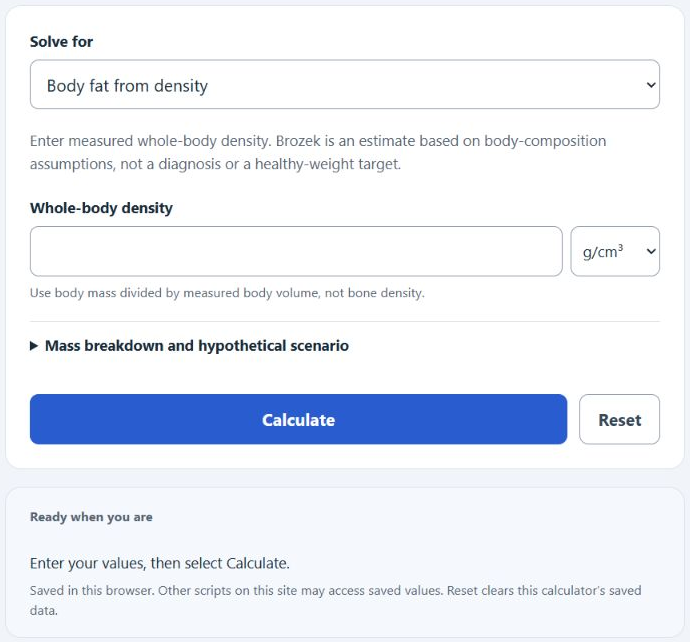
Choose a method and enter the displayed measurements. Density mode estimates body fat with Brozek and shows Siri for comparison. Skinfold and underwater modes first estimate density; the historical Navy tape method is a separate estimate. Optional mass and scenario fields are not recommendations.
Brozek Equation Formula
Variables:
- BF is estimated body fat percentage (%)
- p is the density (g/cm^3)
How to Calculate Brozek Equation?
The following steps outline how to calculate the Brozek Equation.
- First, determine the density (g/cm^3).
- Next, gather the formula from above: BF = (4.57/p – 4.142) * 100.
- Finally, calculate the Brozek Equation.
- After inserting the variables and calculating the result, check your answer with the calculator above.
Example Problem :
Use the following variables as an example problem to test your knowledge.
density = 1.05 g/cm³; BF = (4.57 / 1.05 − 4.142) × 100 ≈ 21.0%
FAQs
What is body fat percentage and why is it important?
Body fat percentage expresses fat mass as a fraction of total body mass. An equation-based estimate does not diagnose health or determine an appropriate weight target. Fat-free mass includes water, bone, organs and muscle.
How accurate is the Brozek Equation for calculating body fat percentage?
Brozek assumes a particular body-compartment composition. Hydration, age, population and measurement technique can affect the estimate; it is not universally accurate. Invalid model outputs are rejected rather than labeled as a health category.
Can I calculate my body fat percentage without knowing my density?
Brozek itself requires whole-body density. The skinfold and underwater modes estimate density first. The tape mode instead applies a separate circumference equation. None replaces a professional assessment.
Are there any alternatives to the Brozek Equation for calculating body fat percentage?
Yes, there are several other formulas and methods for calculating or estimating body fat percentage, such as the Jackson/Pollock 7-Site Caliper Test, the Durnin/Womersley Caliper Method, and bioelectrical impedance analysis (BIA). Each method has its own advantages and limitations.