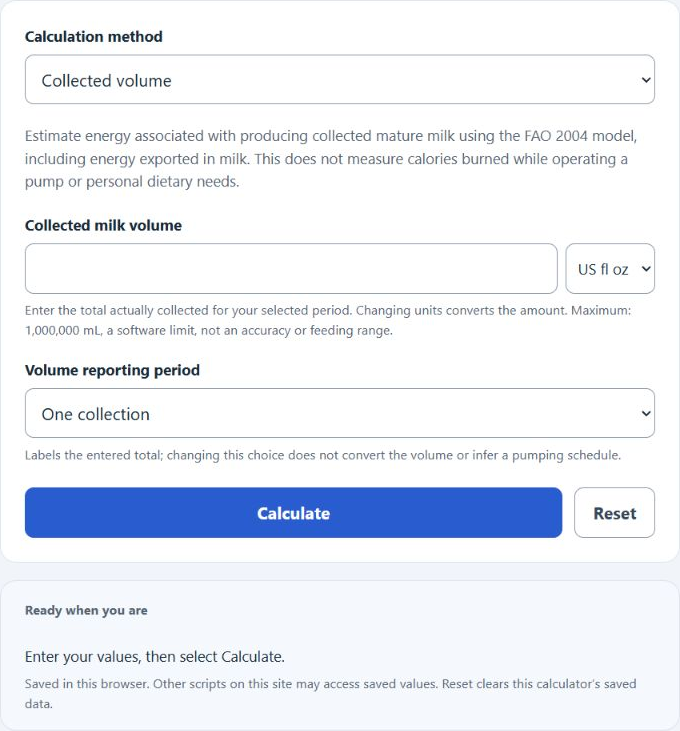
Estimate the milk-production energy attributable to collected milk using the FAO/WHO/UNU 2004 model. Enter a collection, day, or week volume in US fl oz or mL, or use average collected volume per session and whole sessions per day. This includes energy exported in milk; it does not measure the physical action of pumping, personal dietary needs, weight loss, or total lactation when other milk is not recorded.
Related Calculators
- Calories Burned Washing Dishes Calculator
- Calories Burned Massage Calculator
- EER Calculator (Estimated Energy Requirement Calculator)
- Weight Loss Percentage Calculator
- All Health and Medical Calculators
Milk Production Energy Formula
- E: estimated milk-production energy (FAO model), in kilocalories (kcal), including energy exported in the milk
- V: collected milk volume in mL; 1 US fl oz = 29.5735295625 mL
- 0.862625 kcal/mL: 1.03 g/mL approximate milk density × 0.67 kcal/g mean gross milk energy ÷ 0.80 assumed energy-conversion efficiency
For daily estimates from sessions, multiply average collected volume per session by whole sessions per day (1–30), then apply the formula. The FAO/WHO/UNU 2004 reference uses mean milk energy and an assumed 80% conversion efficiency; IOM milk-volume guidance supplies the approximate density. These are population assumptions, not measurements of your milk or metabolism. The milk-energy reference covers samples from 1–24 months of lactation; it is not a first-week colostrum estimate. A collection reports energy attributable to that milk, not energy used at the time it was pumped. Uncollected or directly nursed milk is omitted, and collecting no milk does not mean lactation has no energy cost.
Reference Values
The table separates estimated gross energy contained in milk from the FAO model estimate of energy required to produce it. Values use the same fixed assumptions and are rounded to two decimals; they are illustrative quantities, not recommended output or individual measurements.
| Milk Pumped | mL | Milk gross energy (kcal) | FAO production estimate (kcal) |
|---|---|---|---|
| 2 US fl oz | 59.15 | 40.82 | 51.02 |
| 4 US fl oz | 118.29 | 81.63 | 102.04 |
| 6 US fl oz | 177.44 | 122.45 | 153.07 |
| 8 US fl oz | 236.59 | 163.27 | 204.09 |
| 25 US fl oz | 739.34 | 510.22 | 637.77 |
| 32 US fl oz | 946.35 | 653.08 | 816.35 |
Illustrative reporting bases for the same model; these are not lactation-stage, supply, or feeding targets:
| Reporting basis | Illustrative collected volume | FAO production estimate (kcal) |
|---|---|---|
| One collection | 5 US fl oz | 127.55 for that milk |
| One day | 30 US fl oz/day | 765.33/day |
| One week | 210 US fl oz/week | 5,357.28/week |
| Daily from sessions | 5 US fl oz/session × 6 sessions/day | 765.33/day |
Example and FAQ
Example: A collection of 5 US fl oz is 147.8676478125 mL. The FAO model gives 147.8676478125 × 1.03 × 0.67 ÷ 0.80 ≈ 127.55 kcal of milk-production energy attributable to that milk. If your average collected volume is 5 US fl oz across 6 sessions per day, 30 US fl oz/day gives approximately 765.33 kcal/day. This is a milk-production estimate, not measured pumping exercise energy or a dietary target.
Does pumping burn the same as nursing? This model estimates energy attributable to producing a recorded milk amount, regardless of how it is collected or fed. It does not compare the physical effort of pumping and nursing or measure total lactation energy. Milk directly nursed or otherwise not recorded is outside the entered estimate.
Should I eat back these calories? Do not use this result to set food intake or a weight-loss plan. CDC guidance recommends an additional 330–400 kcal/day for well-nourished breastfeeding mothers compared with their intake before pregnancy, with individual needs affected by age, body mass index, activity, and feeding pattern. That guidance is not a per-ounce rule. The 2023 Dietary Reference Intakes use a different energy-requirement method based on milk energy output, total energy expenditure, and tissue mobilization; they do not apply this calculator’s 80% efficiency divisor. Seek individual advice from your health care professional.
Why is there no likely range? The source assumptions produce one reference estimate, not an individual confidence interval. Milk composition and production efficiency vary, and the source does not establish a likely range for an individual. The model is also not suitable for measuring the calories in a particular infant feed.
Does pump time matter? Pump time is not an input to this volume-based production model. Equal collected amounts receive equal model estimates, but that does not establish equal actual energy expenditure or assign milk synthesis to the pumping interval. For a day volume, the calculator can show a seven-day estimate if the same volume is collected daily; for a week volume, it can show the daily average. A single collection does not invent additional sessions.