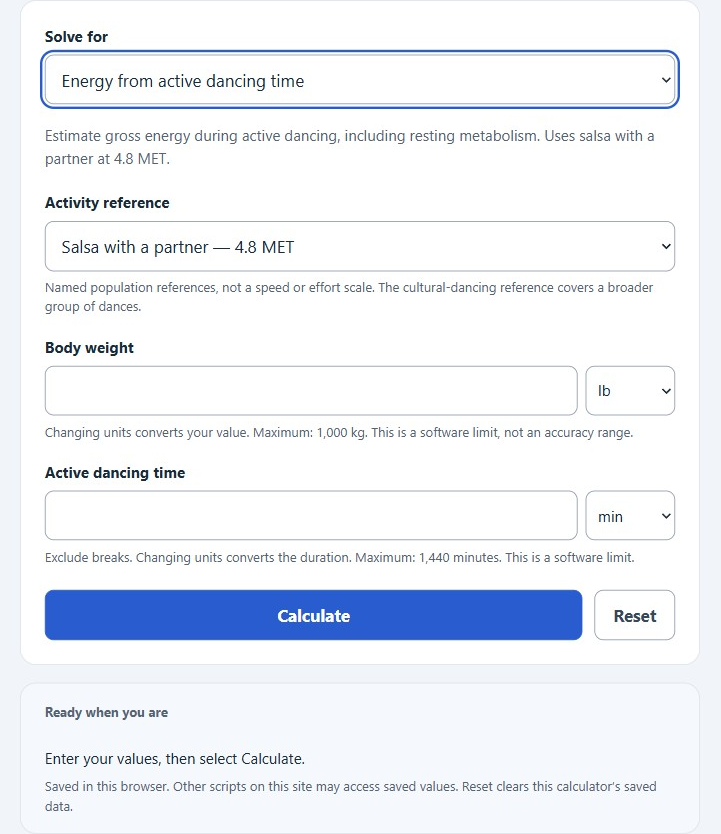
Estimate calories used during active salsa dancing by body weight, time, and activity reference, or estimate active dancing within a session and time for a calorie goal.
Calories Burned Salsa Dancing Formula
- MET: activity reference from the 2024 Adult Compendium: partner salsa 4.8, Afro-Cuban salsa 6.0, salsa to a video 6.3, or broad ethnic/cultural dancing including salsa 4.5. These are named activities, not a slow-to-fast pace scale.
- weight(kg): body weight in kilograms (lb × 0.45359237)
- minutes: time spent actively dancing
For a class or social night, multiply total time by your estimated active dancing percentage divided by 100 before using the formula. The starting 60% is a planning assumption you can change, not a typical share for any session type. Break-period energy is excluded. To find active time for a calorie goal, divide the goal by Calories per minute (MET × 3.5 × weight in kg ÷ 200).
MET values come from the 2024 Adult Compendium of Physical Activities for ages 19–59. The formula estimates gross energy during active dancing, including resting energy. Actual energy use varies with effort and individual characteristics; this is not a precise personal measurement.
Typical Burn Rates and Activity References
Estimated Calories per 30 active minutes for three named salsa references, using the listed pound weights before rounding (kg labels are approximate):
| Body weight | Partner salsa (4.8 MET) | Afro-Cuban salsa (6.0 MET) | Salsa to a video (6.3 MET) |
|---|---|---|---|
| 120 lb (54 kg) | 137 | 171 | 180 |
| 150 lb (68 kg) | 171 | 214 | 225 |
| 180 lb (82 kg) | 206 | 257 | 270 |
| 210 lb (95 kg) | 240 | 300 | 315 |
| 240 lb (109 kg) | 274 | 343 | 360 |
Choose the activity reference that best matches your dancing:
| Activity reference | Source activity |
|---|---|
| Partner salsa | Salsa dancing with a partner, 4.8 MET (03090) |
| Afro-Cuban salsa | Afro-Cuban salsa and associated Cuban dance steps, 6.0 MET (03005) |
| Salsa to a video | Salsa dancing to a video, 6.3 MET (03091) |
Example
For a 160 lb dancer using the partner-salsa reference during a 90-minute social, assume 60% active dancing:
- Weight: 160 × 0.45359237 ≈ 72.6 kg (calculate before rounding)
- Active time: 90 × 0.60 = 54 minutes
- Calories = 4.8 × 3.5 × (160 × 0.45359237) ÷ 200 × 54 ≈ 329 Calories during active dancing; energy during the other 36 minutes is excluded.
FAQ
Does leading or following burn more? This calculator uses the same partner-salsa reference for leading and following. It does not estimate a role-specific difference.
Should I subtract resting calories? The displayed estimate is gross energy during active dancing, including resting energy. It is not additional exercise calories, and this calculator does not subtract resting calories.
Why is my fitness tracker different? A tracker and this calculator can use different methods and assumptions. This calculator uses a standard activity reference and your entered weight and time; it is not a precise measurement or a guaranteed lower estimate.