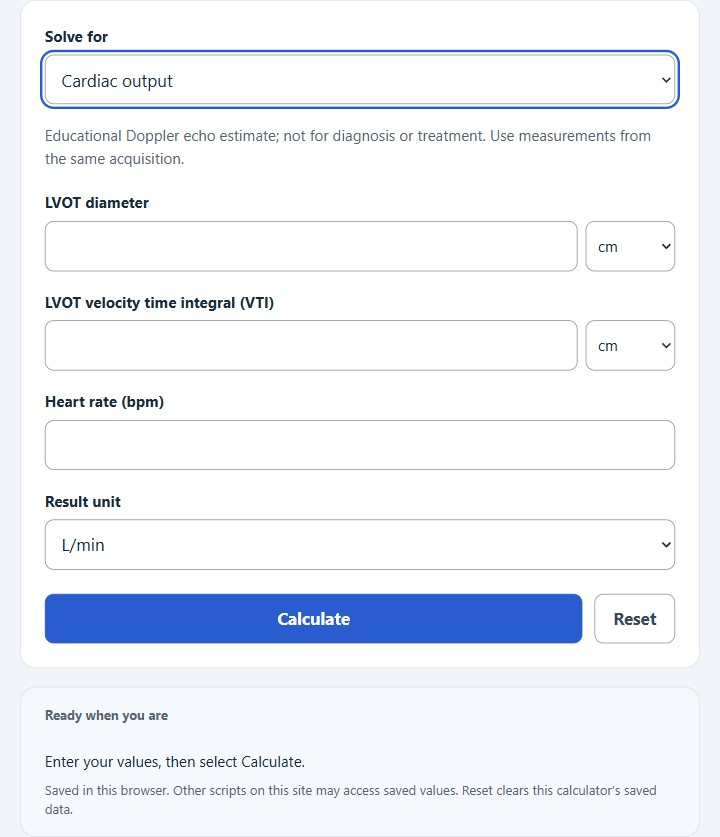
Select cardiac output, LVOT diameter, VTI, or heart rate, then enter the three known echo values. Choose the relevant input and result units: cm, mm, in, bpm, mL/sec, mL/min, or L/min.
Educational use only (not medical advice): This tool provides an estimate of cardiac output from Doppler echo measurements and must be interpreted by a qualified clinician. Intended for clinicians/trainees familiar with Doppler echo acquisition. Results depend heavily on measurement technique (e.g., LVOT assumed circular, LVOTD measurement variability, Doppler alignment). Do not use this tool to make diagnosis or treatment decisions. If you have chest pain, shortness of breath, fainting, or other emergency symptoms, seek emergency care.
Measurement notes
In typical practice, LVOT diameter is measured inner-edge to inner-edge in mid-systole (parasternal long-axis), and LVOT VTI is traced with pulsed-wave Doppler just proximal to the aortic valve with careful Doppler alignment. For detailed acquisition guidance and limitations, consult professional echocardiography guideline documents (for example, American Society of Echocardiography guidance).
Related Calculators
- ESV Calculator
- Effective Orifice Area Calculator
- DO2 Calculator
- Central Venous Pressure Calculator
- All Health and Medical Calculators
Cardiac Output Echo Formula
The cardiac output echo calculation uses LVOT diameter, LVOT VTI, and heart rate to estimate flow through the left ventricular outflow tract. The calculator uses centimeters, beats per minute, and liters per minute as its base units.
Select the value to solve for. The calculator rearranges the same equation using the three known values:
- CO = cardiac output, in L/min
- SV = stroke volume, in mL/beat
- LVOTD = left ventricular outflow tract diameter, in cm
- LVOT Area = cross-sectional area of the LVOT, in cm²
- VTI = velocity time integral, in cm
- HR = heart rate, in beats per minute
- pi = 3.14159…
To calculate cardiac output, the calculator first finds LVOT area from the LVOT diameter, then multiplies that area by VTI to get stroke volume. Stroke volume is then multiplied by heart rate and divided by 1000 to convert mL/min to L/min.
To solve for LVOT diameter, VTI, or heart rate, the calculator works backward from the same cardiac output relationship. Select the value you want to solve for and enter the three displayed known values.
Echo Input Checks and Unit Conversions
These are broad input-review flags retained from this tool, not validated normal ranges, diagnostic cutoffs, or calculation limits. Measurements require clinician interpretation.
| Measurement | Tool input-review interval | Base unit used in formula |
|---|---|---|
| LVOT diameter | About 1.5 to 3.0 cm | cm |
| LVOT VTI | About 5 to 40 cm | cm |
| Heart rate | About 30 to 220 bpm | bpm |
| Cardiac output | About 2 to 12 L/min | L/min |
| Input or output | Conversion to base unit | Example |
|---|---|---|
| LVOT diameter in mm | cm = mm × 0.1 | 20 mm = 2.0 cm |
| LVOT diameter in inches | cm = inches × 2.54 | 0.79 in = about 2.01 cm |
| VTI in mm | cm = mm × 0.1 | 200 mm = 20 cm |
| Cardiac output in mL/min | L/min = mL/min ÷ 1000 | 5000 mL/min = 5 L/min |
| Cardiac output in mL/sec | L/min = mL/sec × 0.06 | 83.33 mL/sec = about 5 L/min |
Example Calculations
Example 1: Calculate cardiac output
Suppose you enter:
- LVOT diameter = 2.0 cm
- VTI = 20 cm
- Heart rate = 70 bpm
First calculate LVOT area:
Then calculate stroke volume:
Then calculate cardiac output:
The result is about 4.40 L/min.
Example 2: Calculate VTI
Suppose you enter:
- LVOT diameter = 2.0 cm
- Heart rate = 75 bpm
- Cardiac output = 5.0 L/min
LVOT area is:
Stroke volume from cardiac output and heart rate is:
Now solve for VTI:
The result is about 21.22 cm.
FAQ
Why does LVOT diameter have such a large effect on cardiac output?
LVOT diameter is squared in the area formula. A small measurement difference in LVOT diameter can produce a larger difference in LVOT area, stroke volume, and cardiac output. For example, changing LVOT diameter from 2.0 cm to 2.1 cm increases the calculated area by more than 10 percent.
What units should you use for LVOT diameter and VTI?
The formula uses centimeters for both LVOT diameter and VTI. If you enter millimeters or inches, the calculator converts them to centimeters before calculating. Make sure the selected unit matches the value you typed, since entering 20 as cm instead of mm would make the measurement 10 times larger than intended.
Is cardiac output from echo the same as invasive cardiac output?
No. Echo-derived cardiac output is an estimate based on LVOT diameter, Doppler VTI, and heart rate. It can differ from invasive measurements because of image quality, Doppler alignment, LVOT measurement technique, rhythm irregularity, and timing of the measurement.