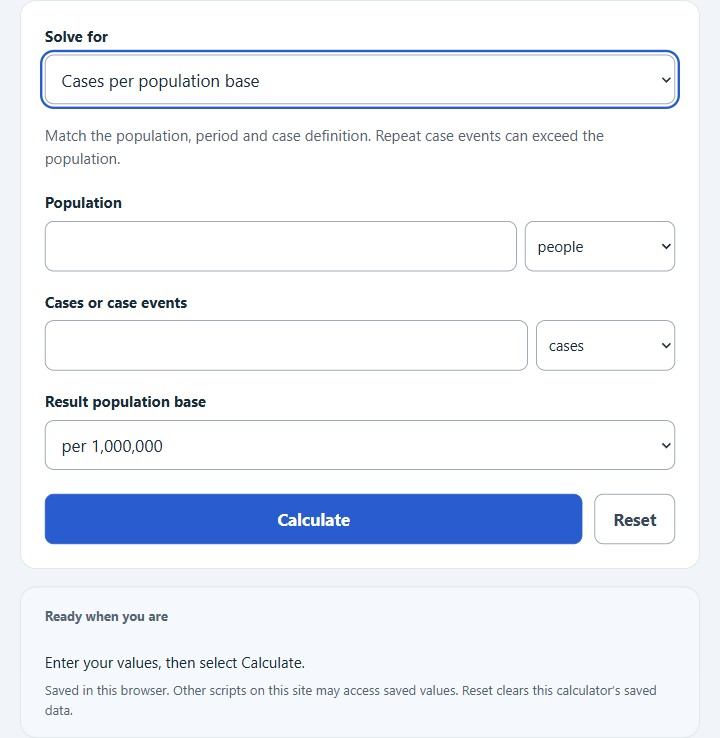
Calculate cases per million from population and case counts, find missing population, cases, or rate, convert bases, and estimate period incidence.
Important: This calculator is for informational and statistical use only (not medical advice and not a personal risk assessment). Make sure your numerator (cases) and denominator (population) refer to the same place and time period and use consistent definitions (e.g., confirmed vs. probable; unique people vs. events). If cases include repeat events or cumulative totals across time, “Cases as % of population” can exceed 100% and should not be interpreted as unique people affected. “Annualized” is a simple extrapolation of the average daily rate to 365 days and may not reflect seasonality, outbreaks, testing changes, or reporting delays. For official definitions and surveillance data, consult the CDC, WHO, or your local health department.
- All Health and Medical Calculators
- Complaints Per Million Calculator
- DPMO Calculator (Defects Per Million Opportunities)
Cases Per Million Formula
Formula source: Basic Epidemiology, 2nd Edition (2006), World Health Organization
Variables:
- CPM is the Cases Per Million (cases per 1,000,000 people)
- C is the total number of cases
- P is the total population
What Cases Per Million Actually Measures
Cases per million is a population-normalized rate that converts raw case counts into a standardized unit, making populations of vastly different sizes directly comparable. A city of 500,000 and a country of 500 million cannot be fairly compared using raw numbers; cases per million eliminates that distortion by expressing burden relative to a fixed reference population of one million people.
The formula is a case-to-population ratio scaled to a chosen base. New cases over a defined period give a period case frequency; existing cases at a snapshot give prevalence. Incidence density requires a person-time denominator, which this calculator does not collect. Cumulative incidence as a risk also requires an appropriate disease-free population and unique-person case definition. The period mode reports the observed frequency and a daily average; optional annualization extrapolates that average to 365 days. One model month is 365/12 days, consistent with the model year.
Why the Choice of Rate Base Matters
Epidemiologists and public health agencies do not use a single universal denominator. The choice of per 100,000 versus per million versus per 100 million is driven by the expected magnitude of the phenomenon being tracked, and that convention has direct consequences for how numbers are read.
| Disease / Context | Standard Rate Base | Why That Base |
|---|---|---|
| Tuberculosis (global) | Per 100,000 | Common chronic infectious disease; 100K produces readable whole numbers in most countries |
| COVID-19 (pandemic comparisons) | Per 1,000,000 | High absolute numbers globally; per million keeps figures below 100,000 for most countries |
| Heart failure incidence | Per 1,000 | Published estimates vary by population and case definition; the base is a reporting convention |
| Primary malignant cardiac tumors | Per 100,000,000 | A large base can make rare-event figures easier to read; verify the original study and period |
| Manufacturing defects (DPMO) | Per 1,000,000 opportunities | Six Sigma convention; expresses near-zero defect rates on a human-readable scale |
A rate reported per million does not imply the disease is rare, nor does per 1,000 imply it is common. The base is chosen so that the resulting number has practical meaning: a two-digit or three-digit value is easier to compare than 0.000034 or 3,400,000. Always confirm which base a source uses before comparing figures across reports.
Reference Thresholds Used by Public Health Agencies
The following historical benchmarks illustrate rate bases and their program-specific meanings. They are not current clinical or reopening instructions. WHO TB frameworks distinguish global targets from low-incidence-country pre-elimination and elimination goals. The CDC examples below describe its 2021 community-transmission framework, which also considered test positivity.
| Agency / Program | Threshold | Meaning |
|---|---|---|
| WHO End TB Strategy | <100 TB cases per million per year | Target for “end of the TB epidemic” by 2035 |
| WHO End TB Strategy | <10 TB cases per million per year | “Pre-elimination” status |
| WHO End TB Strategy | <1 TB case per million per year | “Elimination as a public health problem” |
| CDC community transmission (2021; historical) | 10 to 49.99 new cases per 100,000 over 7 days | Moderate case-frequency category; test positivity also contributed |
| CDC community transmission (2021; historical) | 0 to 9.99 new cases per 100,000 over 7 days | Low case-frequency category; test positivity also contributed |
Limitations and Common Misreadings
Cases per million is only as reliable as the data feeding it. Several systematic factors can distort the figure even when the arithmetic is correct.
Testing intensity: A jurisdiction running 10,000 tests per day will detect more cases than one running 1,000 tests, even if true disease burden is identical. During COVID-19, researchers found that for some low-income countries the ratio of total estimated infections to confirmed reported cases exceeded 100:1, meaning a cases-per-million figure could be 100 times lower than the actual infection rate.
Case definition changes: The WHO issued updated COVID-19 case definitions in 2022, shifting the boundary between suspected, probable, and confirmed cases. A country that adopted new definitions mid-surveillance will show apparent trend breaks that are definitional rather than epidemiological.
Population denominator quality: Cases per million uses total population as its base. If the denominator comes from an outdated census or excludes undocumented residents, the rate shifts artificially. Populations with large transient or seasonal components (tourist destinations, border regions) are particularly susceptible to denominator error.
Numerator scope mismatch: Cumulative counts generally increase as cases accrue, but reporting corrections can revise them downward. Regions with different observation windows cannot be compared fairly from cumulative totals alone. Period-specific case frequency is more informative about recent reported burden, while testing, delays and population differences still affect interpretation.
Population heterogeneity: Cases per million collapses the entire population into a single number. Age structure, immunity levels, urban density, and household size all vary within a population and profoundly affect transmission risk. A country with 40% of its population over 65 faces a structurally different risk profile than one with 40% under 15, even at identical cases-per-million figures.
Incidence vs. Prevalence: A Critical Distinction
Cases per million most commonly expresses incidence, not prevalence, though both can technically use the same formula. Incidence counts new cases arising in a defined time window among people who were disease-free at the start. Prevalence counts all existing cases at a single point in time, regardless of when they developed.
A disease can have a much larger prevalence than annual incidence because people diagnosed in earlier years remain prevalent cases. Estimates vary with age, population, case definitions and period. Using a prevalence figure where new-case incidence is intended, or vice versa, confuses how many people are affected with how many new cases arise.
FAQ
What is cases per million used for beyond infectious disease?
Cases per million is used in manufacturing quality control (defects per million opportunities in Six Sigma), customer experience measurement (complaints per million units sold), pharmacovigilance (adverse events per million doses administered), and environmental epidemiology (cancer cases per million attributable to a specific exposure). The math is identical across all these fields; only the definition of a “case” and the relevant population change.
Can cases per million exceed 1,000,000?
Yes. If the numerator counts events rather than unique people, or if cumulative events span many years while the denominator is the current population, the rate can theoretically exceed 1,000,000. This happens in vaccination adverse event tracking (where one person may report multiple events) or when mapping cumulative multi-year case totals against a static population count. A rate above 1,000,000 does not indicate an error; it indicates that on average each person in the population experienced more than one event over the measured period.
Why does the WHO use different bases for different diseases?
The WHO and other agencies choose a rate base that produces numerically convenient, communicable values for their specific disease context. TB is reported per 100,000 because that yields readable two- to four-digit figures for most high-burden countries. COVID-19 comparisons used per million because pandemic-scale transmission pushed per-100,000 figures into unwieldy five-digit territory. Rare cancers may use per 100 million. The base is a presentation choice, not a statement about disease severity.
How can inaccuracies in population data affect the result?
Population estimates come from censuses, surveys, and modeled projections, all of which carry uncertainty. A 5% overcount in the denominator produces a ~5% underestimate of the true rate, and vice versa. In rapidly growing or shrinking populations, using a midyear estimate rather than a start-of-year or end-of-year figure reduces this error. For local or subnational calculations, small-area population estimates carry much larger relative uncertainty than national figures.
How does cases per million compare to case fatality rate (CFR)?
Cases per million measures the frequency of disease in a population. Case fatality rate (CFR) measures the proportion of detected cases that result in death, expressed as deaths divided by confirmed cases. The two metrics answer different questions: cases per million tells you how widespread the disease is; CFR tells you how lethal it is among those who are diagnosed. A disease with very high cases per million but low CFR (e.g., common cold) differs fundamentally from one with low cases per million but high CFR (e.g., Ebola in most outbreaks).