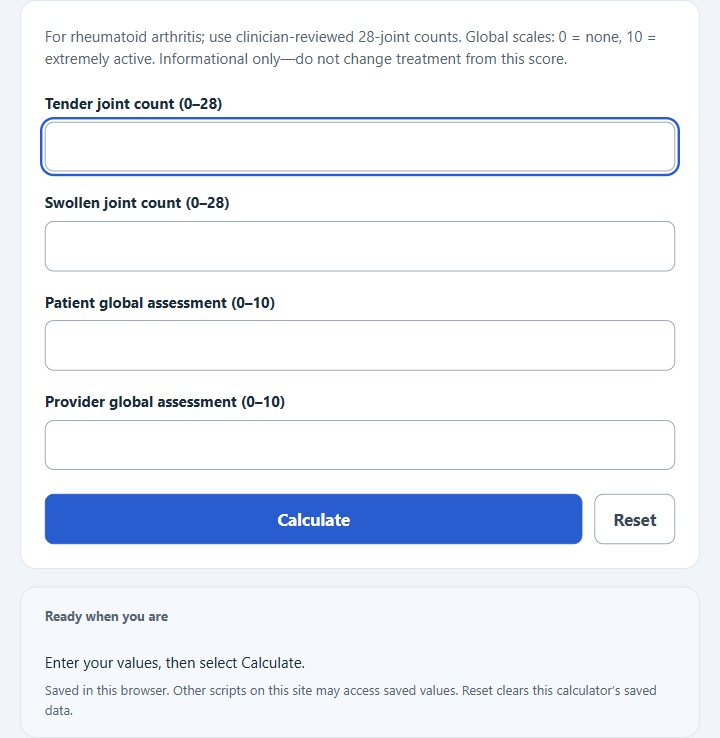
Calculate the Clinical Disease Activity Index (CDAI) from tender and swollen joint counts plus patient and physician global assessments.
Medical disclaimer: This calculator is for informational/educational purposes only and does not provide medical advice or a diagnosis. CDAI scoring and interpretation (including joint counts) should be performed and reviewed by a qualified healthcare professional (such as a rheumatologist). Do not start/stop/change medications based on this result; seek medical care promptly for severe or worsening symptoms.
- Health Calculators
- SLE Calculator
- HOMA Index Calculator
- ABI Calculator
- Cardiac Index Calculator
- Atherogenic Index Calculator
CDAI Formula
The Clinical Disease Activity Index, or CDAI, is calculated by adding the tender joint count, swollen joint count, patient global assessment, and provider global assessment.
- CDAI = Clinical Disease Activity Index, with a possible range of 0 to 76
- TJC28 = Tender Joint Count based on 28 joints, from 0 to 28
- SJC28 = Swollen Joint Count based on 28 joints, from 0 to 28
- PtGA = Patient Global Assessment of disease activity, from 0 to 10
- PrGA = Provider or Physician Global Assessment of disease activity, from 0 to 10
The calculator checks that the joint counts are whole numbers from 0 to 28 and that both global assessments are between 0 and 10. It then adds the four values, preserving entered decimal precision, and shows the corresponding activity band using the unrounded sum.
CDAI Score Interpretation
CDAI scores are commonly grouped into disease activity categories. Lower scores indicate less rheumatoid arthritis disease activity.
| CDAI Score | Disease Activity Category |
|---|---|
| 0 to 2.8 | Remission |
| More than 2.8 to 10 | Low disease activity |
| More than 10 to 22 | Moderate disease activity |
| More than 22 to 76 | High disease activity |
CDAI Input Ranges
| Input | Allowed Range | How It Is Used |
|---|---|---|
| TJC28 | 0 to 28, whole numbers only | Adds the number of tender joints to the score |
| SJC28 | 0 to 28, whole numbers only | Adds the number of swollen joints to the score |
| PtGA | 0 to 10 | Adds the patient-rated disease activity score |
| PrGA | 0 to 10 | Adds the provider-rated disease activity score |
Example CDAI Calculations
Example 1
You enter these values:
- TJC28 = 3
- SJC28 = 2
- PtGA = 4.0
- PrGA = 3.0
The CDAI score is 12.0, which falls in the moderate disease activity range.
Example 2
You enter these values:
- TJC28 = 1
- SJC28 = 0
- PtGA = 1.2
- PrGA = 1.0
The CDAI score is 3.2, which falls in the low disease activity range.
CDAI Calculator FAQ
What is a good CDAI score?
A CDAI score of 2.8 or lower is generally classified as remission. A score above 2.8 and up to 10 is usually considered low disease activity. The meaning of a score should be interpreted in context with symptoms, physical examination, treatment history, and clinical judgment.
Does CDAI require a blood test?
No. CDAI does not include inflammatory markers such as CRP or ESR. It uses only the tender joint count, swollen joint count, patient global assessment, and provider global assessment. This makes it different from scores that require lab results.
Why is the maximum CDAI score 76?
The maximum comes from adding the highest possible value for each input: TJC28 of 28, SJC28 of 28, PtGA of 10, and PrGA of 10. The total is 76.