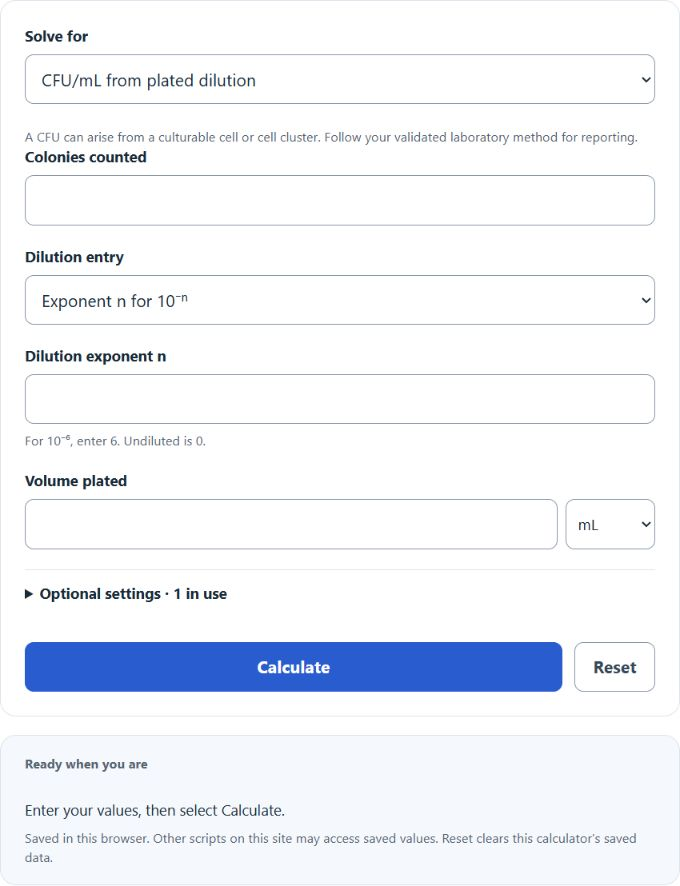
Calculate CFU/mL from colony counts, plated dilution, and volume, or build serial dilution steps with count-range guidance, log10 results, and detection limits.
Related Calculators
- Transformation Efficiency Calculator
- Percent Viability Calculator
- ng/uL Dilution Calculator
- Abbott Formula Calculator
- All Biology Calculators
CFU/mL Formula
The calculator uses one of two formulas depending on the mode you select.
Plate count mode:
- N = number of colonies counted on the plate
- V = volume plated, in mL
- D = dilution plated, expressed as a decimal (e.g., 10^-6 = 0.000001)
Serial dilution mode: the calculator first builds the final dilution from the per-step transfer and diluent volumes.
- V_t = sample volume transferred at each step
- V_d = diluent volume added at each step
- n = number of serial transfers
- N, V = colonies counted and volume plated, as above
A CFU can arise from one culturable cell or a cell cluster. Serial mode assumes identical transfer and diluent volumes at every step. Countability limits depend on the validated method; the selected guide is not a product-safety assessment.
Reference Tables
Use these to sanity check your inputs and your result.
| Colony count on plate | Interpretation |
|---|---|
| 0 | No colonies detected; follow the method’s reporting limit. This does not establish sterility. |
| 1–29 | Low count; interpretation depends on the method (current FDA BAM includes 15–300). |
| 30–300 | USDA/AOAC guide, not universal. Apply your validated method. |
| > 300 | Check the method’s upper limit; TNTC is not a numeric input. |
There is no universal CFU/mL acceptance range for these sample types. Potability and food safety require the appropriate organism-specific tests, culture conditions and applicable laboratory or regulatory method.
Worked Example
You count 154 colonies on a plate. You plated 0.1 mL of a 10^-6 dilution.
- Reciprocal dilution = 10^6 = 1,000,000
- CFU/mL = 154 × 1,000,000 ÷ 0.1 = 1.54 × 10^9 CFU/mL
FAQ
What is a CFU? A colony forming unit is one viable cell or cluster of cells that grows into a single visible colony on agar. It is a count of culturable cells, not total cells.
Which countability range applies? Current FDA BAM pour-plate guidance is 15–300, while USDA/AOAC uses 30–300 and APHA uses 25–250. Use your validated method; low counts carry greater relative uncertainty and crowding can impair counting.
What if I plated more than one volume? Do not take an unweighted mean when plates represent different original-sample volumes. Follow the validated method’s exposure-weighted calculation and handling of TNTC. This calculator estimates one plate at a time.
How do I enter a 10-fold serial dilution? In serial mode, set the transferred volume to 1 mL and the diluent volume to 9 mL. Each step then equals a 1:10 dilution.