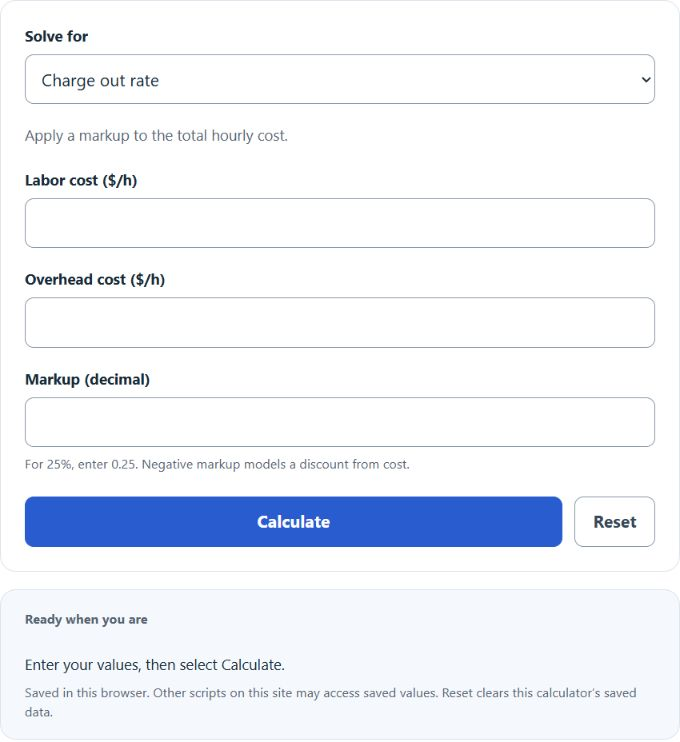
Choose charge out rate, labor cost, overhead, or markup, then enter the three known values using the same billable-hour basis.
- All Business Calculators
- Predetermined Overhead Rate Calculator
- Fully Burdened Labor Rate Calculator
- Loaded Labor Rate Calculator
- Bill Rate Calculator
- Cost Per Hour Calculator
Charge Out Rate Formula
The charge out rate is the hourly rate you bill for work. It is based on the direct labor cost, overhead cost, and profit markup.
The calculator can also rearrange the same formula to solve for any missing value:
- Charge Out Rate is the hourly billing rate charged to the customer.
- Labor is the direct cost of labor per hour, usually wages plus direct employment costs.
- Overhead is the indirect business cost allocated to each billable hour.
- Profit is the markup entered as a decimal. For example, 25% is entered as 0.25.
Select the value to solve for, enter the three known values, and select Calculate. The calculator uses the same formula for all four modes. Costs and price must be nonnegative. Negative markup down to −1 models a discount from cost; singular or inconsistent inverse cases are explained rather than reported as valid results.
Common Profit Markup Decimal Conversions
Use decimal markup values in the profit field. A markup is based on cost, not on the final selling price.
| Profit Markup | Enter as Decimal | Multiplier |
|---|---|---|
| 10% | 0.10 | 1.10 |
| 20% | 0.20 | 1.20 |
| 25% | 0.25 | 1.25 |
| 30% | 0.30 | 1.30 |
| 50% | 0.50 | 1.50 |
Typical Inputs for a Charge Out Rate
| Input | What to Include | Example per Hour |
|---|---|---|
| Labor | Wages, payroll taxes, benefits, direct employee costs | $35 |
| Overhead | Rent, software, admin time, insurance, equipment, utilities | $20 |
| Profit markup | Desired markup on total hourly cost | 0.30 |
Example
Example 1: Calculate the charge out rate
You have a labor cost of $40 per hour, overhead of $25 per hour, and a profit markup of 0.30.
The charge out rate is $84.50 per hour.
Example 2: Calculate the profit markup
You charge $90 per hour. Your labor cost is $45 per hour and your overhead is $15 per hour.
The profit markup is 0.50, or 50%.
FAQ
What is a charge out rate?
A charge out rate is the hourly rate charged to a customer for work performed. It should cover the direct labor cost, a share of overhead costs, and the profit markup you want to earn.
What is the difference between markup and margin?
Markup is based on cost. Margin is based on the final selling price. This calculator uses markup. For example, if your total hourly cost is $100 and you apply a 25% markup, the charge out rate is $125. The profit margin on that $125 rate is 20%, not 25%.
How should you estimate overhead per hour?
Add the indirect costs needed to run the business, then divide them by expected billable hours. Overhead can include rent, insurance, software, administration, equipment, utilities, and non-billable support time.