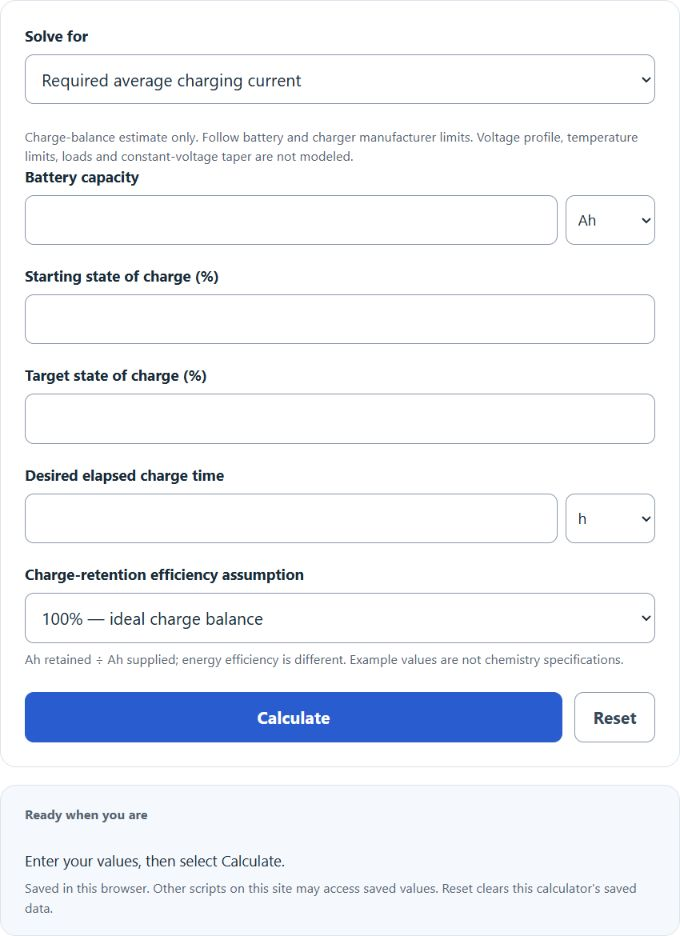
Estimate average battery-side charging current or charge-balance time, or convert a C-rate to current. Use manufacturer-approved charging settings; this model does not determine a safe charging schedule.
Related Calculators
- F to nF Conversion Calculator
- Farads To Amp Hours Calculator
- Joules To kW Calculator
- Volts To Megawatts Calculator
- All Unit Converters
Charging Current Formula
The calculator uses three related formulas, one for each mode.
Required charger current (how many amps you need to reach a target charge in a set time):
Charge time (how long a given charger will take):
C-rate current (the current that corresponds to a stated C rating):
- I = charging current in amps (A)
- C = battery capacity in amp-hours (Ah)
- SoC_start = current state of charge (%)
- SoC_target = target state of charge (%)
- t = charge time in hours
- eff = charge-retention efficiency as a decimal (for example an assumed 0.95); this is not energy efficiency
- C_rate = the rate in inverse hours; 1C means amperes numerically equal to rated amp-hours, without guaranteeing a one-hour full charge
A few assumptions sit behind these numbers. The formulas treat the charge as a constant-current process and ignore the constant-voltage taper that lithium and lead-acid chargers use near the top of charge. Actual time can differ substantially. The efficiency term represents retained amp-hours divided by supplied amp-hours, not heat or wall-plug energy losses. Heating is a reason to follow manufacturer limits and assess conditions, not merely lower a calculator assumption.
Each mode of the calculator solves the same balance for a different unknown. The "Required current" mode rearranges for I when you fix the time. The "Charge time" mode rearranges for t when you fix the charger output. The "C-rate" mode skips state of charge entirely and just multiplies capacity by the C rating to give the current at that rate.
Reference Tables
The source table below is retained as unverified illustrative assumptions, not measured charge-retention efficiencies or safe charge-rate specifications. Default calculator efficiency is now the explicit ideal 100% assumption; use battery-specific data when modeling losses.
| Battery type | Illustrative source value | Illustrative source rate |
|---|---|---|
| Lithium-ion / LiPo | 90 to 95% | 0.5C to 1C |
| LiFePO4 | 95 to 98% | 0.5C to 1C |
| Flooded lead-acid | 80 to 85% | 0.1C to 0.3C |
| AGM / Gel | 80 to 85% | 0.1C to 0.3C |
| NiCd / NiMH | 65 to 75% | 0.1C to 1C |
The next table shows what a given C rate means in plain terms.
| C rate | Ideal reciprocal-rate time | Notes |
|---|---|---|
| 0.1C | 10 hours | Not a universal trickle-charge recommendation |
| 0.5C | 2 hours | Suitability depends on the battery |
| 1C | 1 hour | Requires a compatible rated battery/charger |
| 2C | 30 minutes | Only if rated for it |
| 3C+ | 20 minutes or less | Only within manufacturer-approved limits |
Worked Examples
Example 1: Sizing a charger. You have a 100 Ah lead-acid battery at 50% charge and want it full in 8 hours. Assumed charge-retention efficiency is 85%.
Capacity to add = 100 × (100 − 50) / 100 = 50 Ah. Required current = 50 / (8 × 0.85) = 7.35 A. This is an arithmetic average-current estimate; it does not select a safe charger or guarantee full charge in eight hours.
Example 2: How long will it take? A 2500 mAh lithium-ion cell is empty. Average battery-side current is assumed to be 1 A and charge retention 95%.
Capacity = 2.5 Ah. Effective current = 1 × 0.95 = 0.95 A. Time = 2.5 / 0.95 = 2.63 hours, or about 2 hours 38 minutes for the constant-current portion.
Example 3: Reading a C rating. A 2000 mAh pack is rated for charging at 2C.
Current = 2 Ah × 2 = 4 A. The ideal reciprocal-rate time is 30 minutes; taper, losses and manufacturer limits still apply.
FAQ
Why is the real charge time longer than the calculator says? Charging profiles vary. Many lithium chargers transition from constant current to constant voltage and taper current. This model is a constant-average-current charge balance; no universal top-off duration can be added. Use the battery and charger specifications.
Can I charge faster than 1C? Only if the battery is rated for it. Check the datasheet for the maximum charge current. Pushing past it shortens cycle life and can cause overheating.
What efficiency should I use if I do not know it? Use measured battery-specific charge-retention data, or select the explicitly ideal 100% case to examine a lossless balance. The retained source examples are not verified chemistry recommendations and do not model heat losses.
Does the charger voltage matter? The Ah balance does not directly use voltage, but correct charging voltage and profile are essential for compatibility and safety. Charger power/voltage capability, battery/BMS limits and concurrent loads affect the current actually available.