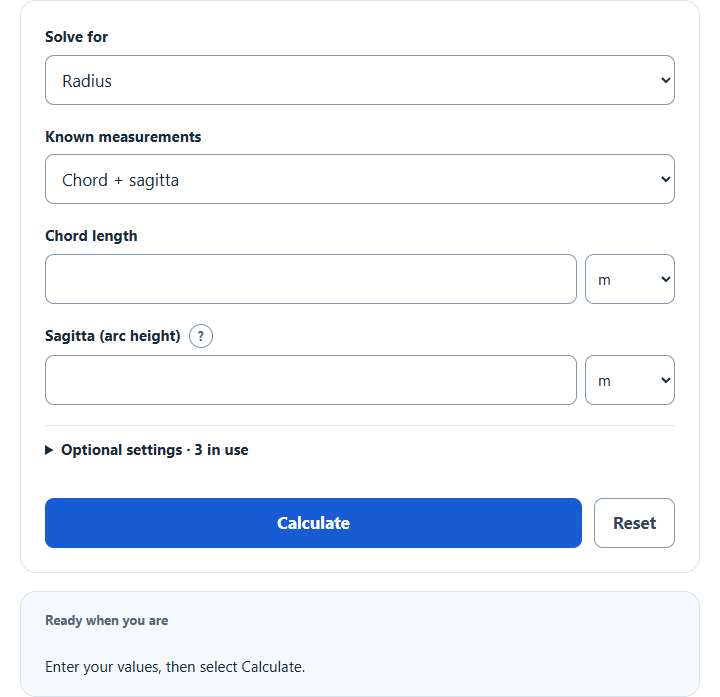
Calculate the radius of a circle from chord length and arc height (sagitta), and solve for chord, sagitta, central angle, or arc length in any unit.
- All Math and Numbers Calculators
- Top Chord Length Calculator
- Circle Length Calculator
- Arc Length Calculator
Calculator Functions
| Function | What it does | What it requires |
|---|---|---|
| Radius | Finds the radius of the circle that a circular arc belongs to | Requires the chord length and sagitta, or one of three other pairs: chord and central angle, sagitta and central angle, chord and arc length |
| Chord length | Finds the straight-line distance between the two ends of the arc | Requires the radius and sagitta, or the radius and central angle, sagitta and central angle, or radius and arc length |
| Sagitta (arc height) | Finds the height of the arc above the midpoint of its chord | Requires the radius and chord, or one of four other pairs of radius, chord, central angle and arc length |
| Central angle | Finds the angle the arc spans at the center of the circle, in degrees and radians | Requires the chord length and sagitta, or one of four other pairs of radius, chord, sagitta and arc length |
| Arc length | Finds the distance along the curve between the two ends of the arc | Requires the chord length and sagitta, or one of five other pairs of radius, chord, sagitta and central angle |
Lengths can be entered in m, cm, mm, ft, in or yd, and angles in degrees or radians. Every result lists the full set of arc measurements: radius, diameter, chord, sagitta, arc length, central angle, center-to-chord distance, circumference, segment area, sector area and circle area. Optional settings choose the result unit, the decimal places and a table of 5, 9 or 13 curve layout points.
Chord to Radius Formulas
| R | Radius of the circle |
| c | Chord length, the straight line between the ends of the arc |
| h | Sagitta, the perpendicular distance from the midpoint of the chord to the arc [1] |
All three lengths use the same unit. The calculator turns whichever pair is entered into a radius and a central angle θ, then works out everything else from those two.
Radius
With a chord and sagitta the main formula applies directly: a 10 m chord with a 2 m sagitta gives 2 ÷ 2 + 10² ÷ (8 × 2) = 7.25 m. With a chord and central angle, R = c ÷ (2 × sin(θ ÷ 2)), so a 10 m chord spanning 60° also has a 10 m radius. With a chord and arc length there is no direct formula, and the calculator solves sin(θ ÷ 2) ÷ (θ ÷ 2) = c ÷ L numerically.
Chord length
From a radius and sagitta, the same length is c = 2 × √(h × (2R − h)) [2]. A 7.25 m radius with a 2 m sagitta gives 2 × √(2 × 12.5) = 10 m.
Sagitta (arc height)
This is the height for the minor arc, the one shorter than a semicircle. A 7.25 m radius and a 10 m chord give 7.25 − √(52.5625 − 25) = 2 m. The same chord also cuts off a major arc on the other side, with a height of 2R − h, and the Arc selection setting chooses between them. In terms of the angle, h = 2 × R × sin²(θ ÷ 4).
Central angle
A 10 m chord with a 2 m sagitta spans 4 × arctan(0.4) = 1.522 rad, or 87.206°. From a radius and chord the angle is θ = 2 × arcsin(c ÷ (2R)) [2], and from a radius and arc length it is θ = L ÷ R [2].
Arc length
θ is in radians. The 10 m chord and 2 m sagitta above give 7.25 × 1.522 = 11.035 m along the curve.
Segment and sector area
This is the area between the chord and the arc. The sector, the full wedge out to the center, is R² × θ ÷ 2.
How to Calculate Radius from Chord Length and Height
Measure the chord straight across the arc from end to end. Measure the height at the exact middle of the chord, square to it, up to the curve. Square the chord, divide by eight times the height, then add half the height. For a 48 in chord with a 6 in height: 48² ÷ (8 × 6) = 48, plus 6 ÷ 2 = 3, so the radius is 51 in.
Limits of This Estimate
- The arc must be part of a true circle. An ellipse or a freehand curve has no single radius.
- A shallow arc is sensitive to the height measurement. On a 48 in chord, a height of 1 in gives a 288.5 in radius and a height of 1.125 in gives 256.6 in.
- Curve layout offsets are shown only for arcs up to a semicircle, measured square to the chord from one end.
- A straight line (zero height) and a full circle are not accepted.
Sources
- Wolfram MathWorld, Sagitta: definition of the sagitta, radius from chord and sagitta (equation 4), and sagitta from radius and chord (equation 3)
- Wolfram MathWorld, Circular Segment: chord length, central angle, arc length and segment area (equations 2, 6, 9, 10, 13 and 15)