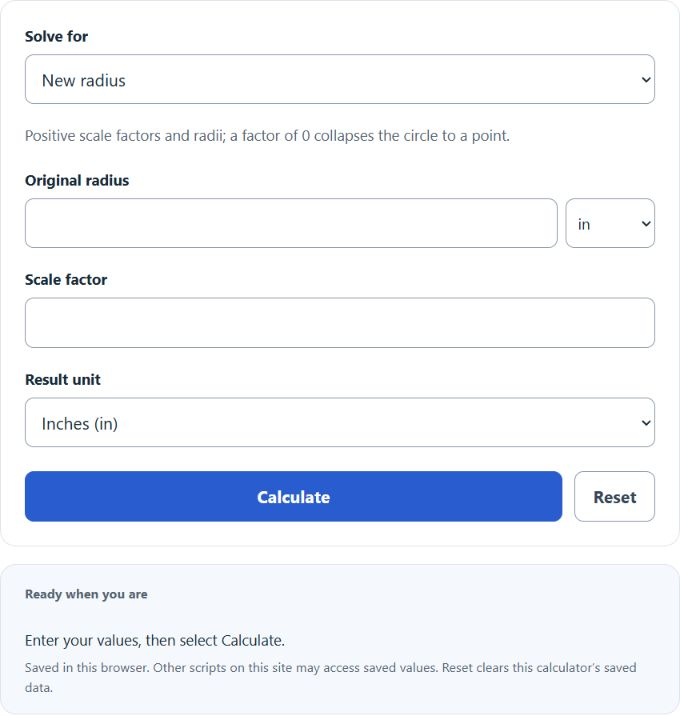
Select the original radius, scale factor, or new radius to solve, then enter the other two positive values. Radius units include inches, feet, centimeters, meters, yards and miles.
- All Math and Numbers Calculators
- Circle Coverage Calculator
- Center Of Circle Calculator
- Circle Volume Calculator
Circle Dilation Formula
The formula for the radius of a circle after a positive dilation is:
Variables:
- NR is the new radius of the dilated circle.
- OR is the original radius of the circle.
- SF is the dimensionless scale factor.
The original and new radii must be expressed in the same unit before applying the formula. The calculator handles that conversion automatically.
What is Circle Dilation?
Circle dilation is a geometric transformation that scales every point of a circle relative to a fixed point called the center of dilation. A positive scale factor changes the size of the circle while preserving its shape. The image of a circle under a dilation is another circle, so any two nondegenerate circles are similar.
Circles are not the only family of figures whose members can all be similar. For example, all squares are similar to one another, as are all equilateral triangles. What is special about circles is that their shape has no independent aspect ratio or angle parameter: once the radius is set, every other length measurement follows proportionally.
Scale Factor and Its Effects
When a circle with radius r is dilated by a positive scale factor k, the new radius is kr. Circumference also scales linearly with k because C = 2πr, so the new circumference is 2π(kr) = kC.
Area scales with the square of the scale factor. Since A = πr², replacing r with kr gives Anew = π(kr)² = k²A. A circle dilated by a factor of 3 therefore has 3 times the radius and circumference but 9 times the area.
| Scale Factor (k) | New Radius | Circumference Change | Area Change |
|---|---|---|---|
| 0.25 | r / 4 | 0.25x | 0.0625x |
| 0.5 | r / 2 | 0.5x | 0.25x |
| 1 | r (unchanged) | 1x | 1x |
| 2 | 2r | 2x | 4x |
| 3 | 3r | 3x | 9x |
| 10 | 10r | 10x | 100x |
Center of Dilation
The center of dilation is the fixed point from which the transformation scales the figure. It does not need to be the center of the circle. If the center of dilation coincides with the circle's center, the resulting circle is concentric with the original. If the center of dilation is elsewhere, the circle's center moves as its radius changes.
For a point (x, y) dilated about (h, k) by scale factor s, the image is (x', y') = (h + s(x - h), k + s(y - k)). Therefore, a circle centered at (a, b) with radius R is mapped to a circle centered at (h + s(a - h), k + s(b - k)). For a positive scale factor, its new radius is sR.
Dilation Type by Scale Factor
A positive scale factor greater than 1 produces an enlargement. A positive scale factor between 0 and 1 produces a reduction. A scale factor of exactly 1 is the identity transformation, so the circle is unchanged. This calculator uses positive scale factors because it is solving for the positive radius of a nondegenerate circle.
Some coordinate-geometry treatments extend homotheties to negative scale factors. In that convention, a negative factor places image points on the opposite side of the center of dilation and the radius scales by the absolute value of the factor. A factor of 0 collapses every point to the center and no longer produces a nondegenerate circle.
Why All Circles Are Similar
Two circles with radii r₁ and r₂ can be related by a scale factor of r₂ / r₁ after their centers are aligned. If their centers differ, a translation can first align them and a dilation can then match their radii. Because corresponding lengths scale by the same factor, the ratio of circumference to diameter is preserved, which is consistent with the same value of π for every circle.
Real-World Applications
Map scaling provides a simple dilation example. The same idealized circular feature shown on a 1:10,000 map is drawn 10 times larger in linear dimensions than on a 1:100,000 map. Its represented area on the page is therefore 100 times larger.
Optics uses the same scaling relationship for circular lenses and apertures. If the aperture radius is multiplied by k, its opening area is multiplied by k². Under otherwise comparable conditions, this area relationship is important when reasoning about how much light can pass through the opening.
Center-pivot irrigation is another geometric example. If the irrigated radius is multiplied by k, the theoretical circular coverage area is multiplied by k². Doubling the pivot radius increases the potential covered area by a factor of four.
For a circular parabolic antenna with the same wavelength and efficiency, collecting area is proportional to the square of its diameter. Increasing all linear dimensions by a factor of k therefore increases the geometric aperture area by k².
The same principle extends to three-dimensional models, but volume scales with the cube of the linear scale factor. For example, if a spherical model's radius increases by a factor of 1.26, its volume increases by about 1.26³, or approximately 2 times.
Dilation vs. Other Circle Transformations
Dilation changes size while preserving shape, angle measures, and proportional corresponding lengths. Translation changes position without resizing, rotation changes orientation without resizing, and reflection creates a mirror image without resizing. Those three are rigid transformations because they preserve distances. A dilation with a scale factor other than 1 is not distance-preserving, but it is a similarity transformation.