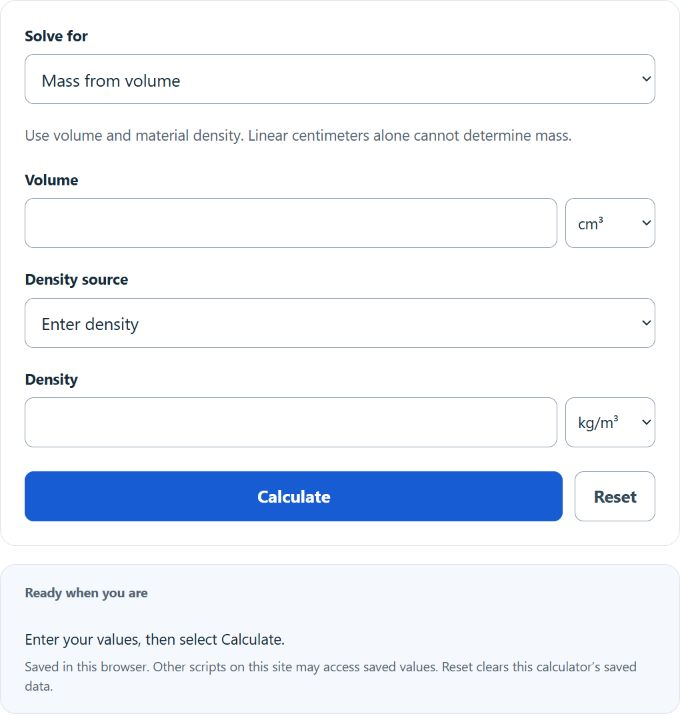
Calculate mass from volume and density, estimate unrounded freight dimensional weight, or convert length, volume, mass and density units. Linear centimeters alone do not determine mass. Carrier rounding and per-package rules may change billable weight; confirm your tariff. Use custom bulk density for sand, and material-specific density when known.
- All Unit Converters
- mg/kg to Percent Calculator
- KG to Force Calculator
- Inch to Kg Calculator
- cm³ To Grams Calculator
kg from cm³ Formula
Formula source: LibreTexts — “Density, Mass, and Center of Mass” (stating \(m = D \cdot V\))
Variables:
- m is the mass (kilograms)
- V is the volume in cubic meters (m³); divide cm³ by 1,000,000
- D is the density (kg/m³)
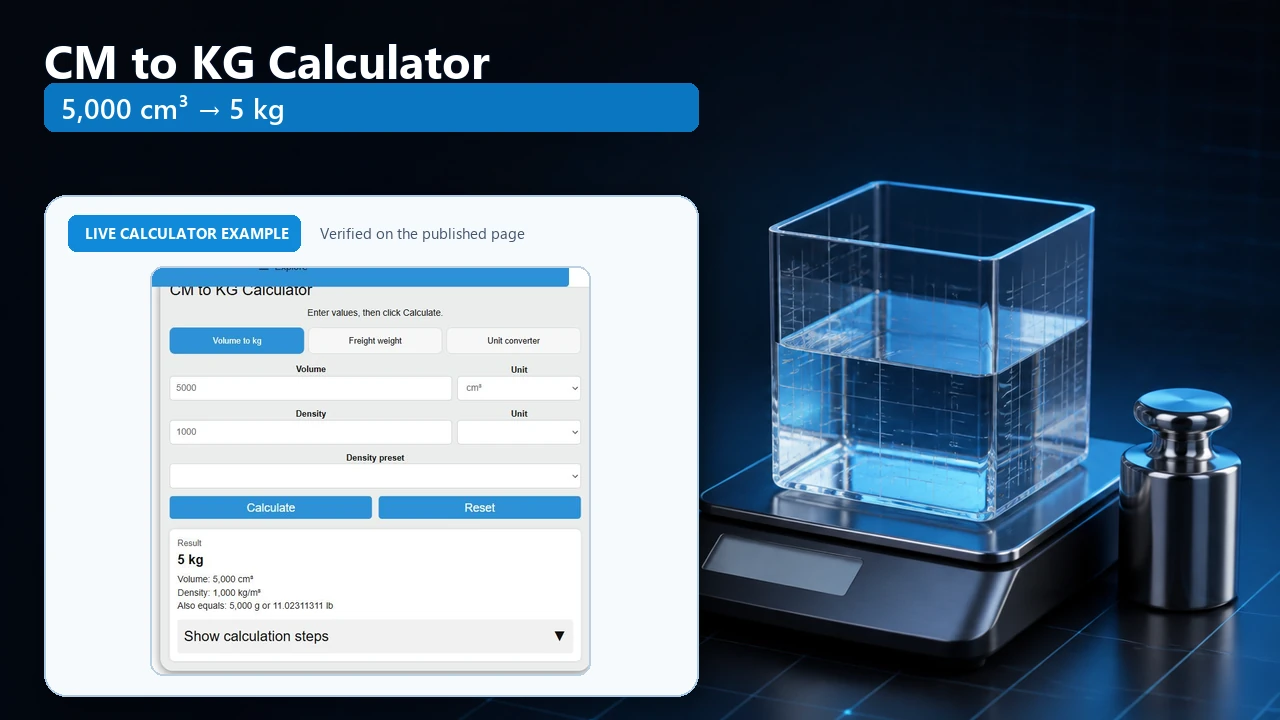
To calculate mass in kilograms, multiply volume in m³ by density in kg/m³. For cm³ and g/cm³, mass in kg equals volume × density ÷ 1,000.
| Volume (L) | Kilograms (kg) |
|---|---|
| 1 | 0.100 |
| 2 | 0.200 |
| 3 | 0.300 |
| 5 | 0.500 |
| 10 | 1.000 |
| 15 | 1.500 |
| 20 | 2.000 |
| 25 | 2.500 |
| 30 | 3.000 |
| 40 | 4.000 |
| 50 | 5.000 |
| 60 | 6.000 |
| 75 | 7.500 |
| 80 | 8.000 |
| 90 | 9.000 |
| 100 | 10.000 |
| 120 | 12.000 |
| 150 | 15.000 |
| 180 | 18.000 |
| 200 | 20.000 |
| * Rounded to 3 decimals. Formula: mass (kg) = volume (L) × density (kg/m³) ÷ 1,000. Table uses an illustrative density of 100 kg/m³, not a material preset. | |
How to Calculate kg from cm³?
The following steps outline how to calculate the kg from cm³.
- First, determine the volume and select its unit (cm³, m³ or another supported volume unit).
- Next, determine the density and select its matching unit (such as kg/m³ or g/cm³).
- Next, use m = V × D with volume in m³ and density in kg/m³, or select Mass from volume above.
- Finally, calculate the kg from cm³.
- After inserting the variables and calculating the result, check your answer with the calculator above.
Example Problem :
Use the following variables as an example problem to test your knowledge.
Volume = 5 m³
Density = 1023 kg/m³; mass = 5 × 1023 = 5115 kg
FAQs
What is density and how is it measured?
Density is a measure of how much mass is contained in a given unit volume of a material. It is usually measured in kilograms per cubic meter (kg/m^3) or grams per cubic centimeter (g/cm^3).
Why is it important to convert cubic meters into kilograms?
Converting cubic meters into kilograms is crucial in various fields such as shipping, engineering, and construction, as it helps in determining the weight of materials or objects from their volume, ensuring proper handling, transportation, and usage.
Can the formula for calculating kg from cm³ be used for any material?
Yes, m = V × D applies when V is occupied volume and D is the corresponding mass density, using consistent units. However, the accuracy of the result depends on the precision of the density value used.
How can errors in calculating kg from cm³ be minimized?
To minimize errors, ensure accurate measurements of the cubic meters and use the precise density value for the material in question. Double-checking calculations and using a reliable calculator can also help reduce mistakes.