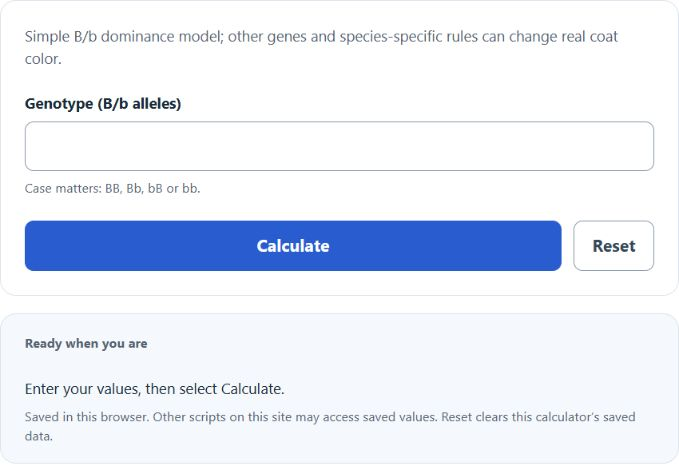
Calculate the black or brown outcome for BB, Bb, bB or bb in a simple B/b dominance model. This educational model does not predict all real animal coat colors; other genes and species-specific rules can mask or modify the outcome.
Related Calculators
- DNA Percentage Calculator
- Fold Change Calculator
- Centimorgan To Percentage Calculator
- Mutation Rate Calculator
- All Biology Calculators
Coat Color Formula
This coat color calculator uses a simple dominant and recessive allele model for the B gene. In this model, B is dominant and produces black coat color when present. The recessive b allele produces brown coat color only when both alleles are recessive.
- Genotype: The pair of alleles entered, such as BB, Bb, bB, or bb.
- B: Dominant allele for black coat color.
- b: Recessive allele for brown coat color.
- Coat Color: The outcome in this stated single-gene model, rather than a complete animal phenotype prediction.
The calculator first checks that the genotype has exactly two alleles and that each allele is either B or b. It treats bB the same as Bb. Then it applies the dominance rule: any genotype with at least one B gives black coat color, while bb gives brown coat color.
Genotype and Coat Color Reference
| Genotype | Allele Type | Predicted Coat Color |
|---|---|---|
| BB | Homozygous dominant | Black |
| Bb | Heterozygous | Black |
| bB | Heterozygous, same as Bb | Black |
| bb | Homozygous recessive | Brown |
Common Input Results
| Input | Calculator Reads As | Result |
|---|---|---|
| BB | BB | Black |
| Bb | Bb | Black |
| bB | Bb | Black |
| bb | bb | Brown |
| BC, B, or bbb | Invalid genotype | Validation error; no new result |
Example Problems
Example 1: Heterozygous genotype
You enter Bb.
Since the genotype contains at least one dominant B allele, the predicted coat color is Black.
Example 2: Homozygous recessive genotype
You enter bb.
Since both alleles are recessive, the predicted coat color is Brown.
FAQs
Why does Bb give a black coat color?
B is dominant in this simple model. That means one copy of B is enough to produce the black coat color. A genotype of Bb has one dominant allele and one recessive allele, so the black trait is shown.
Why does bb give a brown coat color?
The brown coat color appears only when there is no dominant B allele. A genotype of bb has two recessive alleles, so the recessive brown trait is expressed.
Does this calculator predict all real animal coat colors?
No. This calculator uses only a simple B/b inheritance model. Real coat color can involve multiple genes, modifiers, dilution genes, patterns, and species-specific inheritance rules. Use this result as a basic Mendelian genetics prediction, not a complete genetic analysis.