Choose the value to solve: coefficient of friction, friction force, or normal force. Enter the other two nonnegative magnitudes, using newtons, kilonewtons, or pounds-force.
- All Physics Calculators
- All Friction Calculators
- Acceleration Calculator
- Coefficient of Friction W/ Angle Calculator
Coefficient of Friction Formula
The following formula is used in the coefficient of friction calculator above:
- Where μ is the coefficient of friction
- F is the force due to friction
- N is the normal force
To calculate a coefficient of friction, divide the friction force by the normal force. For kinetic friction, this is μk = Fk/N. For static friction, the coefficient is defined using the maximum static friction at the verge of motion: μs = Fs,max/N.
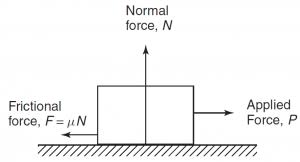
This relationship can be used for kinetic friction (during sliding) and for static friction at the threshold of motion. Static friction adjusts to match the applied force up to a maximum value, Fs,max = μsN. If the applied tangential force exceeds Fs,max, the object starts moving and kinetic friction applies.
Coefficient of Friction Definition
A coefficient of friction is a dimensionless ratio that relates the friction force between two contacting surfaces to the normal force pressing them together.
6 Interesting Questions About Coefficient of Friction
Are you taking an AP physics class or taking an introductory physics class in college? Then, you might have stumbled on this term. So, what’s the coefficient of friction?
The value of each coefficient of friction depends on the materials of the two bodies concerned. The lower the value, the easier it is for the object to move (considering that mass is constant), and vice versa.
How to Calculate the Coefficient of Friction?
The coefficient of friction, symbolized μ, is a scalar value representing the amount of resistance two bodies exert on each other. You can calculate the coefficient of friction using this formula:
μ = f÷N, where:
- μ is the coefficient of friction
- f is the frictional force
- N is the normal force
What Are the Two Coefficients of Friction?
There are two types of coefficient of friction (COF): static and kinetic. Generally, the kinetic coefficient of friction between two bodies is often lower than the static coefficient.
For example, if you’re trying to push an object and it’s not moving, static friction is balancing your push (up to its maximum). The largest push you can apply before it starts to move corresponds to the maximum static friction force, Fs,max = μsN.
Once the object is sliding, the friction force is typically modeled as kinetic friction, Fk = μkN.
What’s a Good Coefficient of Friction?
The definition of a good COF depends on what you’re trying to do.
Say you’re trying to determine a good COF for a rubber variant you’re using to make car tires. In this case, you’d need a variant with a high enough COF to ensure stability on the road. Tire performance also depends on rolling resistance, surface conditions and many other factors; a coefficient alone is not a tire-safety rating.
However, if you’re trying to make gears out of new material, you want them to have a relatively low COF. This way, you can reduce friction and reduce wear.
What’s a Common Coefficient of Friction?
Materials react differently with lubrication, but lubrication often reduces friction compared with dry contact (all else equal).
There is no universal coefficient for a material alone: the surface pair, lubrication and test conditions matter. Coefficients can exceed 1; use measured or documented values for the intended conditions.
What’s the Highest Coefficient of Friction?
There isn’t a single “highest” coefficient of friction, because COF depends strongly on the material pair and conditions (surface roughness, cleanliness, speed, temperature, normal load, and whether you mean static or kinetic friction). A coefficient above 1 is possible; it is not a universal maximum or a design guarantee.
What’s the Lowest Coefficient of Friction?
Very low coefficients of friction can occur in well-lubricated contacts or in “superlubric” regimes. Biological contacts require their own experimental conditions and cannot be assigned a universal coefficient here.
PTFE and engineered coatings can have low friction in particular tests. Use the reported counter-surface, load, speed, lubrication and temperature with any measured value.
Conclusion
Friction is an inevitable part of the forces acting on bodies in contact, not just in classical physics but also in real life. That’s why it’s worth reading more about it and discovering all its wonders that have been around since the dawn of time.
How to calculate a coefficient of friction?
How to calculate coefficient of friction
- First, determine the friction force acting parallel to the surface.
Measure or estimate the friction force. For kinetic friction, use the steady sliding force; for static friction, use the maximum force just before motion begins.
- Next, determine the normal force acting on the object.
On a level surface with no additional vertical forces and no vertical acceleration, the normal force equals the weight mg. Otherwise, calculate N from the vertical force balance.
- Calculate the coefficient of friction
Compute μ = F_f/N (use F_k for kinetic friction or F_s,max for maximum static friction).
FAQ
A coefficient of friction is a dimensionless value that relates the friction force between two surfaces to the normal force pressing them together (μ = F/N).
Static friction acts between surfaces that are not sliding relative to each other (up to a maximum value). Dynamic (kinetic) friction acts when the surfaces are sliding.