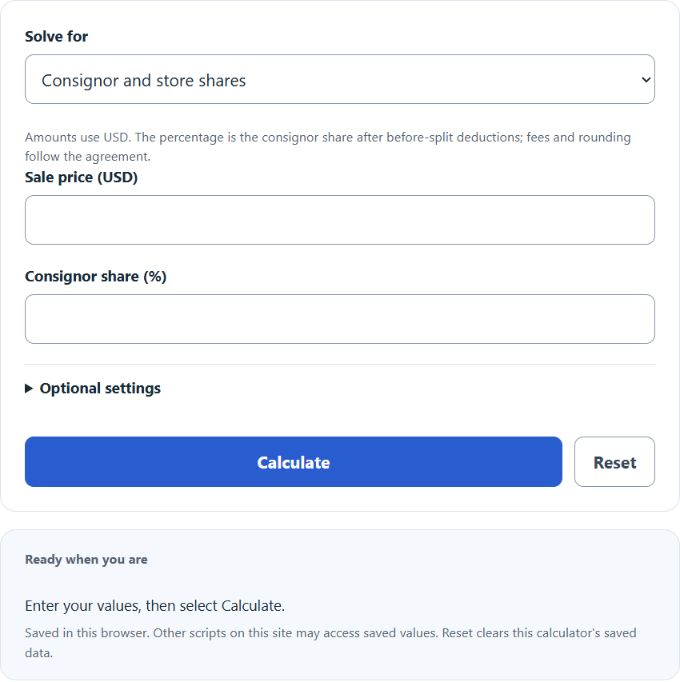
Calculate consignor payout, store commission, or the required sale price from a consignment split, with optional fees and before- versus after-split comparisons.
Consignment Percentage Formula
The consignment percentage is the consignor’s share of the amount available to split. The formulas below assume no separate fees; the optional calculator deductions adjust the available base and net payout. Reverse sale-price mode targets the gross consignor share before the consignor’s own fee.
- S = share of sales disbursed to consignors, in dollars
- T = total sales amount, in dollars
- P = consignment percentage, as a percent
To calculate the share paid to the consignor, multiply total sales by the consignment percentage, then divide by 100.
- P = consignment percentage, as a percent
- S = share of sales disbursed to consignors, in dollars
- T = total sales amount, in dollars
To calculate the consignment percentage, divide the consignor’s share by total sales, then multiply by 100.
- T = total sales amount, in dollars
- S = share of sales disbursed to consignors, in dollars
- P = consignment percentage, as a percent
To calculate total sales, divide the consignor’s share by the consignment percentage, then multiply by 100. The percentage cannot be zero when solving for total sales.
Illustrative Consignment Percentage Ranges
The following ranges are hypothetical agreement examples, not measured market averages or recommended terms. Use your actual agreement; the percentage here refers to the consignor’s share.
| Item or setting | Example consignor share | What it means |
|---|---|---|
| Clothing and accessories | 40% to 60% | The consignor receives this portion of the sale price. |
| Furniture and home goods | 50% to 70% | At these example terms, the consignor receives 50% to 70% of the available split base. |
| Art, antiques, and collectibles | 50% to 80% | At these example terms, the consignor receives 50% to 80% of the available split base. |
| Online resale marketplace | 60% to 90% | The seller may keep more, but fees and shipping can reduce the final amount. |
Consignment Split Examples
These examples assume no separate fees. The calculator rounds the gross consignor share half up to cents and assigns the remaining split base to the store; agreements may specify different rounding.
| Total sales | Consignor percentage | Consignor receives | Remaining amount |
|---|---|---|---|
| $100.00 | 50% | $50.00 | $50.00 |
| $250.00 | 60% | $150.00 | $100.00 |
| $800.00 | 70% | $560.00 | $240.00 |
Example Problems
Example 1: Calculate the consignor’s share
You sell an item for $300, and the consignment percentage is 60%.
The share of sales disbursed to the consignor is $180.00.
Example 2: Calculate the consignment percentage
The total sales amount is $500, and the consignor receives $325.
The consignment percentage is 65%.
FAQ
What does consignment percentage mean?
Consignment percentage is the percent of the sale amount paid to the consignor. For example, if an item sells for $200 and the consignor percentage is 60%, the consignor receives $120.
Is the consignment percentage the same as the store commission?
Not always. Some agreements state the consignor’s percentage, while others state the store’s commission. If the consignor gets 60%, the store keeps 40%, before any separate fees. Make sure you know which percentage your agreement uses before entering the value.
Should fees, taxes, or shipping be included in total sales?
Use the sale amount defined in your agreement. Enter before-split fees in the optional deduction field, or enter an already-net sale amount and leave that deduction blank; do not subtract the same fee twice. A separate consignor fee is deducted after the split. Taxes and shipping are included only if your entered agreement amounts include them.