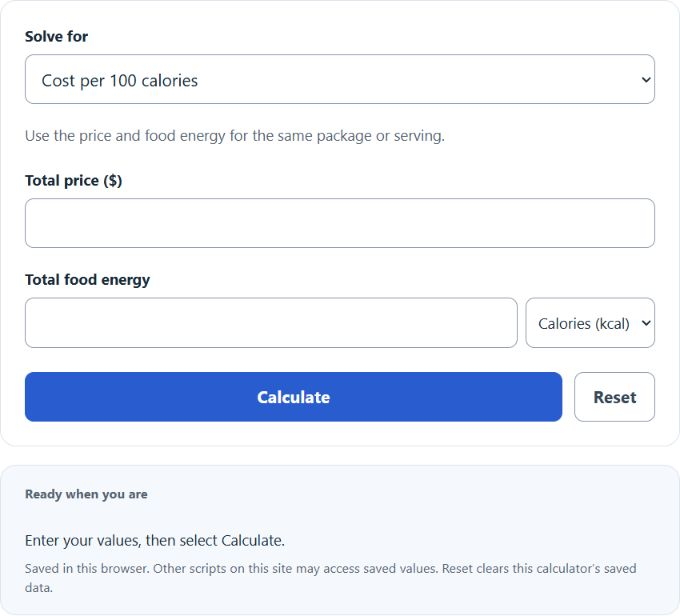
Calculate cost per 100 calories from price and total calories, compare two products, or find calories per dollar for food and grocery shopping.
Related Calculators
- Calories Per Dollar Calculator
- Cost Per Serving Calculator
- Grams To Calories Calculator
- Pizza Value Calculator
- All Food and Cooking Calculators
Cost Per 100 Calories Formula
The following equation is used to calculate the Cost Per 100 Calories.
- Where CP100C is the cost per 100 food calories ($/100 kcal)
- TC is the total cost ($)
- C is the total food calories (kcal) for the same package or serving as the price
To calculate the cost per 100 calories, divide the total cost by the total calories and multiply by 100.
What is Cost Per 100 Calories?
Definition:
Cost per 100 calories refers to how much it costs to obtain 100 calories of a particular food or meal. This metric allows individuals to compare foods based on their energy content relative to cost.
How to Calculate Cost Per 100 Calories?
Example Problem:
The following example outlines the steps and information needed to calculate the Cost Per 100 Calories.
First, determine the total calories. In this example, a food item contains 2,000 calories in total.
Next, determine the total cost of that food item. This item costs $4.00.
Finally, calculate the cost per 100 calories using the formula above:
CP100C = (TC / C) * 100
CP100C = ($4.00 / 2000) * 100
CP100C = $0.20 per 100 calories
FAQ
What factors can affect the cost per 100 calories?
Several factors influence the cost per 100 calories, including the type of food, its overall nutritional profile, market prices, seasonality, and brand. Highly processed or specialty foods may be more expensive per 100 calories than basic staple foods like grains or legumes.
How can I use the cost per 100 calories metric to make healthier or more budget-friendly choices?
By comparing the cost per 100 calories across different items, you can identify foods that provide better calorie value for your budget. Combining this information with nutritional content (e.g., vitamins, minerals, protein) allows you to choose foods that not only are inexpensive per calorie but also support your dietary goals.
Are cheaper cost-per-calorie foods always the best choice?
Not necessarily. While cost per calorie is a useful metric for budgeting, it’s important to balance cost with overall nutrition. Foods that are low in cost per calorie might offer less nutritional value. Consider your dietary needs, including protein, vitamins, and minerals, alongside this cost measurement.