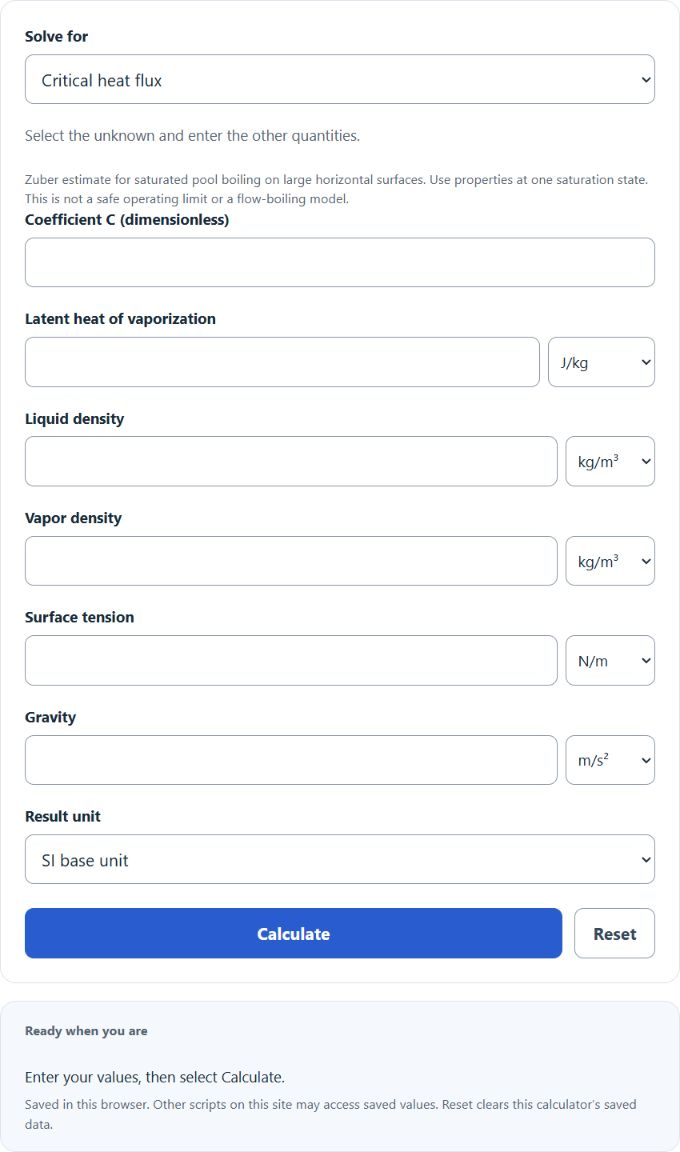
Calculate critical heat flux for saturated pool boiling using Zuber correlation from coefficient, latent heat, densities, surface tension, and gravity.
Critical Heat Flux Formula
The calculator uses the Zuber correlation for saturated pool boiling. It works in SI units internally, then converts the result back to the unit you selected.
- q”CHF = critical heat flux, usually in W/m² or BTU/hr-ft²
- C = Zuber coefficient, dimensionless
- hfg = latent heat of vaporization, in J/kg or BTU/lb
- ρl = liquid density, in kg/m³ or lb/ft³
- ρv = vapor density, in kg/m³ or lb/ft³
- σ = surface tension, in N/m or lbf/ft
- g = gravitational acceleration, in m/s² or ft/s²
Select the quantity to solve for and enter the other six quantities. The calculator uses the same Zuber equation for every mode. Vapor density can have two mathematical solutions; both are reported when distinct. Choose a physically consistent solution using independent saturation-property data.
Typical Inputs for Saturated Water Calculations
Use saturated liquid and vapor properties at the same pressure or saturation temperature. Mixing properties from different states can give a physically meaningless result.
| Property | Common symbol | Typical value for saturated water near 100°C | SI unit |
|---|---|---|---|
| Zuber coefficient | C | About 0.131 | dimensionless |
| Latent heat of vaporization | hfg | 2,257,000 | J/kg |
| Liquid density | ρl | 958 | kg/m³ |
| Vapor density | ρv | 0.598 | kg/m³ |
| Surface tension | σ | 0.0589 | N/m |
| Standard gravity | g | 9.80665 | m/s² |
| Quantity | Conversion used |
|---|---|
| Heat flux | 1 BTU (IT)/hr-ft² ≈ 3.154590745 W/m² |
| Latent heat | 1 BTU (IT)/lb = 2326 J/kg |
| Density | 1 lb/ft³ ≈ 16.018463374 kg/m³ |
| Surface tension | 1 lbf/ft ≈ 14.593902937 N/m |
| Acceleration | 1 ft/s² = 0.3048 m/s² |
Example Calculations
Example 1: Calculate critical heat flux
Suppose you use these saturated water values:
- C = 0.131
- hfg = 2,257,000 J/kg
- ρl = 958 kg/m³
- ρv = 0.598 kg/m³
- σ = 0.0589 N/m
- g = 9.80665 m/s²
Using the Zuber correlation:
The critical heat flux is about 1.11 MW/m².
Example 2: Calculate the Zuber coefficient
Suppose the measured critical heat flux is 1,110,000 W/m² and the other inputs are:
- hfg = 2,257,000 J/kg
- ρl = 958 kg/m³
- ρv = 0.598 kg/m³
- σ = 0.0589 N/m
- g = 9.80665 m/s²
Solving for C gives:
FAQ
What does critical heat flux mean?
Critical heat flux is the heat flux at which boiling behavior changes sharply and heat transfer can become much less effective. In pool boiling, reaching CHF often corresponds to the transition from nucleate boiling toward film boiling, where a vapor layer can insulate the heated surface.
When is the Zuber correlation appropriate?
The Zuber correlation is commonly used for saturated pool boiling on large horizontal surfaces. It assumes hydrodynamic instability controls the burnout condition. It is not a general formula for all flow boiling, subcooled boiling, microchannels, or strongly geometry-dependent cases.
Why must liquid density be greater than vapor density?
The formula contains the density difference ρl − ρv. For normal saturated boiling, the liquid phase is denser than the vapor phase. If ρl is not greater than ρv, the fourth-root term is not physically valid for this correlation.