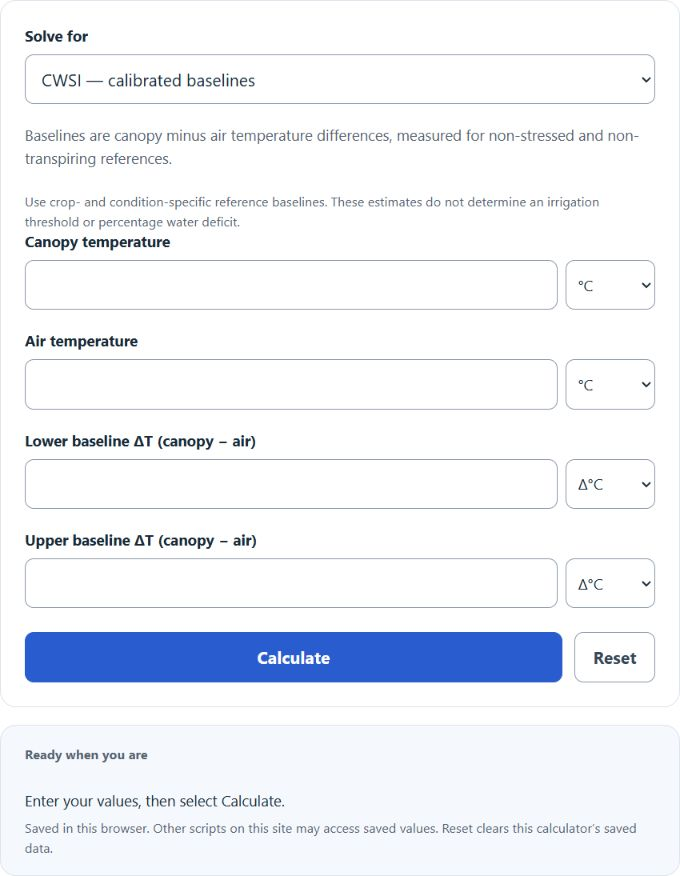
Calculate CWSI using calibrated baselines, retain the simplified wet-bulb ratio and its inverse calculations, or estimate wet-bulb temperature and vapor pressure deficit.
Related Calculators
- Water Potential Calculator
- NDVI Calculator
- Crop Coefficient Calculator
- Field Capacity Calculator
- All Biology Calculators
Crop Water Stress Index Formula
The calibrated-baselines mode uses CWSI = [(Tc − Ta) − LL] / (UL − LL), where LL and UL are crop- and condition-specific canopy-minus-air temperature differences for non-stressed and non-transpiring references, and UL must exceed LL. The simplified modes retain the wet-bulb reference ratio shown below; that shortcut is not a validated replacement for calibrated CWSI.
Variables:
- CWSI is the Crop Water Stress Index (unitless)
- Tc is the canopy temperature (°C or °F)
- Ta is the air (dry-bulb) temperature (°C or °F)
- Tw is the wet-bulb temperature (°C or °F)
To calculate the simplified ratio, subtract the wet-bulb temperature from the canopy temperature. Then subtract the wet-bulb temperature from the air temperature. Divide the first result by the second result to get the Crop Water Stress Index. (If Ta = Tw, the index is undefined.)
What is a Crop Water Stress Index?
The Crop Water Stress Index (CWSI) is a unitless indicator used to describe plant water stress from canopy temperature measurements. In the standard approach, CWSI normalizes the canopy–air temperature difference between a non-water-stressed (lower) baseline and a fully stressed (upper) baseline (often dependent on vapor pressure deficit, VPD). The simplified modes use a reference-temperature method that uses wet-bulb temperature (which can be estimated from air temperature and relative humidity) as a “wet” reference and air temperature as a simple “dry” reference. For this ratio, 0 corresponds to the wet-bulb reference and 1 to air temperature. Values outside 0–1 are retained and require checking the references; the ratio does not establish an irrigation threshold or percentage water deficit.
How to Calculate Crop Water Stress Index?
The following steps outline how to calculate the simplified wet-bulb ratio using the formula: CWSI = (Tc – Tw) / (Ta – Tw).
- First, determine the canopy temperature (Tc) in degrees Celsius (or Fahrenheit).
- Next, determine the air temperature (Ta) in degrees Celsius (or Fahrenheit).
- Next, determine the wet bulb temperature (Tw) in degrees Celsius (or Fahrenheit).
- Use the formula CWSI = (Tc – Tw) / (Ta – Tw) to calculate the simplified wet-bulb ratio.
- After inserting the values of Tc, Ta, and Tw into the formula, calculate the result.
Example Problem:
Use the following variables as an example problem to test your knowledge:
Canopy temperature (Tc) = 22°C
Air temperature (Ta) = 25°C
Wet bulb temperature (Tw) = 20°C
Solution (simplified ratio): ratio = (Tc − Tw) / (Ta − Tw) = (22 − 20) / (25 − 20) = 0.40