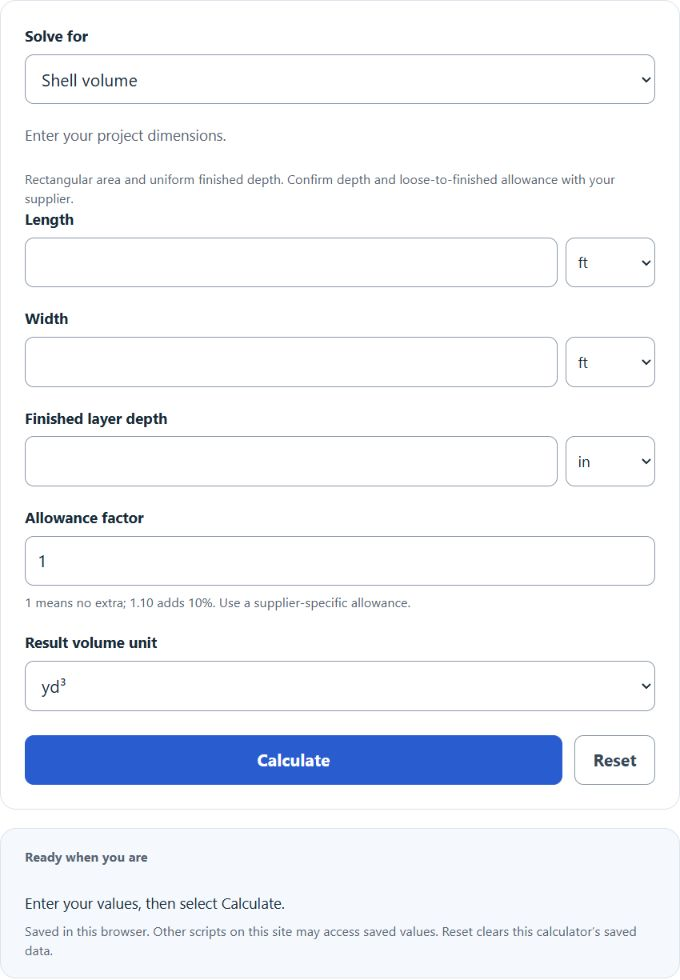
Calculate crushed shell volume, length, width, depth, or waste factor from project measurements in feet, inches, meters, and yards.
Related Calculators
- Playground Mulch Calculator
- Tiles Per Square Meter Calculator
- Boulder Weight Calculator
- Pool Deck Square Footage Calculator
- All Construction Calculators
Crushed Shell Formula
The crushed shell calculator uses area, depth, and a waste or compaction factor to estimate material volume. Length and width are converted to feet, depth is converted to inches, and the base volume is calculated in cubic feet before being converted to your selected volume unit.
- V = volume of crushed shell in cubic feet
- L = length in feet
- W = width in feet
- D = depth in inches
- C = waste/compaction factor
Select the quantity to solve for; the calculator rearranges the same formula:
- Volume calculation: enter length, width, depth, and factor to find the amount of crushed shell needed.
- Length calculation: enter width, depth, factor, and volume to find the project length that volume will cover.
- Width calculation: enter length, depth, factor, and volume to find the project width that volume will cover.
- Depth calculation: enter length, width, factor, and volume to find the shell depth.
- Factor calculation: enter length, width, depth, and volume to find the implied waste or compaction factor.
Common Crushed Shell Depths
These are illustrative planning depths, not installation specifications. Confirm finished depth, base preparation, and suitability with your shell supplier or installer.
| Use | Typical Depth | Notes |
|---|---|---|
| Light garden topping | 1 to 2 in | Best for decorative coverage over a prepared base. |
| Walkway or patio area | 2 to 3 in | Suitability depends on the shell product and prepared base. |
| Driveway surface layer | 3 to 4 in | May need a stronger base layer below the shell. |
Allowance Factor Arithmetic
| Factor | Extra Material | Illustrative Meaning |
|---|---|---|
| 1.00 | 0% | Exact geometric volume with no allowance. |
| 1.05 | 5% | A user-selected 5% volume allowance. |
| 1.10 | 10% | A user-selected 10% volume allowance. |
| 1.15 | 15% | A user-selected 15% volume allowance. |
Example Calculations
Example 1: Calculate crushed shell volume
You want to cover an area that is 20 ft long and 6 ft wide with crushed shell 2 in deep. Use a factor of 1.10 for 10% extra.
Convert cubic feet to cubic yards:
You would need about 0.81 cubic yards of crushed shell.
Example 2: Calculate depth from known volume
You have 1 cubic yard of crushed shell for an area that is 18 ft long and 8 ft wide. Use a factor of 1.00.
First convert volume to cubic feet:
Then solve for depth:
One cubic yard would cover that area at about 2.25 inches deep.
FAQs
How many cubic yards of crushed shell do I need?
Multiply length in feet by width in feet by depth in feet. Since depth is often measured in inches, divide the depth by 12 first. Then multiply by your waste or compaction factor. To convert cubic feet to cubic yards, divide by 27.
What waste or compaction factor should I use?
Use 1.00 for geometric volume without an allowance. Obtain the loose-to-finished volume allowance for your product and installation from the supplier. For example, a selected factor of 1.10 adds 10%; this is not a universal compaction recommendation.
Should crushed shell depth be measured before or after compaction?
The calculator treats depth as the finished layer depth. A supplier-specific allowance may account for spreading and compaction. Do not infer that a fixed 10% or 15% allowance is sufficient for every shell product or installation.