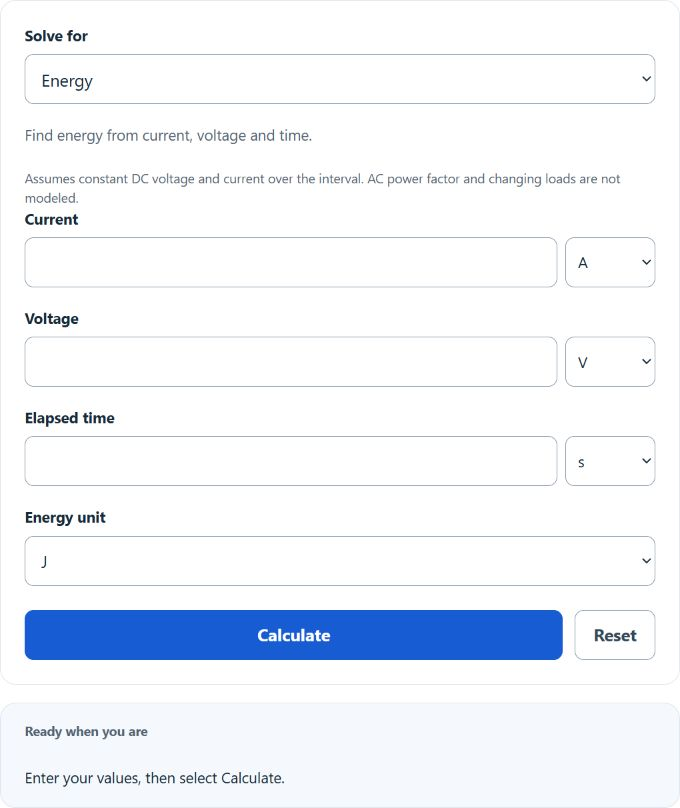
Calculate energy from current, voltage and time, or solve for any missing input values with unit conversions in A, V, s, J, Wh and kWh.
- All Unit Converters
- All Energy Calculators
- Battery Energy Calculator
- Overload Current Calculator
- Voltage to Energy Calculator
Current To Energy Formula
The calculator assumes constant DC current and voltage over a nonnegative time interval. In base units, current is in amps, voltage is in volts, time is in seconds, and energy is in joules. AC power factor and changing loads require a different model.
Rearranged formulas are used when you select a different quantity to calculate:
- E = energy, measured in joules (J) in the base formula
- I = current, measured in amps (A)
- V = voltage, measured in volts (V)
- t = time, measured in seconds (s)
In Energy mode, the calculator multiplies current by voltage to get power in watts, then by time to get energy. Other modes divide energy by the other two known values; their denominator must be nonzero.
Before calculating, the entered values are converted to base units: amps, volts, seconds, and joules. After the calculation, the result is converted back to the unit you selected, such as milliamps, kilovolts, hours, watt-hours, or kilowatt-hours.
Common Electrical Energy Unit Conversions
These conversions are useful when checking a current-to-energy result by hand.
| Quantity | Unit | Base unit conversion |
|---|---|---|
| Current | 1 mA | 0.001 A |
| Current | 1 kA | 1000 A |
| Voltage | 1 kV | 1000 V |
| Time | 1 min | 60 s |
| Time | 1 h | 3600 s |
| Energy | 1 kJ | 1000 J |
| Energy | 1 Wh | 3600 J |
| Energy | 1 kWh | 3,600,000 J |
Typical Result Interpretation
| Result type | What it means | Helpful check |
|---|---|---|
| Joules (J) | Energy for a short time interval or small load | 1 watt used for 1 second equals 1 J |
| Watt-hours (Wh) | Energy for small devices over minutes or hours | 1 watt used for 1 hour equals 1 Wh |
| Kilowatt-hours (kWh) | Energy commonly used for household electricity usage | 1000 watts used for 1 hour equals 1 kWh |
Example Calculations
Example 1: Calculate energy from current
You have a 2 A current, a 12 V voltage, and a time of 10 seconds.
The energy is 240 J.
Example 2: Calculate current from energy
You have 72 Wh of energy, a voltage of 12 V, and a time of 3 hours. First, convert watt-hours to joules and hours to seconds.
The current is 2 A.
FAQ
How do you convert current to energy?
You cannot convert current to energy by itself. You also need voltage and time. Current tells you the rate of charge flow, voltage tells you the electrical potential, and time tells you how long the current flows. Use E = I × V × t to calculate energy.
Why does the calculator use joules as the base energy unit?
A joule is the SI derived unit for energy. Since 1 watt equals 1 joule per second, multiplying volts by amps gives watts, and multiplying watts by seconds gives joules.
What is the difference between Wh and J?
Both watt-hours and joules measure energy. Joules are based on seconds, while watt-hours are based on hours. The conversion is 1 Wh = 3600 J. For larger electrical usage, kilowatt-hours are often easier to read, where 1 kWh = 3,600,000 J.