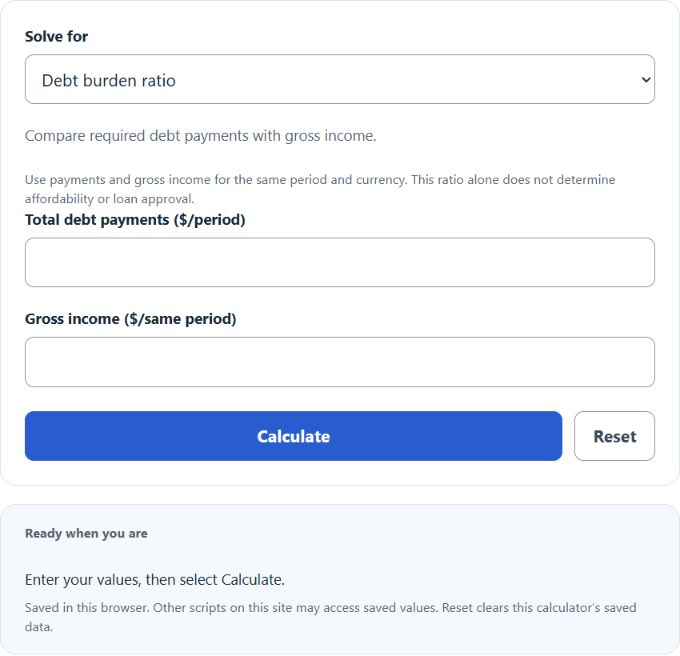
Calculate debt burden ratio from total debt payments and income, or find missing debt payments or income from the ratio as a percentage.
Debt Burden Ratio Formula
The following equation gives the debt burden ratio as a decimal. Multiply by 100 to display a percentage. Use payments and gross income for the same period and currency; standard monthly debt-to-income uses gross income before taxes and deductions.
- Where DBR is the debt burden ratio (ratio or %)
- TDP is the total debt payments ($)
- TI is the total income ($)
To calculate the debt burden ratio, divide the total debt payments by the total income.
What is a Debt Burden Ratio?
Definition:
The debt burden ratio is a measure that indicates how much of an individual’s or organization’s income is allocated to servicing debts over a given period. By comparing total debt payments to overall income, it provides a ratio or percentage of income committed to debt payments. It does not by itself establish affordability or whether further borrowing is advisable.
How to Calculate Debt Burden Ratio?
Example Problem:
The following example outlines the steps and information needed to calculate the Debt Burden Ratio.
First, determine the total debt payments for the period. In this example, the total monthly debt payments are $600.
Next, determine the total monthly income. In this example, the monthly income is $3,000.
Finally, calculate the debt burden ratio using the formula above:
DBR = TDP / TI
DBR = $600 / $3000
DBR = 0.2 or 20%
FAQ
What is a good debt burden ratio?
Debt-to-income limits vary by lender, loan product and circumstances. No single ratio guarantees manageable debt or loan approval; other expenses and financial obligations also matter.
How can I lower my debt burden ratio?
Strategies include reducing expenses, refinancing high-interest debts, increasing income through additional work or side projects, and prioritizing debt repayment to reduce principal balances faster.
How does a high debt burden ratio affect borrowing?
Lenders may view a high debt burden ratio as a sign of increased risk, potentially leading to higher interest rates, stricter loan terms, or even loan application denials.
Is the debt burden ratio the same as debt-to-income ratio?
They are closely related concepts. Many use the terms interchangeably, although specific calculations may vary slightly. Both measure how much of your income goes toward paying debts.