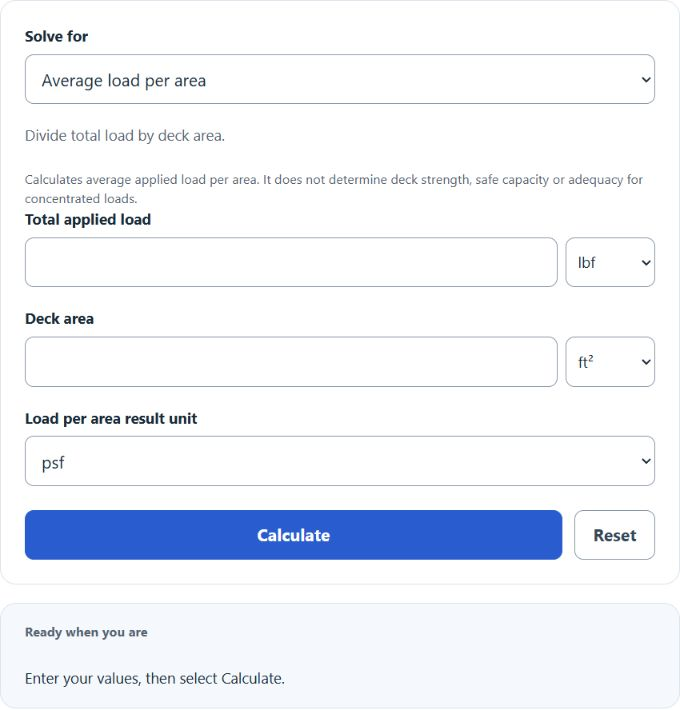
Calculate average applied load per area in psf, Pa, or kPa, or select total load or deck area to solve from the other two values.
Related Calculators
- Deck Board Calculator
- Weld Section Modulus Calculator
- Gust Factor Calculator
- Percent Slope Calculator
- Ramp Length Calculator
- All Construction Calculators
Deck Load (psf) Formula
The basic deck load formula divides the total load on the deck by the deck area. The result is an average load per unit area, usually expressed in pounds-force per square foot, or psf. This average is not a calculation of deck strength or allowable capacity, and it does not evaluate concentrated loads.
- DS = average deck load per area, commonly in psf
- L = total load on the deck
- A = deck area
The same relationship can be rearranged depending on which value you need to calculate.
- To calculate deck load in psf: enter total load and deck area. The calculator uses DS = L / A.
- To calculate total load: enter average load per area and deck area. The calculator uses L = DS * A.
- To calculate deck area: enter total load and average load per area. The calculator uses A = L / DS.
The calculator can also convert between lbf and N for load, ft² and m² for area, and psf, Pa, and kPa for load intensity.
Common Deck Load Reference Values
| Load type | Typical value | What it means |
|---|---|---|
| Dead load | 10 to 15 psf | Weight of deck framing, boards, railings, and fixed materials |
| Live load | 40 psf | People, furniture, grills, and movable items on many residential decks |
| Total design load | 50 to 55 psf | A common combined dead load plus live load range for residential deck design |
| Snow load | Varies by location | May control the design in snow regions and should be checked against local code |
Deck Load Unit Conversions
| Conversion | Equivalent value |
|---|---|
| 1 lbf | 4.4482216 N |
| 1 ft² | 0.09290304 m² |
| 1 psf | 47.880259 Pa |
| 1 kPa | 1000 Pa, about 20.8854 psf |
Example Deck Load Calculations
Example 1: Calculate deck load in psf
You have a total load of 8,000 lbf spread over a deck area of 200 ft².
The average deck load is 40 psf.
Example 2: Calculate total load
You want to know the total load for a 240 ft² deck designed for 50 psf.
The total load is 12,000 lbf.
FAQ
What does psf mean for a deck?
PSF means pounds per square foot. For a deck, it describes how much load is applied over each square foot of deck surface. A 40 psf load means each square foot is assumed to carry 40 pounds on average.
Is deck load the same as total weight?
No. Total weight is the full load on the deck, usually in pounds-force or newtons. Deck load in psf is that total load divided by the deck area. For example, 10,000 lbf over 250 ft² equals 40 psf.
Can I use the result as a final deck design value?
Use the result as a load calculation, not as a complete structural design. Deck design also depends on joist size, beam size, post spacing, connections, footing capacity, wood species, snow load, and local building code requirements.