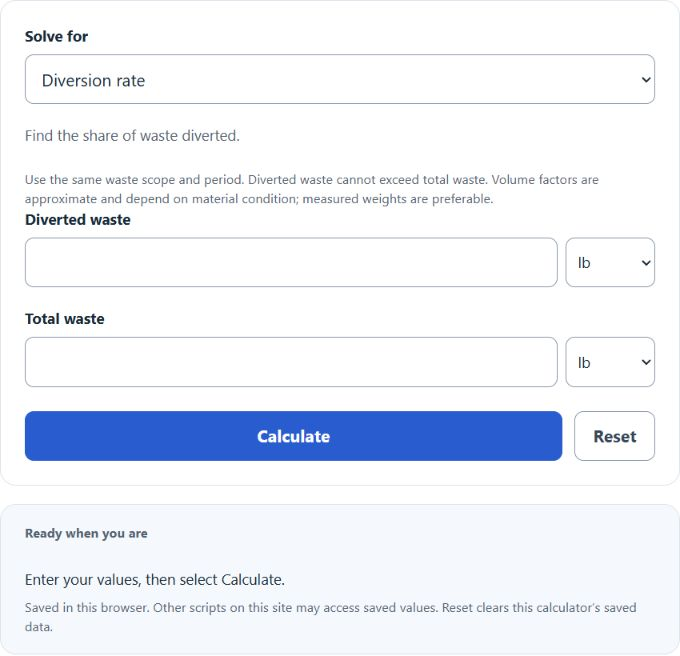
Calculate waste diversion rate, its inverse weights and non-diverted waste; plan a fixed-total target; or estimate weight from volume and an editable material factor.
Related Calculators
- Net Weight Calculator
- Waste Factor Calculator
- Waste Weight Calculator
- Food Waste Percentage Calculator
- Scrap Rate Calculator
- All Everyday Life and Education Calculators
Diversion Rate Formula
The following two example problems outline the steps and information needed to calculate the Diversion Rate.
- Where DIV is the Diversion Rate (%)
- WDW is the weight of diverted waste (lb or US short tons)
- WTW is the positive total waste weight (same unit as WDW)
Divide diverted waste weight by total waste weight and multiply by 100. Use matching units, scope and period; total waste must be positive and diverted waste cannot exceed it. Non-diverted waste is not necessarily all landfilled.
How to Calculate Diversion Rate?
The following example problems outline how to calculate Diversion Rate.
Example Problem #1:
- First, determine the weight of diverted waste (lbs/tons).
- The weight of diverted waste (lbs/tons) is given as: 3,000.
- Next, determine the weight of total waste (lbs/tons).
- The weight of total waste (lbs/tons) is provided as: 10,000.
- Finally, calculate the Diversion Rate using the equation above:
DIV = WDW / WTW * 100
The values provided above are inserted into the equation below and computed.
DIV = 3,000 / 10,000 * 100 = 30.00 (%)
Example Problem #2:
For this problem, the variables required are provided below:
weight of diverted waste (lbs/tons) = 6,000
weight of total waste (lbs/tons) = 12,000
Test your knowledge using the equation and check your answer with the calculator..
DIV = WDW / WTW * 100 = ?