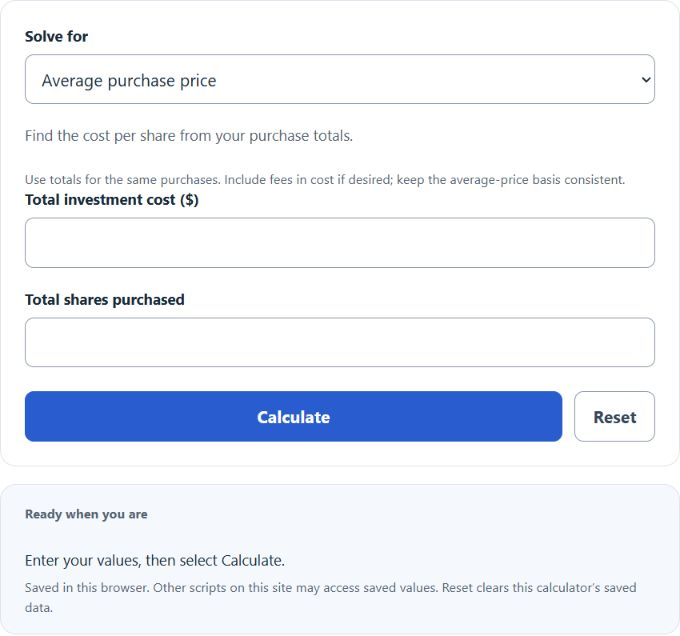
Calculate dollar-cost averaging by finding total investment cost, shares purchased, or average share price when you enter the other two values.
Dollar-Cost Averaging Formula
The calculator uses the relationship between total investment cost, total shares purchased, and average purchase price per share. This is the basic cost-basis formula used to summarize dollar-cost averaging purchases.
- APP = average purchase price per share
- TIC = total investment cost in dollars
- TN = total number of shares purchased
Choose Average purchase price to divide your total investment cost by the total number of shares purchased.
- TIC = total investment cost in dollars
- TN = total number of shares purchased
- APP = average purchase price per share
Choose Total investment cost to multiply the number of shares by the average purchase price per share.
- TN = total number of shares purchased
- TIC = total investment cost in dollars
- APP = average purchase price per share
Choose Total shares purchased to divide your total investment cost by the average purchase price per share.
Average Cost Basis Reference
Dollar-cost averaging usually means buying the same investment over time at different prices. The table below shows how multiple purchases combine into one average purchase price.
| Purchase | Shares Bought | Price per Share | Cost |
|---|---|---|---|
| 1 | 10 | $50 | $500 |
| 2 | 8 | $60 | $480 |
| 3 | 12 | $45 | $540 |
| Total | 30 | Average: $50.67 | $1,520 |
What the Result Tells You
| Result | Meaning |
|---|---|
| Average purchase price per share | Your average cost for each share across all purchases. |
| Total investment cost | The entered acquisition cost. Include fees if desired, using a consistent average-price basis; dividends and taxes are not modeled. |
| Total shares purchased | The number of shares represented by the total cost and average purchase price. |
Dollar-Cost Averaging Examples
Example 1: Find the average purchase price
You invested $2,400 and purchased 48 shares total.
Your average purchase price is $50.00 per share.
Example 2: Find the total investment cost
You purchased 75 shares at an average purchase price of $32.40 per share.
Your total investment cost is $2,430.00.
FAQ
Is dollar-cost averaging the same as average purchase price?
No. Dollar-cost averaging is an investing method where you buy over time, often with a fixed dollar amount. Average purchase price is the result of those purchases expressed as one cost per share. This calculator finds the average purchase price, total cost, or share count from the other two values.
Does this calculator include trading fees or commissions?
Only if you include them in the total investment cost. If you paid commissions or transaction fees and want a true cost basis estimate, add those costs to the total amount invested before using the calculator.
Can the average purchase price be higher or lower than my current share price?
Yes. Your average purchase price is based on what you paid in the past. The current market price can be higher or lower. If the current price is above your average purchase price, the position has an unrealized gain before taxes and fees. If it is below, the position has an unrealized loss.