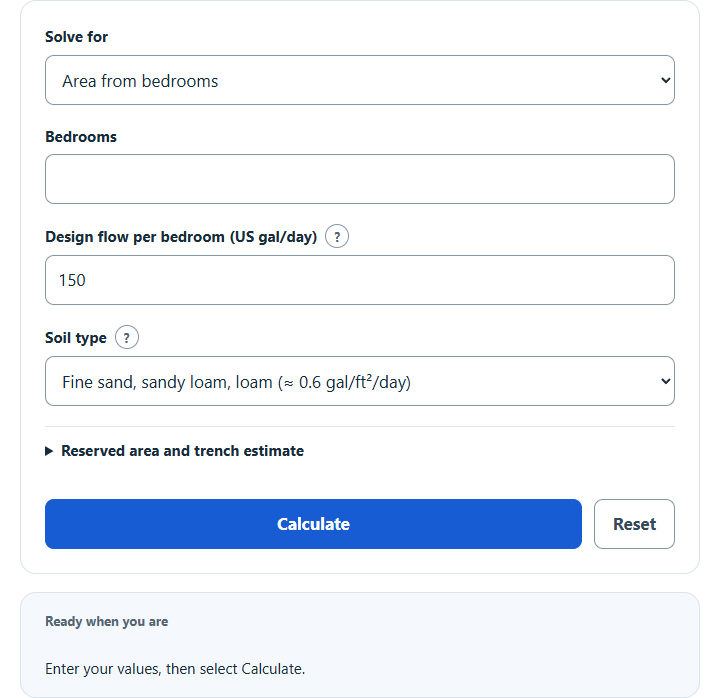
Calculate septic drain field (leach field) size from bedrooms or daily flow and your soil type, using typical loading rates or your own approved rate.
Related Calculators
- Soil Infiltration Rate Calculator
- Percolation Rate Calculator
- Void Ratio Calculator
- Pipe Flow Calculator
- French Drain Slope Calculator
- All Construction Calculators
Drain Field Size Formula
The following formula is used to calculate the drain field size.
Variables:
- DFS is the drain field size (square feet)
- DF is the daily flow into the septic system (gallons per day)
- AR is the absorption rate of the soil (gallons per day per square foot)
For this area-loading model, divide approved design daily flow by the approved long-term soil loading rate. Additional reserved absorption area is calculated separately as active area × reserve percentage / 100. Active trench-bottom length is active area divided by trench bottom width; total land footprint also requires spacing, setbacks and site-specific design. A percolation test is not itself a long-term loading rate.
What is a Drain Field Size?
Drain field size is a critical component of a septic system, determining the area necessary to properly filter and treat wastewater as it percolates through the soil. The size of the drain field is influenced by the daily flow of wastewater and the soil’s absorption rate. Proper sizing is essential to prevent system failure and environmental contamination.
How to Calculate Drain Field Size?
The following steps outline how to calculate the Drain Field Size.
- First, determine the daily flow (DF) into the septic system in gallons per day.
- Next, determine the absorption rate (AR) of the soil in gallons per day per square foot.
- Next, gather the formula from above = DFS = DF / AR.
- Finally, calculate the Drain Field Size (DFS) in square feet.
- After inserting the variables and calculating the result, check your answer with the calculator above.
Example Problem :
Use the following variables as an example problem to test your knowledge.
Daily flow into the septic system (DF) = 500 gallons per day
Absorption rate of the soil (AR) = 0.4 gallons per day per square foot