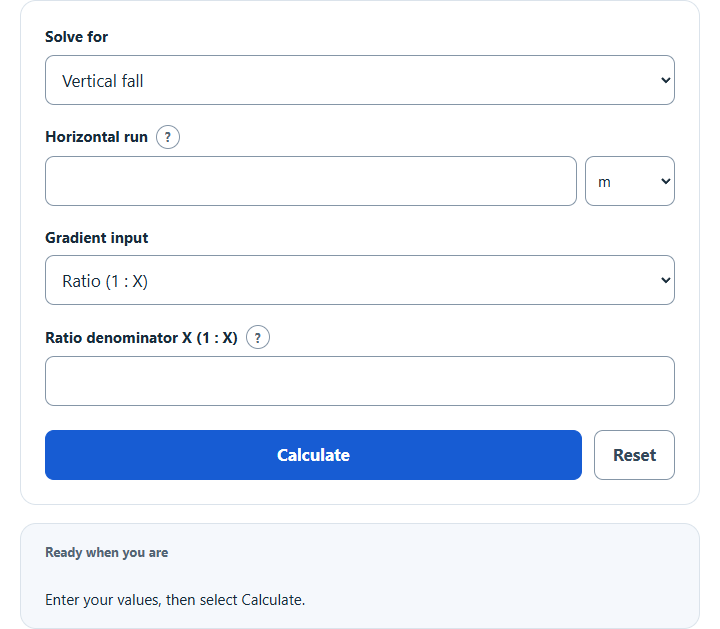
Calculate drainage fall from pipe run and gradient, such as 1 in 40 or 1 in 80, or find the gradient from run and fall, in metric or imperial units.
Related Calculators
- Percent Slope Calculator
- Road Camber Calculator
- Slope Per Foot Calculator
- Pipe Slope Calculator
- All Construction Calculators
Calculator Functions
| Function | What it does | What it requires |
|---|---|---|
| Vertical fall | Finds the total drop a drain needs over its run at a chosen gradient | Requires the horizontal run and the gradient as a 1 : X ratio, a percent, mm per metre or inches per foot |
| Gradient from run and fall | Finds the slope of an existing or planned pipe as a percent and a 1 : X ratio | Requires the horizontal run and the vertical fall |
| Horizontal run | Finds how far a pipe can travel for the drop available | Requires the vertical fall and the gradient in any of the four forms |
Run is entered in metres or feet and fall in millimetres, inches or metres. Every result also gives the gradient ratio, the fall per metre and per foot, the slope angle, the sloping pipe length and the fall at a quarter, half and three quarters of the run, which helps when setting intermediate levels.
Drainage Fall Formulas
| F | Vertical fall, in the same unit as the run |
| R | Horizontal run, measured level and not along the sloping pipe |
| S | Slope as a decimal: 1 ÷ X for a 1 in X gradient, percent ÷ 100, mm per metre ÷ 1,000 or inches per foot ÷ 12 |
Vertical fall
An 8 m run at 1 in 80 falls 8 ÷ 80 = 0.1 m, or 100 mm. A 20 ft run at ¼ inch per foot falls 20 × 0.25 = 5 inches. The table gives the same gradients in each form the calculator accepts.
| Gradient | Percent | Fall per metre | Fall per foot |
|---|---|---|---|
| 1 in 40 | 2.5% | 25 mm | 0.3 in |
| 1 in 48 | 2.083% | 20.83 mm | ¼ in |
| 1 in 60 | 1.667% | 16.67 mm | 0.2 in |
| 1 in 80 | 1.25% | 12.5 mm | 0.15 in |
| 1 in 96 | 1.042% | 10.42 mm | ⅛ in |
| 1 in 150 | 0.667% | 6.67 mm | 0.08 in |
For foul drains in England, Approved Document H gives the flattest recommended gradients: 1 in 40 for 75 mm and 100 mm pipes carrying a peak flow under 1 litre per second, 1 in 80 for the same sizes above that flow, where a 100 mm drain needs at least one WC connected, and 1 in 150 for a 150 mm drain serving at least five WCs [1]. Other countries set their own figures, so use the gradient in the plumbing or building code that applies to the job.
Gradient from run and fall
Both lengths go in the same unit before dividing. A fall of 10 mm over 4,500 mm is 10 ÷ 4,500 = 0.00222, which is 0.222% or 1 in 450. The ratio is 1 ÷ S and the percent is 100 × S.
Horizontal run
With 150 mm of drop available and a gradient of 1 in 60, the pipe can run 0.15 × 60 = 9 m. A level pipe has no answer here, because zero slope never uses up the fall.
Limits of This Estimate
- The result is geometry for one straight pipe at a constant slope. It does not size the pipe, check its flow capacity or confirm that a gradient meets a code.
- Run means the level distance. Measuring along the sloping pipe gives a slightly longer figure, shown in the result as the sloping pipe length.
- The Approved Document H gradients are minimums for foul drains in England and depend on flow and what is connected [1]. Rainwater drains, land drains and other countries follow different tables.
Sources
- HM Government, The Building Regulations 2010, Approved Document H: Drainage and waste disposal, Table 6: recommended minimum gradients for foul drains