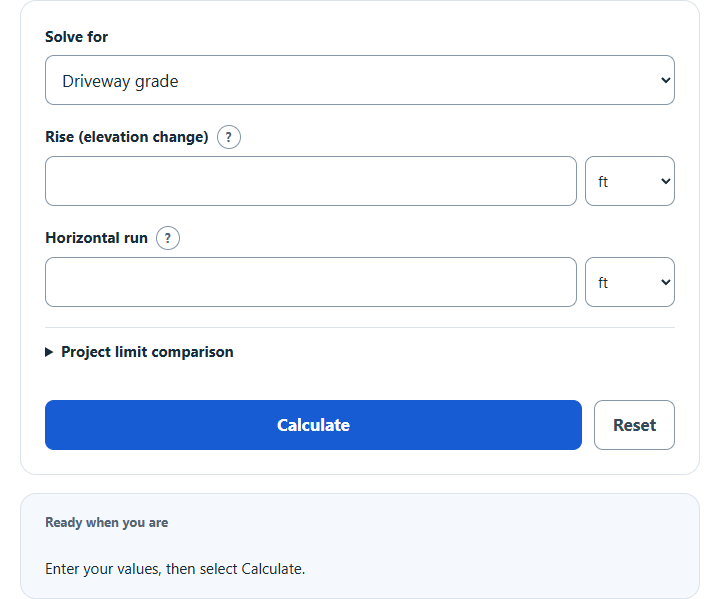
Calculate driveway slope as a percent grade, angle and ratio from the rise and run, or find the rise or run for a target grade, in feet, inches or metres.
Driveway Slope Formula
The following formula is used to calculate the slope of a driveway:
Variables:
- Rise is the signed vertical change in height, converted to the same length unit as run
- Run is the positive horizontal distance over which the rise occurs, not the sloped paving length
- Slope is the steepness or incline of the driveway expressed as a percentage
To calculate the driveway slope, divide the rise by the run and then multiply by 100 to get the percentage.
What is a Driveway Slope?
A driveway slope is the measure of how steep a driveway is. It is calculated as the ratio of the vertical rise to the horizontal run, expressed as a percentage. The slope is an important consideration in driveway design, affecting the ease of access, drainage, and safety. Driveways with too steep a slope can be difficult to navigate, especially in adverse weather conditions, while those with too gentle a slope may have issues with water pooling.
How to Calculate Driveway Slope?
The following steps outline how to calculate the Driveway Slope:
- First, measure the rise (the vertical height) of the driveway in inches.
- Next, measure the run (the horizontal distance) of the driveway in feet.
- Select the correct unit beside each input; the calculator converts rise and run to matching units before dividing.
- Use the formula: Slope (%) = (Rise / Run) * 100 to calculate the slope.
- Choose Driveway grade and enter the rise and horizontal run with their units. Positive rise goes upward along the measured run; negative rise falls. A project-limit comparison is optional and requires your own applicable limit.
Example Problem:
Use the following variables as an example problem to test your knowledge.
Rise of the driveway = 15 inches
Run of the driveway = 20 feet