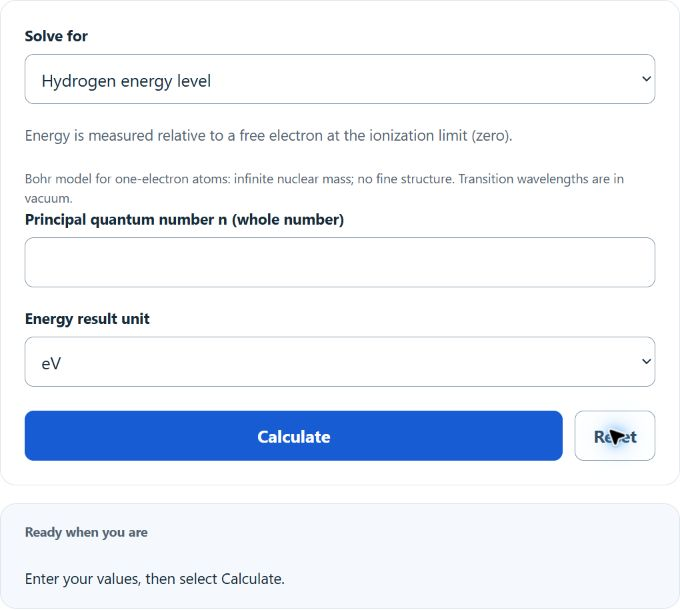
Calculate hydrogen energy levels from n or find photon wavelength, frequency, and energy for hydrogen-like ion transitions in eV, J, and nm.
Energy Level Formula
The following rounded equation describes hydrogen in the Bohr model. The calculator consistently uses h c R∞ ≈ 13.605693 eV with infinite nuclear mass; transition wavelengths are in vacuum. It omits reduced-mass, fine-structure and relativistic corrections.
- Where E is the energy of the bound electron level (negative relative to the ionization limit at 0 eV)
- n is the principal quantum number (n = 1, 2, 3, …)
What is an Energy Level?
Definition:
An energy level is one of the discrete allowed energies that a system (such as an atom, molecule, or electron in an atom) can have.
How to Calculate Energy Level?
Example Problem:
The following example outlines the steps and information needed to calculate Energy Level.
First, determine the principal quantum number (n) of the electron in the hydrogen atom. For this example, n = 3.
Next, use the formula above to calculate the energy level:
E = −13.605693 eV / n²
E = −13.605693 eV / 3² ≈ −1.511744 eV
E ≈ −2.42208 × 10⁻¹⁹ J