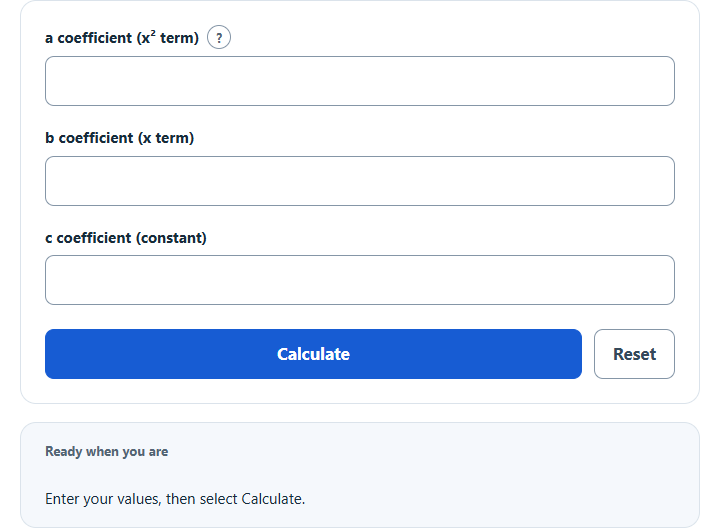
Find the excluded values of a rational expression: enter the denominator’s coefficients a, b and c to get the x values that make it zero.
Related Calculators
- Diamond Problem Calculator
- Fraction to Ratio Conversion Calculator
- Percent Removal Calculator
- Increase Ratio Calculator
- All Math and Numbers Calculators
Excluded Value Formula
Excluded real values are the real zeros of the original denominator.
Variables:
- x is an excluded real value when it makes the original denominator zero.
- a, b and c are the denominator coefficients. Enter 0 for an absent term.
- Δ is the discriminant: negative means no real zeros, zero means one repeated zero, and positive means two real zeros.
Set the denominator equal to zero. For a = 0 and b ≠ 0, solve x = −c/b. A nonzero constant denominator has no excluded values. An identically zero denominator is undefined for every real x.
What is an Excluded Value?
An excluded value is a real input for which the original denominator of a rational expression is zero. Exclude it from the domain even when a common factor cancels with the numerator. This calculator handles linear and quadratic denominators, not restrictions from square roots or logarithms.
How to Calculate Excluded Value?
The following steps outline how to calculate the Excluded Value.
- First, write the original denominator as ax² + bx + c.
- Next, enter all three coefficients, including zeros for absent terms.
- Next, set the denominator equal to zero and solve its linear or quadratic equation.
- Finally, remove every real zero of the original denominator from the domain.
- After inserting the variables and calculating the result, check your answer with the calculator above.
Example Problem :
Use the following variables as an example problem to test your knowledge.
Denominator: x² − 5x + 6
Coefficients: a = 1, b = −5, c = 6
Factor the denominator to find its real zeros:
x² − 5x + 6 = (x − 2)(x − 3), so the excluded values are x = 2 and x = 3.