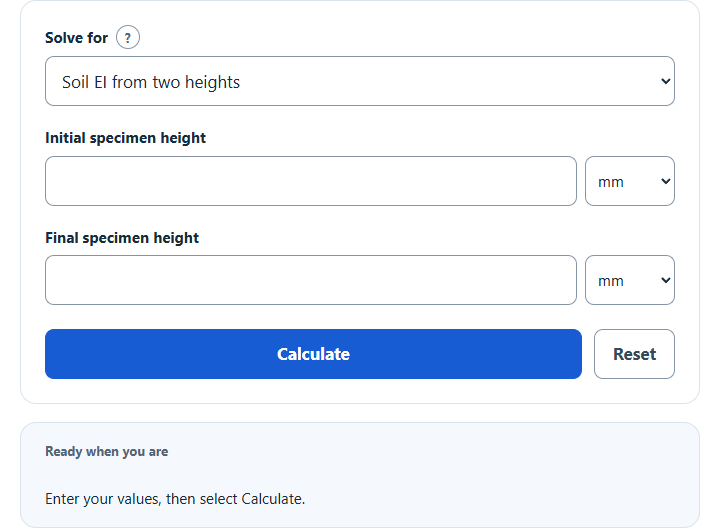
Calculate soil expansion index (EI) from initial and final specimen heights, EI = 1000 × ΔH / H₁, with its swell-potential band, or find volume expansion.
Related Calculators
- Effective Stress Calculator
- Angle Of Internal Friction Calculator
- Excavation Slope Calculator
- Overburden Pressure Calculator
- All Construction Calculators
Calculator Functions
| Function | What it does | What it requires |
|---|---|---|
| Soil EI from two heights | Finds the soil expansion index, its swell band and the percent swell | Requires the initial and final specimen heights |
| Soil EI from height change | Finds the same index when the dial reading gives the change in height directly | Requires the initial specimen height and the measured height change |
| Soil EI with initial height unknown | Works back to the initial height, then finds the index | Requires the final specimen height and the measured height change |
| General fractional volume change | Finds the relative change in volume of any object or material | Requires the initial and final volumes |
| General final volume | Finds the volume after a known fractional change | Requires the initial volume and the fractional change |
| General initial volume | Finds the volume before a known fractional change | Requires the final volume and the fractional change |
| Thermal final volume | Finds the volume after heating or cooling | Requires the initial volume, both temperatures and an expansion coefficient |
| Thermal initial volume | Finds the volume before heating or cooling | Requires the final volume, both temperatures and an expansion coefficient |
| Thermal volume coefficient | Finds the volume coefficient γ from a measured expansion | Requires both volumes and both temperatures |
| Thermal temperature change | Finds the temperature change that produces a given expansion | Requires both volumes and an expansion coefficient |
| Thermal final temperature | Finds the temperature reached after a given expansion | Requires both volumes, the initial temperature and an expansion coefficient |
| Thermal initial temperature | Finds the starting temperature before a given expansion | Requires both volumes, the final temperature and an expansion coefficient |
Specimen heights are entered in mm or inches, and volumes in m³, L, ft³ or in³. Temperatures are in °C. The thermal functions accept either a volume coefficient γ or a linear coefficient α, and the functions that return a volume let the result unit be chosen.
Expansion Index Formulas
| EI | Soil expansion index (no unit) |
| Hf | Final specimen height, after wetting (mm) |
| Hi | Initial specimen height, before wetting (mm) |
The expansion index comes from ASTM D4829, a laboratory test in which a compacted soil specimen is flooded with distilled water and its swell is measured. The standard describes EI as an indicator of a soil's swelling potential, a qualitative index and not a design value for the actual amount of expansion [1]. The calculator also labels the result with the standard's bands of potential expansion [2]:
| Expansion index | Potential expansion |
|---|---|
| 0–20 | Very low |
| 21–50 | Low |
| 51–90 | Medium |
| 91–130 | High |
| Above 130 | Very high |
A calculated value that falls between two bands, such as 20.5, is marked as a boundary to confirm against the laboratory's reported index. A negative value is reported as contraction with no band.
Soil EI from two heights
The main formula applies directly. A 25.4 mm specimen that swells to 27.94 mm gives 1000 × 2.54 ÷ 25.4 = 100, which is in the high band. Percent swell is the same ratio times 100, here 10%.
Soil EI from height change
ΔH is the measured change in height, so the final height is Hi + ΔH. A 1.27 mm rise on a 25.4 mm specimen gives an index of 50.
Soil EI with initial height unknown
The initial height is recovered first and the main formula is then applied. A final height of 26.67 mm after a 1.27 mm rise means the specimen started at 25.4 mm, for an index of 50.
General fractional volume change
Vi and Vf are the initial and final volumes. Growing from 30 m³ to 50 m³ gives e = 20 ÷ 30 = 0.666667, a 66.67% increase and a final-to-initial ratio of 1.666667. A negative e means contraction. This fraction is not a soil expansion index, which only comes from the standard wetting test.
General final volume
The fractional change is entered as a decimal, so 0.08 means 8% expansion. A 2 m³ volume with e = 0.08 becomes 2.16 m³.
General initial volume
A final volume of 2.16 m³ after 8% expansion started at 2.16 ÷ 1.08 = 2 m³. The fractional change must be greater than −1.
Thermal final volume
V₀ is the initial volume, γ is the volume expansion coefficient (1/°C) and ΔT is the final temperature minus the initial temperature. When a linear coefficient α is supplied, the calculator uses γ ≈ 3α, which holds for a uniform solid because the higher-order terms are negligible at coefficients of a few parts per million per degree [3]. One cubic metre with α = 0.000012 per °C heated from 20 °C to 120 °C becomes 1 × (1 + 0.000036 × 100) = 1.0036 m³.
Thermal initial volume
The thermal formula is solved for the starting volume. A final 1.0036 m³ with γ = 0.000036 per °C over a 100 °C rise started at 1 m³.
Thermal volume coefficient
A volume that grows from 1 m³ to 1.0036 m³ between 20 °C and 120 °C has γ = 0.0036 ÷ 100 = 0.000036 per °C. The temperature change cannot be zero. The result also lists γ ÷ 3 as the equivalent linear coefficient for a uniform solid.
Thermal temperature change
With γ = 0.000036 per °C, growing from 1 m³ to 1.0036 m³ takes a 100 °C rise. The coefficient cannot be zero.
Thermal final temperature
ΔT is found as in Thermal temperature change and added to the initial temperature. Starting at 20 °C, the 100 °C rise above ends at 120 °C.
Thermal initial temperature
The same ΔT is subtracted from the final temperature. Ending at 120 °C after a 100 °C rise means a start at 20 °C. A result below −273.15 °C is rejected.
Limits of This Estimate
- The soil functions only do the arithmetic. A reportable EI needs the specimen preparation, loading and wetting set out in ASTM D4829, and the test is not meant to copy field density, water content or loading, so EI does not predict heave on a site [1]. Use the laboratory's reported index for classification.
- ASTM's public summary gives the purpose of the index and its bands; the test procedure and reporting rules are in the standard itself. These estimates are based on the best available data and estimations.
- The thermal functions assume one constant coefficient over the whole temperature range and a small expansion. They do not model phase changes, restrained parts or coefficients that change with temperature, and γ ≈ 3α does not apply to materials that expand differently in different directions.
Sources
- ASTM International, D4829-21, Standard Test Method for Expansion Index of Soils: what the index measures, wetting with distilled water, and that it is an index and not a field prediction
- ASTM International, D4829-11, Standard Test Method for Expansion Index of Soils, Table 1: bands of potential expansion
- Georgia State University, HyperPhysics, Thermal Expansion: Volume Expansion: volume expansion formula and the factor of 3 between volume and linear coefficients